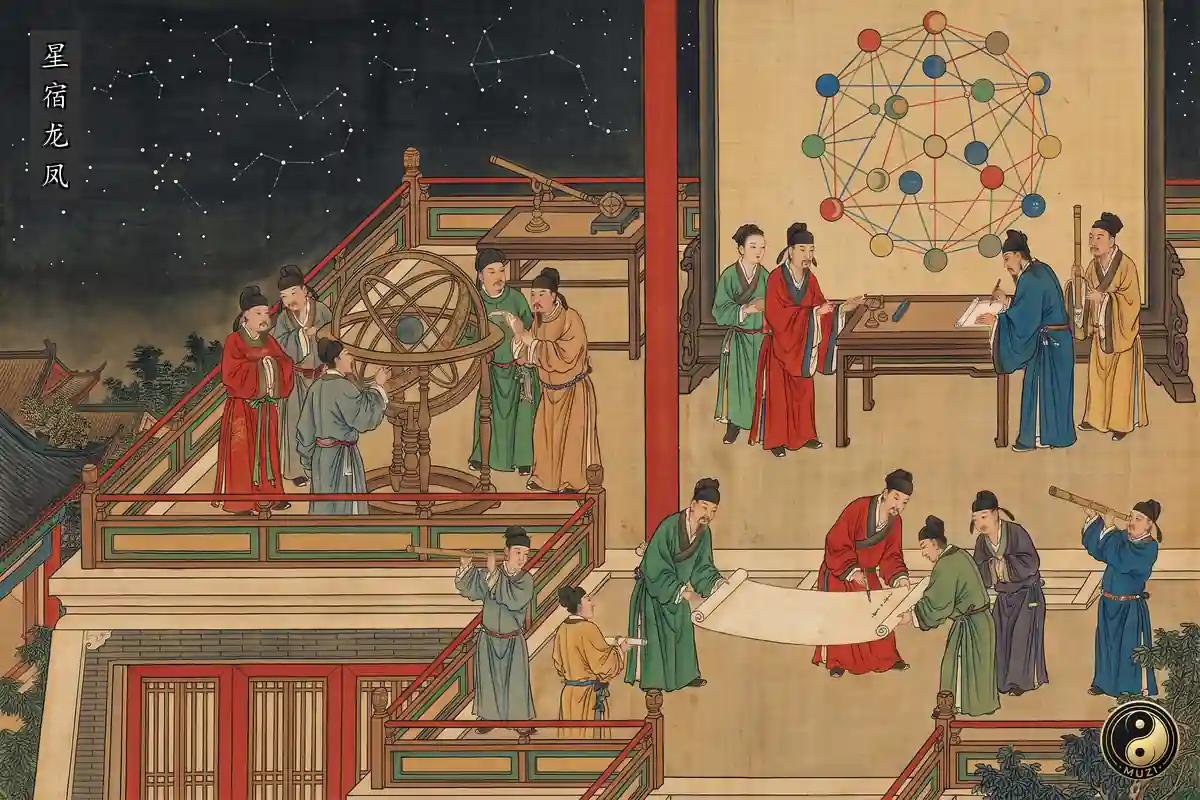
Xing xiu long feng (the stellar lodges and the dragon-phoenix) in the cognitive map of Chinese civilization is the most complete Chinese-style cosmic visual operating system that hard-rules all visible celestial objects, fixed stars, the moon, planets and meteors into a system whose most fundamental units are the Four Images (Azure Dragon, White Tiger, Vermilion Bird, Dark Warrior) multiplied by the Twenty-Eight Lodges (the seven eastern lodges Jiao, Kang, Di, Fang, Xin, Wei, Ji. The seven northern lodges Dou, Niu, Nv, Xu, Wei, Shi, Bi; the seven western lodges Kui, Lou, Wei, Mao, Bi, Zi, Shen; the seven southern lodges Jing, Gui, Liu, Xing, Zhang, Yi, Zhen), with the dragon and phoenix as the supreme super-symbols.
If CE11 Yin-Yang and the Five Phases is this operating system's lowest-level axiom, and CE12 the hexagram system is its most operational dual state-machine packaging, then the stellar lodges and the dragon-phoenix is the complete instantiation of that axiom-system on the macro-celestial-visual plane: every fixed star is assigned a specific star-official name, a set of Five-Phase and Yin-Yang attributes, and a set of correspondences with terrestrial states, geography and human affairs. The provenance of the four characters xing xiu long feng must be traced along three lines: the first is the canonization of the Twenty-Eight Lodges as the most fundamental star-official system of ancient Chinese astronomy (from the Shangshu Yaodian nai ming Xi He, qin ruo hao tian, li xiang ri yue xing chen, jing shou min shi as the earliest astronomical time-keeping mandate, to the Shijing Xiaoya Dadong wei nan you Ji, bu ke yi bo yang. Wei bei you Dou, bu ke yi yi jiu jiang. Wei tian you Han, jian yi you guang as the earliest star-official poetic record. The Zhouli Chunguan's Feng Xiang Shi and Bao Zhang Shi er shi you ba xing zhi wei as officialdom-ization. The Lushi Chunqiu Youshi Lan tian you jiu ye as celestial-zone division. The Shiji Tianguan Shu where Sima Qian canonized the complete matching of 28 lodges by five palaces by four images by central Yellow Dragon. The Huainanzi Tianwen Xun and the Hanshu Tianwen Zhi with the complete systematization of 28 lodges by 24 solar terms by three enclosures); the second is the canonization of dragon and phoenix as the super-symbols of ancient Chinese totemic visuality (from the Neolithic Hongshan culture C-shaped jade dragon and Liangzhu jade bird and Shijiahe jade phoenix through Shang-Zhou bronze ornamental dragon-phoenix motifs. The Shijing Shangsong Xuanniao tian ming xuan niao, jiang er sheng Shang and the Shijing Zhousong Juan A feng huang yu fei, hui hui qi yu. The Shanhaijing's systematic records of dragon-phoenix and human-faced-snake-bodied figures. The Chuci si yu qiu yi cheng yi and feng huang yi qi cheng qi and zhu long he zhao. The Shuowen Jiezi long, lin chong zhi zhang as lexicographic codification, and on to the dynastic application of dragon robes, phoenix crowns, dragon visage, phoenix eyes as state symbols); the third is the convergence of stellar lodges and dragon-phoenix into a Chinese-style cosmic visual system (from the Shiji Tianguan Shu's complete four-image-by-28-lodge-by-five-palace matching through the Huainanzi Tianwen Xun's five-phase-direction matching. The Liji Yueling and Hou Hanshu Lvli Zhi's 12-month-by-28-lodge-by-24-solar-term-by-72-pentad-by-five-emperor matching, and on to the Sanfu Huangtu, Jinshu Tianwen Zhi, Songshi Tianwen Zhi, and Mingshi Tianwen Zhi tradition of dynastic officially assembled astronomical treatises). To see the actual weight of the stellar lodges and the dragon-phoenix in Chinese civilization, all three lines must be walked.
First line, the canonization of the Twenty-Eight Lodges as the most fundamental star-official system of ancient Chinese astronomy. The earliest textual anchor is the repeatedly cited passage from the Shangshu Yaodian: nai ming Xi He, qin ruo hao tian, li xiang ri yue xing chen, jing shou min shi (thereupon he commanded Xi and He, reverently to accord with vast Heaven, to calculate and delineate the sun, moon, stars and asterisms, and respectfully to deliver the seasons to the people). Making Xi He the astronomical-officer clan-family appointed by Yao (a dual-clan division-of-labor system of the Xi and He families), and calculating and delineating the sun, moon, stars and asterisms the most fundamental astronomical action for respectfully delivering the seasons to the people, gives stars and asterisms their first supreme position in the Shangshu as the most fundamental instrument for season-keeping. The same chapter continues with qi san bai you liu xun you liu ri, yi run yue ding si shi, cheng sui (a period of 366 days; using intercalary months to fix the four seasons and complete the year), making 366 days and intercalary months the most fundamental time-cycle mechanism for fixing the four seasons and completing the year, and giving stars and calendrical calculation their first position in Chinese astronomy as the most fundamental mechanism for 'completing the year.'
The text that systematically established xuan ji yu heng (armillary jade traverse) as an astronomical observation instrument is the Shangshu Shundian: zai xuan ji yu heng, yi qi qi zheng (he made use of the armillary jade traverse to regulate the Seven Governors, i.e., the sun, moon and five planets). Making xuan ji yu heng (the earliest astronomical observation instrument) the most fundamental observational tool for regulating the Seven Governors gives astronomical observation its first position in Chinese civilization as the most fundamental instrument for 'regulating the Seven Governors.' The text that gave Ji, Dou, Han their poetic record as star-official names is the Shijing, Xiaoya, Dadong: wei nan you Ji, bu ke yi bo yang. Wei bei you Dou, bu ke yi yi jiu jiang. Wei tian you Han, jian yi you guang (in the south there is the Winnowing Basket, but one cannot use it to winnow; in the north there is the Dipper, but one cannot use it to ladle wine; in heaven there is the River, and its reflected light shines). Making Ji (the Ji star of the Wei lodge among the 28 lodges), Dou (the Dou lodge), and Han (the Heavenly River, the Milky Way) the earliest written record of star-officials already identified by the Shijing poet, this gives star-official identification its first position in Chinese civilization as the earliest record of 'common knowledge already identifiable by Shijing-era poets.' The critical significance of this passage for the stellar lodges as the most fundamental star-official system of ancient Chinese astronomy is that it elevates star-officials from professional objects of astronomical officials to common knowledge already identifiable by literate poets.
The text that gave the 28 star-positions their officialdom-ized systematization as the formal observational purview of a designated official is the Zhouli, Chunguan, Feng Xiang Shi: zhang shi you er sui, shi you er yue, shi you er chen, shi ri, er shi you ba xing zhi wei (he oversees the twelve years, twelve months, twelve chronograms, ten days, and the positions of the twenty-eight stars). Making the 28 star-positions the governed purview of the Feng Xiang Shi, a designated astronomical official, gives the 28 star-positions their first position in the history of Chinese officialdom as the specific purview of a specific official. The same text, Chunguan, Bao Zhang Shi, adds: zhang tian xing, yi zhi xing chen ri yue zhi bian dong, yi guan tian xia zhi qian (he governs the heavenly stars, using them to record the movements of the stars, asterisms, sun and moon, and thereby to observe the shifts of all under heaven). Making the movements of stars, asterisms, sun and moon the most fundamental divinatory object for observing the shifts of all under heaven gives astronomical movements their first position in Chinese political philosophy as the most fundamental evidence for the Mandate-of-Heaven doctrine.
The text that gave the nine celestial fields their systematization as zone divisions of the cosmological schema is the Lushi Chunqiu, Youshi Lan: tian you jiu ye, he wei jiu ye? Zhong yang yue jun tian, dong fang yue cang tian, dong bei yue bian tian, bei fang yue xuan tian, xi bei yue you tian, xi fang yue hao tian, xi nan yue zhu tian, nan fang yue yan tian, dong nan yue yang tian (Heaven has nine fields. What are the nine fields? The center is called Balanced Heaven; the east, Azure Heaven; the northeast, Changing Heaven; the north, Dark Heaven; the northwest, Secluded Heaven; the west, Bright Heaven; the southwest, Vermilion Heaven; the south, Blazing Heaven; the southeast, Luminous Heaven). Using a complete system that matches nine directional skies to nine directional lands, this gives heaven-earth correspondence its first position in the history of the Chinese cosmological schema as a complete nine-directional heaven-earth matching.
The text that gave the 28 lodges by five palaces by four images their complete Sima-Qian-style systematic assembly is the Shiji Tianguan Shu (Sima Qian). Using the seven eastern lodges of the Azure Dragon (Jiao, Kang, Di, Fang, Xin, Wei, Ji), the seven northern lodges of the Dark Warrior (Dou, Niu, Nv, Xu, Wei, Shi, Bi), the seven western lodges of the White Tiger (Kui, Lou, Wei, Mao, Bi, Zi, Shen), the seven southern lodges of the Vermilion Bird (Jing, Gui, Liu, Xing, Zhang, Yi, Zhen), and the central Yellow Dragon as a complete canonized system of 28 lodges matched to four images and five palaces, it gives the 28 lodges their first position in Chinese civilization as the complete canonized codification of the most fundamental star-official system of ancient Chinese astronomy. The text that completed the 28 lodges by 24 solar terms matching is the Huainanzi Tianwen Xun, which uses the complete matching of the 28-lodge positions with the trajectories of the sun, moon and five planets through the celestial circuit as the most fundamental mechanism for agricultural season-keeping. The text that completed the 28 lodges by three enclosures (Purple Forbidden Enclosure, Supreme Palace Enclosure, Heavenly Market Enclosure) matching is the Hanshu Tianwen Zhi (Ban Gu), which uses the three enclosures as the celestial representing of the emperor's residence, a second-tier star-official system above the 28 lodges.
Second line, the canonization of dragon and phoenix as the super-symbols of ancient Chinese totemic visuality. The earliest material anchor is the Neolithic Hongshan culture (c. 4700 BCE) C-shaped jade dragon. Using a curled C-shaped jade dragon as the earliest material form in China possessing a complete dragon imagery, it gives the dragon its first position in Chinese civilization as a totemic symbol possessing a complete form. The Liangzhu culture (c. 3300 BCE) jade bird and the Shijiahe culture (c. 2400 BCE) jade phoenix-shaped vessel are the earliest material forms possessing a complete imagery for the phoenix and the bird totem in Chinese civilization.
The text that established the Dark Bird giving birth to Shang system is the Shijing, Shangsong, Xuanniao: tian ming xuan niao, jiang er sheng Shang (Heaven commanded the Dark Bird, which descended and gave birth to Shang). Making Heaven commanded the Dark Bird to descend and give birth to Shang the most fundamental myth of the Shang tribe's totemic origin gives the Dark Bird / phoenix its first position in Chinese civilization as the lineage-origin totem of the Shang people. The text that established the phoenix in poetry system is the Shijing, Zhousong, Juan A: feng huang yu fei, hui hui qi yu, yi ji yuan zhi. Ai ai wang duo ji shi, wei jun zi shi, mei yu tian zi (the phoenix takes flight, its wings whirring, and it alights. Gracious are the king's many good officers; the exemplary person employs them to delight the Son of Heaven). Making the phoenix whirring its wings the most fundamental symbol of the king's many good officers gives the phoenix its first position in Zhou culture as the most fundamental symbol of the royal lord's auspicious officers.
The text that gave dragon and phoenix their Shanhaijing-style systematic record is the Shanhaijing (Classic of Mountains and Seas). With Dan Xue zhi shan you niao yan qi zhuang ru ji wu cai er wen ming yue feng huang from the Nanshan Jing, Xuan Yuan zhi guo ren mian she shen wei jiao shou shang from the Haiwai Xi Jing, and dong hai zhi zhu zhong you shen ren mian niao shen from the Dahuang Dong Jing, among many other chapters' systematic records, it gives dragon-snake, human-faced-bird-bodied figures their first position in Chinese civilization as the most complete record of the high-antiquity mythological totemic pedigree.
The text that gave dragon and phoenix their Chuci-style (Songs of Chu) application is the Chuci, Lisao: si yu qiu yi cheng yi xi, ke ai feng yu shang zheng (harnessing jade dragons to ride the bird-of-prey, suddenly through the dusty wind I ascend on high), feng huang yi qi cheng qi xi, gao ao xiang zhi yi yi (the phoenix spreads its wings to bear my banner, soaring aloft with steady pinions), wei yu jia fei long xi, za yao xiang yi wei che (for me harness the flying dragon; mingling jade and ivory to make a chariot), and from the Chuci, Tianwen: ri an bu dao, zhu long he zhao (where the sun does not reach, how does the Torch Dragon illuminate?). Using jade dragon, bird-of-prey, phoenix, flying dragon, Torch Dragon as the most fundamental image-repertoire for Qu Yuan's Lisao seeking above and below gives dragon and phoenix their first position in the Chuci as the most fundamental steeds for the poet's spirit-journey through heaven and earth.
The text that gave the dragon its lexicographic codification is the Shuowen Jiezi (Xu Shen, Eastern Han): long, lin chong zhi zhang, neng you neng ming, neng xi neng ju, neng duan neng chang, chun fen er deng tian, qiu fen er qian yuan (the dragon is the chief of scaly creatures; it can be dark or bright, fine or huge, short or long; at the spring equinox it ascends to heaven, at the autumn equinox it plunges into the deep). Using the complete morphological description and life-cycle description of chief of scaly creatures, able to be dark or bright, fine or huge, short or long, ascending to heaven at the spring equinox and plunging into the deep at the autumn equinox gives the dragon its first position in Chinese civilization as the most complete morphological codification of the chief of scaly creatures. The text that gave the phoenix its lexicographic codification is the Erya, Shi Niao: guan, feng (the stork is the phoenix), along with later commentaries by Guo Pu and others.
The application that gave dragon and phoenix their state-ideology status is the dynastic imperial symbolism: the Yellow Emperor ascending to heaven on a dragon (Shiji, Feng Shan Shu), the First Emperor of Qin's dragon visage (Yan Shigu commentary), the dragon robes, dragon thrones, and dragon courts of successive emperors, the phoenix crowns, phoenix robes, and phoenix palanquins of successive empresses, and the dragon-phoenix carvings and decorations of the Forbidden City. This gives dragon and phoenix their first position in Chinese state ideology as the most fundamental visual symbols of the emperor and empress.
Third line, the convergence of stellar lodges and dragon-phoenix into a Chinese-style cosmic visual system. The earliest stellar-lodge by totem convergence is the Shiji Tianguan Shu (Sima Qian). Using the complete four-image-by-28-lodge-by-five-palace matching of the seven eastern Azure Dragon lodges equal Jiao, Kang, Di, Fang, Xin, Wei, Ji, the seven northern Dark Warrior lodges equal Dou, Niu, Nv, Xu, Wei, Shi, Bi, the seven western White Tiger lodges equal Kui, Lou, Wei, Mao, Bi, Zi, Shen, the seven southern Vermilion Bird lodges equal Jing, Gui, Liu, Xing, Zhang, Yi, Zhen and the central Yellow Dragon, it gives the 28 lodges by dragon-phoenix, Dark-Warrior, White-Tiger their first position in Chinese civilization as the complete canonized codification of the Chinese-style cosmic visual system.
The text that completed the four images by Five Phases by direction matching is the Huainanzi Tianwen Xun: north-water-Dark Warrior, east-wood-Azure Dragon, west-metal-White Tiger, south-fire-Vermilion Bird. The text that established the four images by marching formation was the Liji, Quli Shang: xing qian Zhu Que er hou Xuan Wu, zuo Qing Long er you Bai Hu (marching with the Vermilion Bird in front, the Dark Warrior behind, the Azure Dragon on the left, and the White Tiger on the right).
The text that completed the 28 lodges by 24 solar terms by 72 pentads by five emperors matching is the Hou Hanshu Lvli Zhi (Fan Ye), which uses the complete matching of the 28-lodge positions with the 24 solar terms and the 365.25 days as the most fundamental mechanism for agricultural season-keeping. The text that established the palace layout by four images was the Sanfu Huangtu (anonymous), which records the Han-dynasty palace-layout tradition of the imperial palace with Vermilion Bird in front, Dark Warrior behind, Azure Dragon on the left, White Tiger on the right.
The texts that established the 28 lodges by four images by three enclosures tradition across dynastically assembled astronomical treatises are the Jinshu Tianwen Zhi (Fang Xuanling), the Songshi Tianwen Zhi (Toghto), and the Mingshi Tianwen Zhi (Zhang Tingyu), among other dynastic officially assembled astronomical treatises. They gave the 28 lodges by four images by three enclosures Chinese-style cosmic visual system an unbroken record spanning more than 2,000 years in Chinese official historiography.
,、,,。。