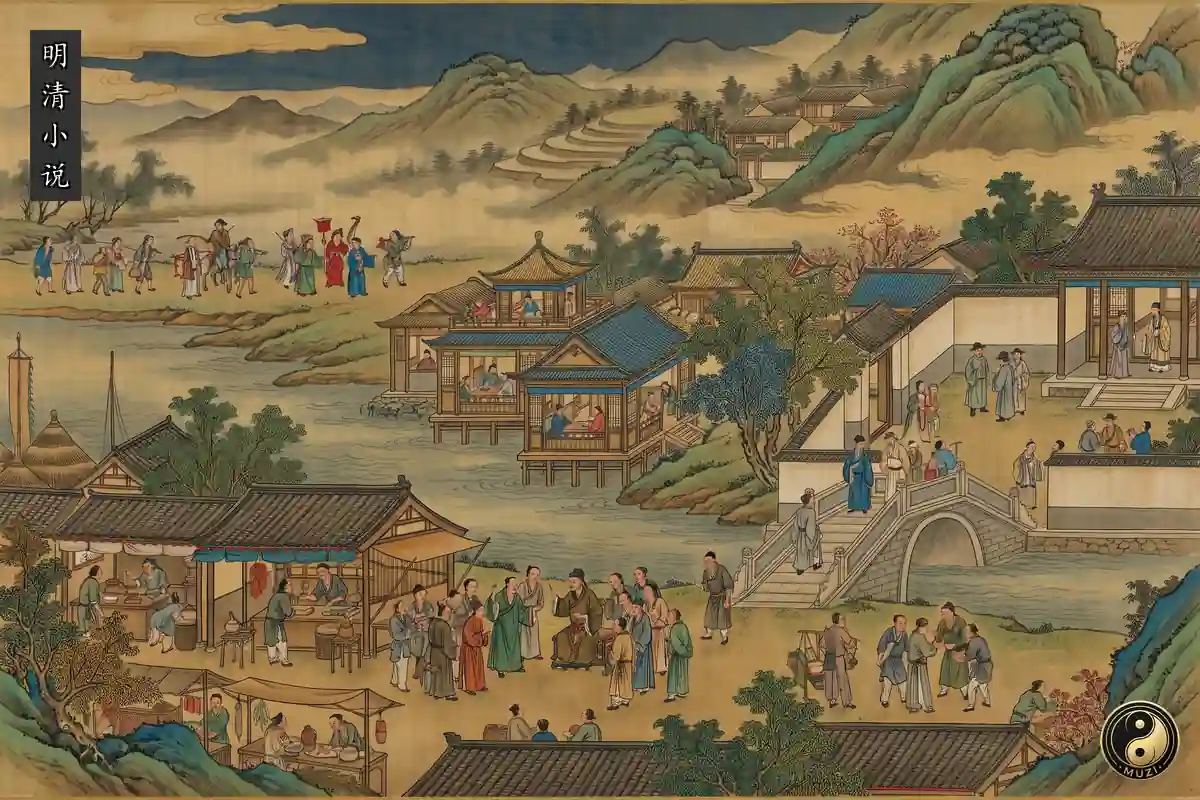
Ming-Qing Fiction (*Ming-Qing xiaoshuo*) in the landscape of classical Chinese long-form narrative is the first-generation guideline of the Huaxia tradition of classical vernacular full-length fiction, born of the historical pressures, from the Wei-Jin to the Qing dynasty (3rd to 19th century), of the four-stage genre evolution through *zhiguai* (records of the strange), *chuanqi* (transmissions of the marvelous), *huaben* (promptbook tales), and *zhanghui* (chapter-divided novels), the industrial-scale diffusion of movable-type printing, the flourishing of the urban commodity economy, the oppressiveness of imperial autocracy. The intellectual rebellion and escape of literati, defined as the cluster of full-length vernacular novels centered on the Four Great Classical Novels (*Sanguo Yanyi*, *Shuihu Zhuan*, *Xiyou Ji*, and *Honglou Meng*) as the panoramic textual simulation sandbox of Huaxia classical literature. A single continuous line must be traced to the end: from Wei-Jin *zhiguai* through Tang *chuanqi*, Song-Yuan *huaben*, the late-Yuan and early-Ming prototype of the chapter-divided novel, Ming-dynasty Four Great Novels and *shiqing* (novel of manners) fiction, to the Qing-dynasty satirical novel, the pinnacle of the chapter-divided form, and the *zhiguai* afterglow.
The earliest textual anchor is Wei-Jin *zhiguai*, with Gan Bao (early Eastern Jin, ?--336 CE) as the representative of *zhiguai* fiction. His *Soushen Ji* (In Search of the Supernatural, 20 scrolls, 464 entries, c. 320 CE) gave Gan Bao and the *Soushen Ji* in the Eastern Jin their foundational position as the progenitor of *zhiguai* short stories. The maturation of short narrative in Tang *chuanqi* was realized by the mid-Tang's Yuan Zhen (779--831 CE), whose *Yingying Zhuan* (Story of Yingying, c. 800 CE) gave Yuan Zhen and the *Yingying Zhuan* their foundational position as the maturation of Tang *chuanqi*. Further continuation of Tang *chuanqi* was accomplished by Li Gongzuo (latter half of the 8th century) and his *Nanke Taishou Zhuan* (Governor of Southern Bough, c. 800 CE), Jiang Fang (latter half of the 8th century) and his *Huo Xiaoyu Zhuan* (Story of Huo Xiaoyu, c. 800 CE), Bai Xingjian (776--826 CE) and his *Li Wa Zhuan* (Story of Li Wa, c. 800 CE). The grand synthesis of Tang *chuanqi* was accomplished by Shen Jiji (latter half of the 8th century) and his *Zhenzhong Ji* (Record within the Pillow, c. 780--805 CE) and Niu Sengru (780--849 CE) and his *Xuanguai Lu* (Record of Mysteries and Marvels, 10 scrolls, c. 830--840 CE), giving Shen Jiji and Niu Sengru in the mid-to-late Tang their foundational position as the grand synthesis of Tang *chuanqi*.
The rise of Song-Yuan *huaben* as the emergence of vernacular narrative was pioneered by the Northern Song's four categories of storytelling (*shuohua si jia*: fiction, historical narrative, scriptural explication, and comic performance; approximately 11th--12th century, in the pleasure quarters of Bianjing), with the *Sanguo Zhi Pinghua* and the *Da Song Xuanhe Yishi* (c. 12th--13th century) as markers of the emergence of vernacular narrative. The prototype of the *Xiyou Ji* story was realized by an anonymous author of the Southern Song (or Yuan dynasty), whose *Da Tang Sanzang Qujing Shihua* (17 sections, c. 1100) gave the anonymous author and the *Da Tang Sanzang Qujing Shihua* their foundational position as the prototype of the *Xiyou Ji* story.
The creation of the late-Yuan and early-Ming chapter-divided novel as the prototype of long-form narrative was accomplished by Luo Guanzhong (approximately 1330--1400 CE), whose *Sanguo Zhi Tongsu Yanyi* (Popular Romance of the Three Kingdoms, 24 scrolls, 240 sections, c. 1370; revised into the 120-chapter edition in 1522) gave Luo Guanzhong and the *Sanguo Zhi Tongsu Yanyi* in the late Yuan and early Ming their foundational position as the progenitor of the chapter-divided long-form narrative. The first peak of the Ming Four Great Novels was reached by Shi Nai'an (approximately 1296--1372 CE), whose *Shuihu Zhuan* (Water Margin, 100 chapters, c. 1370; based on the *Da Song Xuanhe Yishi*) gave Shi Nai'an and the *Shuihu Zhuan* their foundational position as the first peak of long-form narrative. The second peak was reached by Wu Cheng'en of the mid-Ming (approximately 1500--1582 CE), whose *Xiyou Ji* (Journey to the West, 100 chapters, c. 1580; the Shidetang printed edition of 1592 being the earliest) gave Wu Cheng'en and the *Xiyou Ji* their foundational position as the second peak of long-form narrative. The third peak and the founding of the *shiqing* (novel of manners) genre was accomplished by Lanling Xiaoxiaosheng (the Scoffing Scholar of Lanling, latter half of the 16th century), whose *Jinpingmei* (The Plum in the Golden Vase, 100 chapters, c. 1596; the earliest *cihua* edition printed in 1617) gave Lanling Xiaoxiaosheng and the *Jinpingmei* their foundational position as the third peak of long-form narrative and the founder of the *shiqing* novel.
The advancement of mid-to-late Ming short-story collections as citizen literature was accomplished by Feng Menglong (1574--1646 CE), whose Three Words (*San Yan*: *Yushi Mingyan* 1621, *Jingshi Tongyan* 1624, and *Xingshi Hengyan* 1627, 40 stories each) gave Feng Menglong and the 'Three Words' their foundational position as the citizen-literature short-story collection. The other pole of mid-to-late Ming short-story collections was advanced by Ling Mengchu (1580--1644 CE), whose Two Strikes (*Er Pai*: *Chuke Pai'an Jingqi* 1627 and *Erke Pai'an Jingqi* 1632, 40 stories each) gave Ling Mengchu and the 'Two Strikes' their foundational position as the other pole of the citizen-literature short-story collection.
The realization of Qing satirical fiction as the pinnacle of the full-length satirical novel was accomplished by Wu Jingzi of the mid-Qing (1701--1754 CE), whose *Rulin Waishi* (The Scholars, 50 chapters, c. 1750) gave Wu Jingzi and the *Rulin Waishi* their foundational position as the pinnacle of the full-length satirical novel. The fourth peak of long-form narrative and the pinnacle of classical Chinese fiction was realized by Cao Xueqin (1715--1763 CE) and Gao E (?--1815 CE) of the mid-Qing, with the first 80 chapters of *Honglou Meng* (Dream of the Red Chamber, 1754, based on the *Zhiyanzhai Chongping Shitou Ji*) and the final 40 chapters continued by Gao E (the 1791 Cheng-A edition, 120 chapters). This gave Cao Xueqin, Gao E, and the *Honglou Meng* their foundational position as the fourth peak of long-form narrative and the pinnacle of classical Chinese fiction. The Qing *zhiguai* afterglow was realized by Pu Songling (1640--1715 CE) of the mid-Qing, whose *Liaozhai Zhiyi* (Strange Tales from a Chinese Studio, 12 scrolls, 491 stories, c. 1700) gave Pu Songling and the *Liaozhai Zhiyi* their foundational position as the pinnacle of the *zhiguai* short-story collection.
、,,《》《》《》,:、、,, , 。,《》《》,。