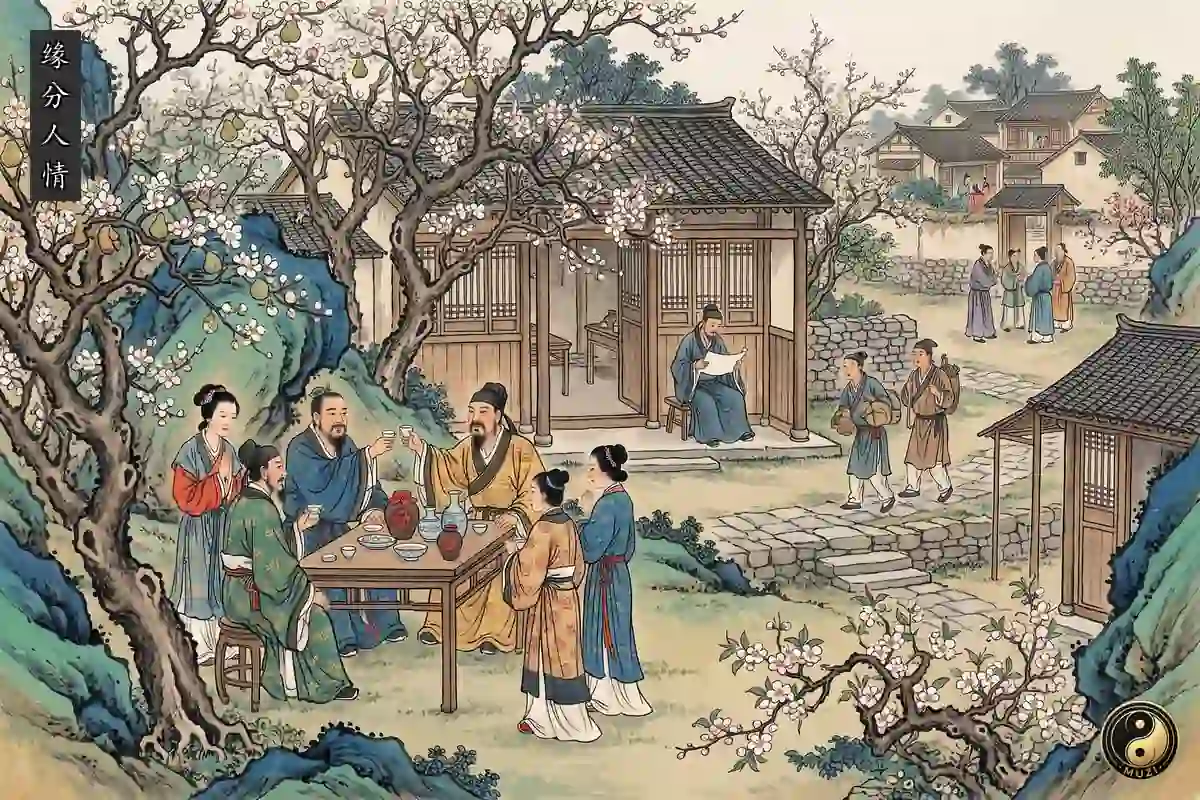
In the workings of the Chinese acquaintance society, fated connections and human sentiment (yuan fen ren qing) is the master switch that hard-rules relationships among people beyond blood kinship into executable, sustainable, crisis-callable informal social contracts. If filial devotion and parental kindness, passed down through the family, loyal heart, altars of soil and grain, and deep affection between hands and feet all handle the relationships of the family intranet, then fated connections and human sentiment handles the acquaintance-society grid outside the family intranet, one that likewise needs to be governed by some form of executable agreement: friends, neighbors, fellow villagers, classmates, colleagues and master-disciple pairs. The actual weight of this grid in Chinese civilization is far greater than any corresponding concept in Western culture can accommodate. The origins of these four characters must be traced along three lines: one is the classicization of human sentiment (ren qing) as a moral category of reciprocal ritual exchange (from the Analects to the Mencius to the Record of Rites to the Xunzi to the Guanzi and on to family instructions and the community compact system from the Song onward). another is the parallel classicization of fated connections (yuan fen) as the Buddhist-Daoist-folk category of causes and destinies beyond human control (from the Madhyama Agama through the Treatise on the Great Perfection of Wisdom and the Record of Meritorious Deeds through the folk traditions of the Old Man Under the Moon and a thousand-li marriage tied by a single thread), and a third is the literary path by which fated connections, destiny and feeling became one of the deepest emotional traditions of Chinese literature (from the Airs of the Book of Songs through the Nine Songs of the Songs of Chu. The Han yuefu Southeast the Peacock Flies, through Tang poetry and Song lyrics, to the Yuan drama Romance of the Western Chamber, the Ming chuanqi Peerta Pavilion, and the Qing novel Dream of the Red Chamber). To grasp the true weight of these four characters, all three lines must be followed. The first line: the classicization of human sentiment as a moral category of reciprocal ritual exchange. The earliest textual anchor is the Analects, Xue Er chapter, in the repeatedly cited passage: Is it not a joy to have friends come from afar? (you peng zi yuan fang lai, bu yi le hu). This made friends (peng) the relationship on the axis of distance (beyond blood, beyond locality) that brings the greatest joy, giving friends the supreme position within the Confucian Five Relations of being capable of crossing physical distance without depending on blood ties. Confucius himself in the Analects, Li Ren chapter, with Virtue is not solitary; it always has neighbors (de bu gu, bi you lin), made virtue the most reliable basis for always having neighbors (bi you lin), establishing neighbor (in the Chinese context, both a geographic neighbor and a metaphorical fellow traveler in virtue) as the first ethical term for a non-kinship mutual-aid system pivoting on virtue. In the Analects, Ji Shi chapter, Confucius further classified friends into beneficial and harmful types: There are three beneficial friends and three harmful friends. A friend who is straightforward, a friend who is sincere, a friend who is broadly learned, these are beneficial. A friend who is obsequious, a friend who is soft and ingratiating, a friend who is glib, these are harmful (yi zhe san you, sun zhe san you. you zhi, you liang, you duo wen, yi yi. you bian pi, you shan rou, you bian ning, sun yi). This made friends an ethical relationship that can be beneficial or harmful, requiring active choice, giving friends for the first time in Confucian ethics the fundamental positioning of not determined by blood but by ethical choice. In the Analects, Yong Ye chapter, Confucius added: The person of benevolence, wishing to establish himself, also establishes others; wishing to succeed, also helps others succeed (fu ren zhe, ji yu li er li ren, ji yu da er da ren). This made the person of benevolence the ethical agent who can extend establishing and succeeding to establishing others and helping others succeed, giving person (ren) for the first time in Confucian ethics the fundamental positioning of not referring only to family members but to all people to whom one's ethics can be extended. The one who extended human sentiment from family ethics to social-political ethics was Mencius. In the Mencius, King Hui of Liang, Part 1, Treat your own elders as elders, and extend it to the elders of others; treat your own young as young, and extend it to the young of others (lao wu lao yi ji ren zhi lao, you wu you yi ji ren zhi you) made one's own elders the fundamental basis for extending concern to the elders of others, giving person for the first time the fundamental position of serving as the basis for ethical extension. In the Mencius, Gaozi, Part 1, The heart of compassion is present in all people (ce yin zhi xin, ren jie you zhi) made compassion the deepest empathy present in all, giving person for the first time the position of a universalized, trans-kinship basis for ethical empathy. In the Mencius, Jin Xin, Part 1, In poverty, attend to one's own goodness alone; in success, extend goodness to all under Heaven (qiong ze du shan qi shen, da ze jian shan tian xia) made attending to goodness alone and extending goodness to all two ethical paths for the scholar in different circumstances, giving extending goodness for the first time the political-ethical position of using one person's goodness to benefit all under Heaven. The systematic codification of human sentiment as a moral category of reciprocal ritual exchange came through the Record of Rites. The Record of Rites, Summary of the Rules of Propriety, Part 1 (Qu Li Shang): Ritual propriety values reciprocity. To give without receiving is contrary to ritual propriety; to receive without giving is also contrary to ritual propriety (li shang wang lai. wang er bu lai, fei li ye; lai er bu wang, yi fei li ye). This made ritual propriety the most basic ethical foundation of reciprocity (wang lai), giving human sentiment for the first time the fundamental positioning of being institutionalized, codified and made reciprocal by ritual propriety. This sentence is critical for fated connections and human sentiment as a social-ethical category because it elevated human sentiment from a private, psychological dimension to an ethical category that is explicitly stipulated by ritual propriety, subject to social judgment, and capable of institutional enforcement. This is the foundational Confucian definition of human sentiment as an executable social contract. The Record of Rites, Suburban Special Sacrifice (Jiao Te Sheng), added: Ritual propriety is repayment and merit (li, bao, gong ye), binding ritual propriety to the two ethical dimensions of repayment (bao) and merit (gong). This is the most fundamental definition of human sentiment as an ethical category that is non-equivalent, long-cycle and capable of being deferred and repaid. The systematic specification of the Seven Emotions as the concrete content of human sentiment is in the Record of Rites, Conveyance of Rites (Li Yun): What are human sentiments? Joy, anger, sorrow, fear, love, dislike and desire, these seven one is able to feel without learning (he wei ren qing? xi, nu, ai, ju, ai, wu, yu, qi zhe fu xue er neng). This made the Seven Emotions the ethical content that is felt without learning, giving human sentiment for the first time the fundamental content definition of universally applicable, regardless of kinship. Xunzi's Rectification of Names (Zheng Ming) further systematized nature, feeling and desire as three distinct ethical levels: Nature is what Heaven endows; feeling is the substance of nature; desire is the response of feeling to things (xing zhe, tian zhi jiu ye; qing zhe, xing zhi zhi ye; yu zhe, qing zhi ying ye). This gave feeling for the first time in Confucian ethics the fundamental positioning of an independent ethical category, distinguished from both 'nature' and 'desire.'
The systematic codification of human sentiment as a neighborly mutual-aid ethic beyond the family intranet, ultimately elevated to the executable community compact (xiang yue) institution, was the community compact system from the Song dynasty onward. The earliest model was the Lu Family Community Compact (Lu Shi Xiang Yue), established in Lantian, Shaanxi, by Lu Dazhong (eldest of the four Lu brothers) in the eleventh century: Encourage each other in virtuous deeds; admonish each other for faults; exchange courtesies in social customs; relieve each other in hardship (de ye xiang quan, guo shi xiang gui, li su xiang jiao, huan nan xiang xu). The last of these four compact articles, relieve each other in hardship (huan nan xiang xu), is the most direct institutional execution of human sentiment as a system callable in crisis. This was the first time in Chinese history that fated connections and human sentiment took the form of a written institution, an executable mechanism, and an organizational vehicle. Zhu Xi's Revised Lu Family Community Compact (Southern Song) further standardized and disseminated the compact. Wang Yangming's Southern Gan Community Compact (Ming, 1518) combined the compact with the School of the Heart-Mind's dimension of extending innate moral knowledge (zhi liang zhi), making the community compact a dual guarantee of moral self-awareness and neighborly order. The community compact, together with the baojia and lijia systems (the three pillars of Ming-dynasty grassroots governance), made human sentiment in the Ming and Qing periods a non-formal social contract covering the entire rural Chinese society, with compact account books, compact heads and deputy heads as organizers, and regular gatherings with winter-month readings as executable mechanisms. This is the most complete form of fated connections and human sentiment as an executable agreement beyond blood, beyond family, but equally fixed. The theoretical grounding of human sentiment as a social ethic upon a material foundation is in the Guanzi, Shepherding the People (Mu Min): When the granaries are full, the people know ritual propriety and etiquette; when food and clothing are sufficient, the people know honor and shame (cang lin shi er zhi li jie, yi shi zu er zhi rong ru). This made full granaries and sufficient food the material precondition for propriety, etiquette, honor and shame, giving human sentiment for the first time the fundamental structure of material foundation as precondition, ethical social contract as superstructure. The second line: the parallel classicization of fated connections (yuan fen) as the Buddhist-Daoist-folk category of causes and destinies beyond human control. After Buddhism entered China, yuan (conditions, causes) as a translation of the Sanskrit term became the core category in Chinese ethics most colored by what lies beyond human control. The Madhyama Agama and the Ekottara Agama stated: All dharmas arise from causes and conditions; all dharmas cease through causes and conditions (zhu fa yin yuan sheng, zhu fa yin yuan mie), making causes and conditions (yin yuan) the fundamental principle of arising and ceasing for all dharmas (all that exists). Vasubandhu's Treasury of Abhidharma laid out four conditions (si yuan: direct cause, immediate antecedent condition, object-support condition, dominant condition) as the four types of condition for the arising of all dharmas. Nagarjuna's Treatise on the Great Perfection of Wisdom stated: All dharmas arise from causes and conditions (yi qie zhu fa, jie cong yin yuan sheng), making causes and conditions the fundamental source of all dharmas. The Diamond Sutra's all forms are illusory (fan suo you xiang, jie shi xu wang) and if one sees me through form or seeks me through sound, that person walks the wrong path and cannot see the Tathagata established that all forms are illusory (not independently self-existent) and their existence must depend on causes and conditions for support. The Avatamsaka Sutra's one is all, all is one (yi ji yi qie, yi qie ji yi) and one flower is a world, one leaf is a Tathagata (yi hua yi shi jie, yi ye yi ru lai) expressed the mutual interpenetration of all and one as the deepest ontological manifestation of the system of causes and conditions. The most thoroughly Sinicized Chan patriarch Huineng, in the Platform Sutra, wrote: When sentient beings sow their seeds, the fruit arises from the ground. Though good and evil be small, they are ultimately accomplished. The Buddha that comes from pretense must never be slighted (you qing lai xia zhong, yin di guo huan sheng. shan e sui xiao zhong cheng ban, jia fo you lai bu ke qing). This made sentient beings, ground and fruit the fundamental conditions for all sentient beings attaining Buddhahood, giving yuan for the first time in Sinicized Buddhism the domesticated form of feeling as the seed, ground as the root of ripening. The key intermediary that further translated yuan from the abstract Buddhist philosophical concept of causes and conditions of all dharmas into a folk concept of fated connections was the folk tradition of a thousand-li marriage tied by a single thread (qian li yin yuan yi xian qian), the Old Man Under the Moon (yue xia lao ren), and destined five hundred years ago (wu bai nian qian zhu ding). This made yuan the deepest psychological presupposition in Chinese folk culture: not a personal choice, but the work of some deeper, uncontrollable force. This is the deepest folk psychological foundation of fated connections and human sentiment as beyond human control, yet still something to be cherished and treated with care. On the Daoist side, the Zhuangzi, Discussion on Making All Things Equal (Qi Wu Lun), with That, too, is a right and wrong; this, too, is a right and wrong. Is there really a that and this? Is there really no that and this? Where that and this find without pairing, this is called the pivot of the Way (bi yi yi shi fei, ci yi yi shi fei, guo qie you bi shi hu zai? guo qie wu bi shi hu zai? bi shi mo de qi ou, wei zhi dao shu), used that-and-this, right-and-wrong as the most fundamental dialectic of the pivot of the Way. This is the most fundamental basis in Daoist philosophy for yuan as beyond human control, beyond human division. The systematic codification of destiny (ming) as an ethical category of beyond human control, yet one must 'accept it as destiny' is in the Zhuangzi, Signs of Virtue Complete (De Chong Fu): Know that nothing can be done about it and accept it as destiny (zhi qi bu ke nai he er an zhi ruo ming). This gave accepting destiny (an ming) for the first time in Daoist ethics the positioning of acceptance without resistance as the highest realm. The systematic codification of destiny as a two-part division of Heaven and destiny is in the Mencius, Wan Zhang, Part 1: What no one causes yet happens is Heaven; what no one brings about yet arrives is destiny (mo zhi wei er wei zhe, tian ye; mo zhi zhi er zhi zhe, ming ye). This made Heaven (the active Way of Heaven) and destiny (the passive, uncontrollable allotment) two distinct categories, giving destiny for the first time in Confucian ethics the dual positioning of uncontrollable, capable of being accepted, but not to be defied. The systematic codification of destiny and fortune as something that can be understood and rewritten through accumulated good deeds is in the Ming-dynasty Yuan Liaofan's Record of Meritorious Deeds (Liao Fan Si Xun): Destiny is shaped by myself; fortune is sought by myself (ming you wo zuo, fu zi ji qiu), All fields of fortune are not apart from this very mind (yi qie fu tian, bu li fang cun), and A household that accumulates good deeds will surely have surplus blessings (ji shan zhi jia, bi you yu qing). This transformed destiny from a completely uncontrollable fatalism into a semi-controllable fortune rewritable through one's own accumulated good deeds. This is the most practically operable ethical version of fated connections and human sentiment in early modern China. Through the ages, destiny and fated connections poetry (Tao Yuanming's Return! For what should I doubt the joy of Heaven's mandate, Li Bai's Heaven gave me talents, they must be put to use, Su Shi's Like mayflies placed between Heaven and Earth, a single grain on the vast ocean) repeatedly confirmed destiny and fated connections as the spiritual bedrock of the literatus. The third line: the literary path by which fated connections, destiny and feeling became one of the deepest emotional traditions of Chinese literature. From the Airs of the States in the Book of Songs, those poems that repeatedly use guan guan cry the ospreys, blue, blue is your collar, and the rushes are luxuriant as emotional evocations (the literary anchor of the beginning of feeling in its broadest sense). The Songs of Chu, Nine Songs, Lord of the Xiang and Lady of the Xiang (the late Warring States literary model of divine-human romance in the state of Chu). The Han yuefu Southeast the Peacock Flies with The rush mat is tough as silk, the boulder never shifts (pu wei ren ru si, pan shi wu zhuan yi), the most classic tragic-couple poem in Chinese literature, to Tang-dynasty Bai Juyi's Song of Everlasting Sorrow with In heaven, let us be birds that fly together; on earth, let us be branches that intertwine (zai tian yuan zuo bi yi niao, zai di yuan wei lian li zhi), the highest literary symbol of Chinese love poetry, to Tang Yuan Zhen's Reflections on Parting with Having once crossed the vast ocean, other waters are hard to appreciate; having once beheld the clouds of Mount Wu, other clouds are not truly clouds (ceng jing cang hai nan wei shui. chu que wu shan bu shi yun), the most classic once possessed, never again verse in Chinese literature, to Tang Li Shangyin's The Ornate Zither with This feeling could have become a thing to remember, but even at the time it was already lost in a haze (ci qing ke dai cheng zhui yi, zhi shi dang shi yi wang ran), the most classic bewilderment of feeling verse, to Song Qin Guan's Magpie Bridge Immortal with If the love between two people lasts long, why must they be together morning and evening? (liang qing ruo shi jiu chang shi, you qi zai zhao zhao mu mu), the highest literary symbol of the Chinese Qixi Festival, to Song Li Qingzhao's Sheng Sheng Man with Searching, searching, seeking, seeking, cold, cold, clear, clear, wretched, wretched, miserable, miserable, mournful (xun xun mi mi, leng leng qing qing, qi qi can can qi qi), the highest literary symbol of Chinese widowhood poetry, to Yuan-dynasty Wang Shifu's Romance of the Western Chamber with May all who feel love in this world be united as spouses (yuan pu tian xia you qing de dou cheng le juan shu), the highest ethical pronouncement on feeling in Yuan drama, to Ming-dynasty Tang Xianzu's Peony Pavilion, Dream Scene (Jing Meng): Feeling, not knowing where it arises, goes ever deeper. The living can die of it; the dead can live again because of it (qing bu zhi suo qi, yi wang er shen, sheng zhe ke yi si, si zhe ke yi sheng), the highest ethical pronouncement on feeling in Ming chuanqi, to Qing-dynasty Cao Xueqin's Dream of the Red Chamber with The Record of the Monk of Feeling (Qing Seng Lu) and feeling as the supreme leitmotif of the entire novel, the highest ethical pronouncement on feeling in Qing fiction. This millennium-spanning tradition of poetry, drama and fiction has repeatedly forged fated connections, destiny and feeling as one of the deepest, most recurrent, most deeply ingrained emotional traditions of Chinese literature, giving fated connections and human sentiment a literary and cultural depth that few other languages can match. ,、、,、、。、。