Yin-Yang and the Five Phases (yin yang wu xing) in the bedrock cognition of Chinese civilization is the most fundamental pair of shape-converters that hard-rules all things in the cosmos into a dualistic oppositional-unity kinetic mechanism and a mutual-generation-mutual-conquest system of five basic substances. If the Yijing (Book of Changes) packages this converter-pair into an inferrable 64-hexagram state-machine, and if the Huangdi Neijing (Yellow Emperor's Inner Canon) medical system instantiates it into an operable human-body diagnostic-therapeutic system, then Yin-Yang and the Five Phases is itself the lowest-level axiom-system on which both the state-machine and the diagnostic system jointly depend. Yin-Yang is the kinematic axiom within that system, governing oppositional unity, waxing-waning and mutual transformation. Five Phases is the dynamic axiom, governing the mutual-generation and mutual-conquest relations among five basic elements. Together they form the entire theoretical bedrock shared by Chinese classical science, classical philosophy, classical medicine, classical astronomy, and classical pitch-pipe tuning theory. The provenance of the four characters yin yang wu xing must be traced along three lines: the first is the canonization of Yin-Yang as a dualistic oppositional-unity kinetic category (from the Xici Zhuan of the Zhouyi, through the Laozi, Zhuangzi, Guanzi, Xunzi and Liji. The Huangdi Neijing); the second is the canonization of Five Phases as a dynamic category of five basic elements (from the Hongfan chapter of the Shangshu, through the Zuozhuan Duke Xiang 27th year, the Guoyu Zhengyu, the Guanzi Wuxing chapter, the Lushi Chunqiu Twelve Annals, the Liji Yueling, the Huainanzi Shize Xun. The Huangdi Neijing Jinkui Zhenyan Lun); the third is the integration of Yin-Yang and Five Phases as two originally independent systems merged into one (from Zou Yan in the late Warring States, through Dong Zhongshu's Chunqiu Fanlu in the Western Han, to the Baihu Tongyi of the Eastern Han, and on to the complete Five-Circuits Six-Qi system of the full Huangdi Neijing). To see the actual weight of Yin-Yang and the Five Phases in Chinese civilization, all three lines must be walked.
First line, the canonization of Yin-Yang as a dualistic oppositional-unity kinetic category. The earliest textual anchor is the repeatedly cited passage from the Xici Zhuan (Commentary on the Appended Phrases, Part I) of the Zhouyi: yi yin yi yang zhi wei dao (one yin, one yang: this is called the Way), making Yin-Yang the most concise self-description of dao (the most fundamental pattern of the cosmos) and giving Yin-Yang within the Zhouyi text its first supreme position as a candidate for the most fundamental axiom of the cosmos. The same chapter then adds yin yang bu ce zhi wei shen (what is unfathomable in yin and yang is called spirit), making Yin-Yang the most fundamental source of shen (the deepest unfathomable motive force) and giving Yin-Yang its first dual positioning in Chinese philosophy as both a pattern and an unfathomable deepest motive force. The philosopher who gave Yin-Yang its full philosophical elaboration as the total motive power of the cosmos was Laozi, in chapter 42 of the Daodejing: wan wu fu yin er bao yang, chong qi yi wei he (all things carry yin on their backs and embrace yang; the blending breath makes them harmonious), making carrying and embracing the most basic structure of all things (every entity simultaneously contains both yin and yang) and giving Yin-Yang its first position in Daoist philosophy as the most basic symmetry in cosmological ontology. The Zhuangzi, Tian Zifang chapter, further states: zhi yin su su, zhi yang he he; su su chu hu tian, he he fa hu di. Liang zhe jiao tong cheng he, er wu sheng yan (utmost yin is austere, utmost yang is blazing; austerity issues from heaven, blaze arises from earth. When the two interact and become harmonious, things are born), making utmost yin and utmost yang the most fundamental division of labor between heaven and earth, and the interaction of both producing harmony the fundamental mechanism by which all things are born, giving Yin-Yang its first complete dynamic model of heaven-earth harmonious generation in Daoist philosophy.
The thinker who systematized Yin-Yang as the great principle of heaven and earth within a political-social framework was the author of Guanzi, Sishi chapter: yin yang zhe, tian di zhi da li ye; si shi zhe, yin yang zhi da jing ye (yin and yang are the great principle of heaven and earth; the four seasons are the great constant of yin and yang), making Yin-Yang the most fundamental great principle behind the four seasons and giving it its first position in Chinese political philosophy as the most fundamental category mediating between heaven and humanity. The Xunzi, Lilun chapter, adds: tian di he er wan wu sheng, yin yang jie er bian hua qi (heaven and earth unite and all things are born; yin and yang come in contact and transformations arise), making union of heaven and earth and contact of yin and yang the two most fundamental steps in the birth of all things and the arising of transformations, giving Yin-Yang its first position in Confucian ethics as the root of ritual and music. The Liji, Yueling chapter, with meng chun zhi yue... sheng de zai mu (the month of early spring... the ascendant virtue resides in wood) and the complete 12-month scheme of yin-yang waxing-waning matched with Five Phases, Five Emperors, Five Spirits, Five Creatures, Five Tones, Five Numbers, Five Flavors, and Five Smells, made Yin-Yang the most fundamental dispatcher for each of the 12 months' distinct virtues, colors, textures, flavors, tones and numbers, giving it its first position in Chinese ritual as the complete execution table for state ceremonies and agricultural calendrical rhythm. The text that gave Yin-Yang its most classic systematization as the Way of heaven and earth, the guiding principle of all things, the parent of transformation, the origin of life and death, the abode of spirit-illumination is the Huangdi Neijing, Suwen, Yin Yang Ying Xiang Da Lun: that repeatedly cited passage gives Yin-Yang a fivefold supreme positioning as the Way of heaven and earth, the guiding principle of all things, the parent of transformation, the origin of life and death, and the abode of spirit-illumination, making it for the first time in Chinese medicine the most fundamental axiom-system for human physiology, pathology, diagnosis, treatment, prevention and cultivation of health.
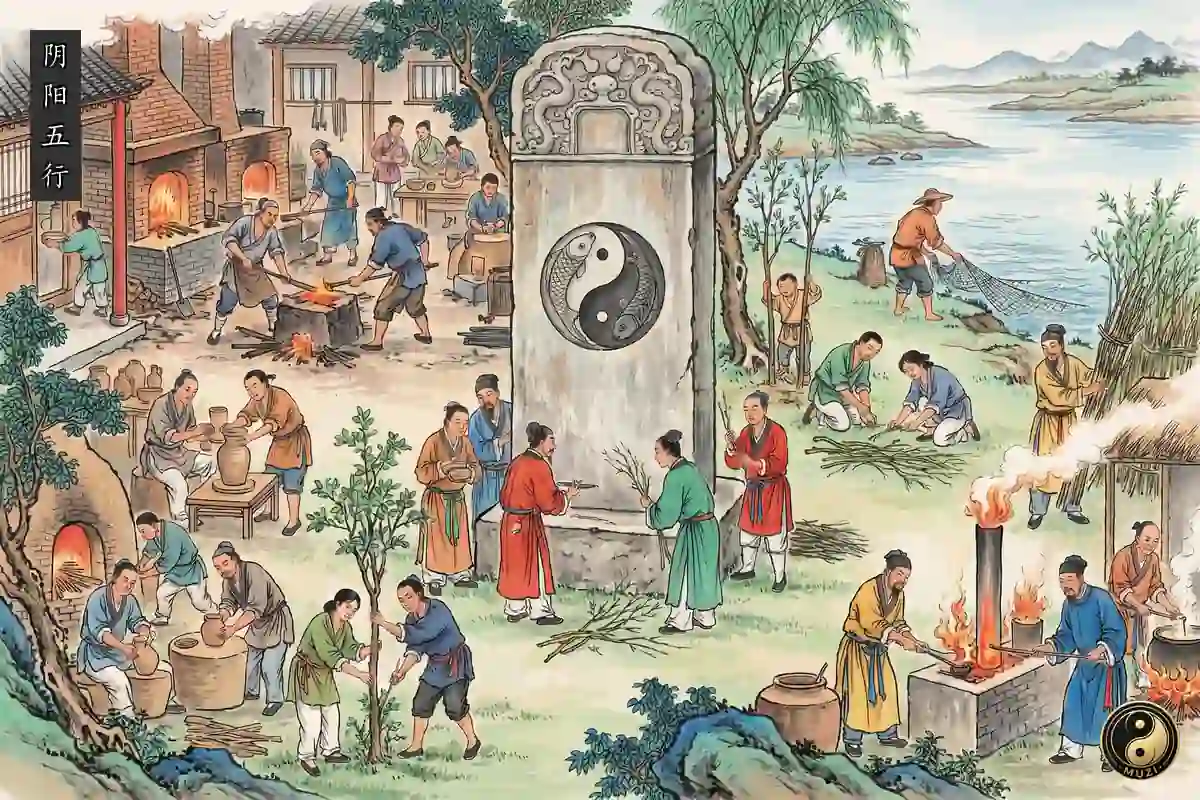
Second line, the canonization of Five Phases as a dynamic category of five basic elements. The earliest textual anchor is the repeatedly cited chu yi yue wu xing passage from the Hongfan chapter of the Shangshu (Book of Documents): wu xing: yi yue shui, er yue huo, san yue mu, si yue jin, wu yue tu. Shui yue run xia, huo yue yan shang, mu yue qu zhi, jin yue cong ge, tu yuan jia se. Run xia zuo xian, yan shang zuo ku, qu zhi zuo suan, cong ge zuo xin, jia se zuo gan (Five Phases: first, water; second, fire; third, wood; fourth, metal; fifth, earth. Water is said to soak downward; fire, to blaze upward; wood, to bend and straighten; metal, to follow and reform; earth, to receive seed and yield harvest. Soaking downward produces saltiness; blazing upward, bitterness; bending and straightening, sourness; following and reforming, pungency; seeding and harvesting, sweetness). This passage defines the Five Phases as five basic substances (water, fire, wood, metal, earth), five basic modes of motion (soaking-downward, blazing-upward, bending-straightening, following-reforming, seeding-harvesting), and five basic tastes (salty, bitter, sour, pungent, sweet) in the most complete and earliest definition, giving Five Phases its first supreme position in the Shangshu as a candidate for the most fundamental material-dynamic category shared by nature, society and the human body. The Shangshu, Gan Shi chapter, further states: you Hu shi wei wu wu xing, dai qi san zheng, tian yong jiao jue qi ming (the You Hu clan insulted and violated the Five Phases, negligently abandoned the three corrections, and Heaven thereupon cut off their mandate), making Five Phases the fundamental basis on which Heaven extinguishes the mandate of those who violate the Five Phases, giving it its first position in Chinese political philosophy as the concrete content of the Mandate of Heaven doctrine.
The text that humanized and systematized the Five Phases as tian sheng wu cai, min bing yong zhi (Heaven produced the five materials. The people use them all jointly) is the Zuozhuan, Duke Xiang 27th year: tian sheng wu cai, min bing yong zhi, fei yi bu ke (Heaven produced the five materials; the people use them all jointly; to abolish one is impermissible), making the five materials (Five Phases as five kinds of raw material) the most fundamental means of production for the people's joint use, giving Five Phases its first position in Chinese ethics as the foundation of the people's livelihood. The Guoyu, Zhengyu section (Shi Bo) further states: yi tu yu jin mu shui huo za, yi cheng bai wu (mix earth with metal, wood, water and fire to produce the hundred things), making the mixing of five elements the fundamental mechanism for producing the hundred things, giving Five Phases its first position in Chinese philosophy as the most fundamental synthetic mechanism for the generation of all things. The critical significance of this sentence for Five Phases as a dynamic category is that it elevates them from five static substances to five dynamic generative base-elements, endowing Five Phases with the dynamic properties of mutual generation and mutual conquest. The Guanzi, Wuxing and Sishi chapters (Guanzi chapters assembled from the Warring States into the early Han) then completely coupled Five Phases with four seasons, five directions, five colors, five tones, five flavors, five creatures, and five grains, giving Five Phases their first position in Chinese political-natural philosophy as the most fundamental dynamic skeleton of a complete cosmological schema.
The text that gave the Five Phases their most classic systematization as a mutual-generation, mutual-conquest dynamic was the Lushi Chunqiu, Twelve Annals (assembled by Lu Buwei's retainers, 239 BCE). Its complete 12-month by Five-Phases coupling system, spring-wood-green-east-azure-dragon-jue-sour... summer-fire-red-south-vermilion-bird-zhi-bitter... late-summer-earth-yellow-center-yellow-dragon-gong-sweet... autumn-metal-white-west-white-tiger-shang-pungent... winter-water-black-north-dark-warrior-yu-salty, gave Five Phases their first position in the complete Chinese schema of time, space, substance, color, tone and flavor as the most fundamental execution table for annual ritual and agricultural scheduling. The Liji, Yueling and the Huainanzi, Shize Xun (Liu An, Western Han) represent the most complete preservation and further refinement of the Lushi Chunqiu Twelve Annals system. The text that gave Five Phases their medical systematization as a complete coupling of five viscera, six bowels, five sense-organs, five emotions, and five fluids is the Huangdi Neijing, Suwen, Jinkui Zhenyan Lun: dong fang qing se, ru tong yu gan, kai qiao yu mu, cang jing yu gan... nan fang chi se, ru tong yu xin, kai qiao yu she... zhong yang huang se, ru tong yu pi, kai qiao yu kou... xi fang bai se, ru tong yu fei, kai qiao yu bi... bei fang hei se, ru tong yu shen, kai qiao yu er (east, green color, connects to the liver, opens at the eyes... south, red, connects to the heart, opens at the tongue... center, yellow, connects to the spleen, opens at the mouth... west, white, connects to the lungs, opens at the nose... north, black, connects to the kidneys, opens at the ears), giving Five Phases their first position in Chinese medicine as the most fundamental physiological-pathological framework for the five-viscera system of the human body. The text that gave Five Phases their astronomicalized systematization as wu qi jing tian (five qi threading through heaven) is the Huangdi Neijing, Suwen, Wu Yun Xing Da Lun, which uses five colors threading heaven as the most fundamental basis for the Five-Phases astronomical-calendrical system.
Third line, the integration of Yin-Yang and Five Phases as two originally independent systems merged into one. The person who systematically integrated these two categories, which had originally developed independently and each had their own textual sources, was the Yin-Yang School (yinyangjia) from the late Warring States through the Western Han. The earliest integrator was Zou Yan (c. 305-240 BCE, a native of Qi in the late Warring States, the true founder of the Yin-Yang School). According to the Shiji, Mengzi Xunqing Liezhuan: Zou Yan... nai shen guan yin yang xiao xi, er zuo guai yu zhi bian, zhong shi, da sheng zhi pian shi yu wan yan. Qi yu hong da bu jing, bi xian yan xiao wu, tui er da zhi, zhi yu wu yin (Zou Yan... deeply observed the waxing and waning of yin-yang, then wrote on strange and far-reaching transformations, composing more than a hundred thousand words on 'cycles' and 'great sages.' His language was grand and unbounded: he invariably first tested on small things, then extrapolated to the limitless). Making deep observation of the waxing and waning of yin-yang the most fundamental starting point for cycles and great sages, this gave Yin-Yang and Five Phases their first integrated paradigm in the history of Chinese philosophy as two complementary layers of a single system.
The thinker who integrated Yin-Yang and Five Phases within political-ethical systematics was Dong Zhongshu (179-104 BCE, Western Han), in his Chunqiu Fanlu (Luxuriant Dew of the Spring and Autumn Annals). Its Wuxing Xiangsheng (Mutual Generation of the Five Phases) and Wuxing Xiangsheng (Mutual Conquest of the Five Phases) chapters systematize Five Phases as two closed-loop dynamic systems: mutual generation: wood-fire-earth-metal-water-wood and mutual conquest: wood conquers earth, earth conquers water, water conquers fire, fire conquers metal, metal conquers wood. This gave Yin-Yang and Five Phases their first position in Confucian political philosophy as the most fundamental dynamic-ethical coupling system for 'resonance between Heaven and humanity' (tianren ganying). This is the most critical textual support for Yin-Yang and Five Phases as the entire governing ideology of the unified empire. The text that nationalized and systematized Yin-Yang and Five Phases as a complete state-ideology system coupling five bonds, five constants, five emperors, five colors, five tones, five flavors, and five numbers is the Baihu Tongyi (Comprehensive Discussions at the White Tiger Hall), assembled by Ban Gu (32-92 CE, Eastern Han) and others. Structured around virtue as the foundation of the state, five emperors matched to five phases, three bonds and six disciplines, and surnames and clan categories, it gave Yin-Yang and Five Phases their first position in Eastern Han state ideology as the officially imperially sanctioned complete cosmological schema and governance system.
The text that gave Yin-Yang and Five Phases their final systematization as a complete Five-Circuits Six-Qi astronomical-calendrical-medical system is the full Huangdi Neijing (main chapters assembled in the Western and Eastern Han). Its Suwen contains the seven Grand Discourses (da lun): Tian Yuan Ji Da Lun, Wu Yun Xing Da Lun, Liu Wei Zhi Da Lun, Qi Jiao Bian Da Lun, Wu Chang Zheng Da Lun, Liu Yuan Zheng Ji Da Lun, and Zhi Zhen Yao Da Lun (collectively known as the Seven Discourses on Circuits and Qi, inserted in Wang Bing's sub-commentary edition of the Suwen). Through the complete coupling of Five Circuits (wu yun, the inter-annual astronomical cycle of the Five Phases: wood, fire, earth, metal, water) and Six Qi (liu qi, the three-yin-three-yang of Yin-Yang: jueyin, shaoyin, taiyin, shaoyang, yangming, taiyang), this framework acts as the most fundamental coupling system for astronomy, calendrics, climate, pathology and therapy. It gave Yin-Yang and Five Phases their first position in Chinese medicine, astronomy and calendrics as the most complete dynamic system that is calculable, predictable and executable. This is the most complete, most mature, and most characteristically classical system-modeling tool form that Yin-Yang and Five Phases achieved in Chinese civilization.
:,、、。。