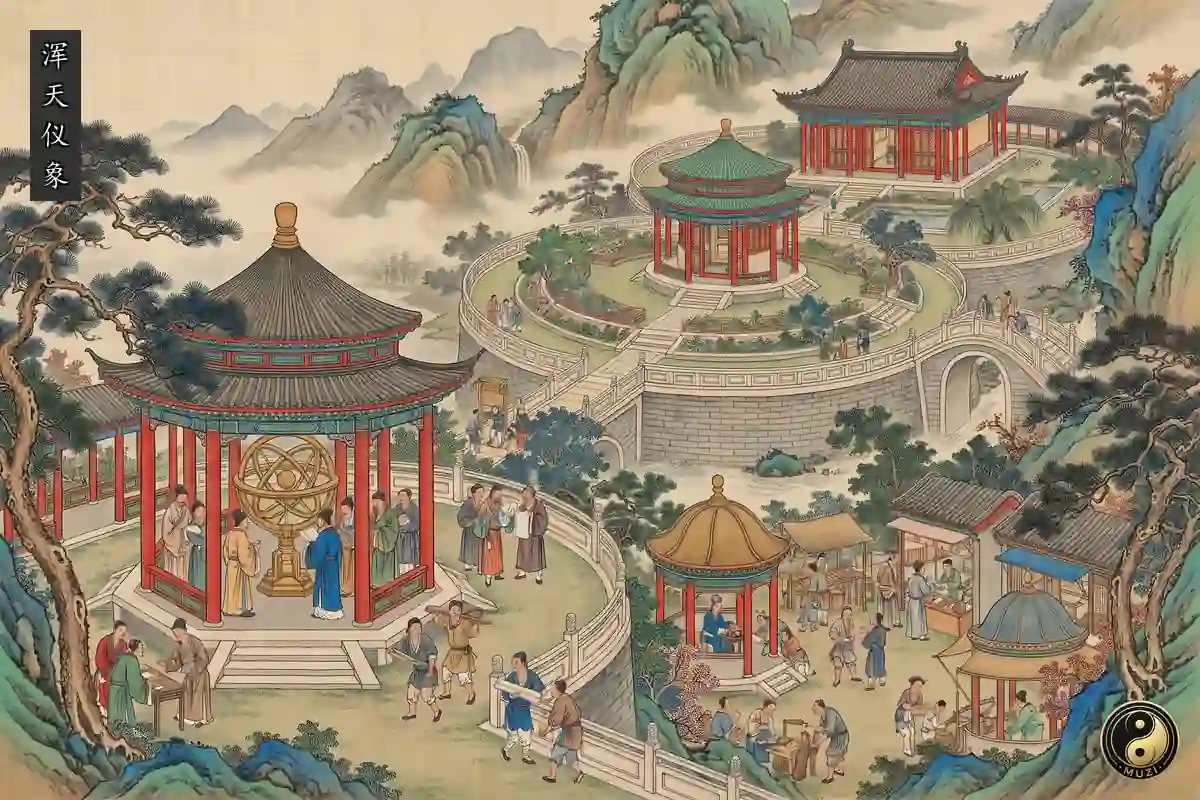





















The armillary sphere (hun tian yi) is a mechanical astronomical instrument of ancient China whose skeleton consists of multiple concentric metal ring-circles, driven by water power or human power, used to simulate the orbital trajectories of the sun, moon, and five planets. It is essentially a mechanical model of the cosmos: whatever trajectory the astronomer conceived for a celestial body, a corresponding bronze ring was cast to represent that trajectory. All rings share a single center (the geocenter) and rotate to reproduce both the diurnal motion and the annual motion of the heavens. This approach of mechanical simulation is more intuitive than any numerical calculation: when the operator turns the armillary, it is as if the cosmos itself is being turned.
The origin of the armillary sphere can be traced to the Western Han. Luoxia Hong, during the Taichu calendar reform in the first year of the Taichu era of Emperor Wu (104 BCE), created a primitive armillary for measuring celestial coordinates. But the person who truly upgraded the armillary from an observational tool to a mechanical demonstration of the cosmos was Zhang Heng (78 to 139 CE) of the Eastern Han. Zhang Heng drove the armillary by water power, synchronizing the rotation speed of the bronze rings with the actual motion of celestial bodies. A person sitting in a sealed chamber and observing the armillary could see that the celestial positions indicated by the instrument matched the real sky outside perfectly. The Jinshu Tianwen Zhi praised this feat: Zhang Heng yi lou shui zhuan zhi, you yu tian hui (Zhang Heng turned it by clepsydra water, and it moreover coincided with Heaven). This water-driven celestial globe is universally recognized as the world's earliest mechanized astronomical clock.
In the thirteenth year of the Kaiyuan era of the Tang dynasty (725 CE), the monk Yi Xing and Liang Lingzan constructed the ecliptic armillary instrument (huangdao youyi), adding an ecliptic ring (representing the sun's annual trajectory) to the traditional armillary, with the ecliptic ring able to slide along the equator to simulate the precession effect. Yi Xing also ingeniously used the armillary for a pioneering geodetic survey: he dispatched Nangong Shuo to lead teams in simultaneously measuring the altitude of the north celestial pole and the summer-solstice shadow length at more than ten latitude points. From these data he calculated the surface distance of one degree of the meridian. This was the first organized geodetic survey in human history (see CE19 for details).
Another important application thread of the armillary sphere is celestial-event recording and star-chart production. During the Three Kingdoms period, Chen Zhuo, Grand Astrologer of the Kingdom of Wu, consolidated the star-official catalogues of Shi Shen, Gan De, and Wu Xian, compiling a celestial globe star chart containing 283 asterisms and 1,464 stars. This is the foundational dataset for one of the earliest systematic star charts in the world. The Dunhuang star chart of the Tang dynasty (c. early eighth century), using a combination of circular and horizontal projections, precisely plotted all stars visible to the naked eye according to coordinates measured by armillary instruments. The five star charts included in Su Song's Xin Yixiang Fayao (c. 1094) of the Song dynasty are the earliest surviving woodblock-printed star charts based on armillary-instrument observations. The celestial data produced by armillary spheres directly drove the transformation of Chinese star charts from schematic diagrams to scientific astronomical maps.
During the Yuanyou era of the Northern Song dynasty (1088 to 1090), Su Song and Han Gonglian completed the construction of the Water-Driven Astronomical Clock Tower (shui yun yi xiang tai) in Bianjing (Kaifeng). This tower, approximately twelve meters tall, is the most monumental creation in the history of the armillary sphere. It integrates three independent mechanical systems into a single structure: the top level houses an armillary instrument for actual observation; the middle level houses a celestial globe (a spherical model of the heavens) for demonstrating celestial phenomena; the bottom level houses a clepsydra-driven time-reporting system in which wooden mannequins automatically strike bells and beat drums at each quarter-hour. Su Song recorded its structure in full detail in the Xin Yixiang Fayao (1094). The escapement mechanism it contains is universally recognized by modern scholars as the earliest astronomical-clock escapement device in the world.
In the Yuan dynasty, Guo Shoujing carried out a bold simplification of the armillary. Traditional armillary instruments stacked all coordinate rings on the same axis, causing severe mutual obstruction and making it difficult to read precise data during observation. Guo Shoujing split the armillary into two independent instruments: an equatorial armillary (for measuring a celestial body's right ascension and declination) and an azimuth instrument (for measuring a celestial body's altitude and azimuth above the horizon). The design philosophy of this simplified instrument (jian yi), one instrument for one problem, is strikingly modern, predating Tycho Brahe's analogous designs by approximately three hundred years. The Yuan-dynasty original of the simplified instrument is preserved to this day at the Purple Mountain Observatory in Nanjing.
The internal logic of the armillary sphere is to use the physical laws of mechanical motion to simulate the mathematical laws of celestial motion. When mathematical tools were not yet sufficient to calculate planetary positions precisely, mechanical simulation provided an equally effective cognitive pathway. From Zhang Heng's water-powered drive in the Eastern Han to Su Song's escapement clock tower in the Northern Song, from Yi Xing's ecliptic armillary in the Tang to Guo Shoujing's simplified instrument in the Yuan, every improvement is essentially the same endeavor: using more precise mechanical means to approach a truer picture of the cosmos. This is precisely why the armillary sphere, this mechanical cosmos, occupied the core position among Chinese astronomical instruments for nearly two thousand years. The idea it embodies transcends any single era or locale: it proves that when mathematics is not yet sufficient to describe every detail of celestial motion, humanity can first cast with its own hands a touchable universe, then refine it inch by inch across the millennia. This is the most distinctive engineering wisdom of Chinese classical mechanical astronomy: forging a working cosmos from metal and water.