The twenty-four solar terms are the most ingenious design in China's ancient calendrical system. Entirely independent of lunar phases, they are based purely on the sun's apparent annual motion along the ecliptic, dividing the tropical year into twenty-four equally-spaced angular nodes, each corresponding to 15 degrees of solar travel. *Lichun* (Start of Spring), *Yushui* (Rain Water), *Jingzhe* (Awakening of Insects), *Chunfen* (Spring Equinox), *Qingming* (Clear and Bright), *Guyu* (Grain Rain), strung together, these names form a rhythmic poem of Chinese agriculture. The unique value of the twenty-four solar terms lies in this: for a lunisolar calendar system whose daily timekeeping is based on lunar phases, they provide an agricultural temporal coordinate determined entirely by the sun's position, wholly independent of the moon.
The systematization of the twenty-four solar terms was completed during the Western Han dynasty. The *Huainanzi*, chapter *Tianwen Xun* (139 BCE), listed for the first time the complete set of twenty-four solar term names and sequences identical to those used today, and established the tropical year at 365.25 days. A key algorithmic distinction applies here: the twenty-four terms divide evenly into two categories, *jieqi* (nodal qi) and *zhongqi* (medial qi), arranged in alternation. The twelve medial qi (Winter Solstice, Great Cold, Rain Water, Spring Equinox, Grain Rain, Grain Full, Summer Solstice, Great Heat, End of Heat, Autumn Equinox, Frost Descent, Light Snow) are critical for determining intercalary months: any month lacking a medial qi is designated intercalary. This rule elevated the twenty-four solar terms from an agricultural timing guide to an intercalation mechanism, with intercalary months determined automatically by astronomical observation rather than arbitrary human decree.
In the long-term refinement of solar terms, determining the exact moment of the winter solstice was always the foremost priority. The winter solstice marks the instant the sun reaches its southernmost point on the ecliptic; from this day onward, daylight gradually lengthens. Zu Chongzhi, in his *Daming Li* (462 CE), became the first to incorporate the effect of precession into the calculation of the winter solstice point, discovering that it was not fixed against the stellar background but shifted westward by approximately 50 arc-seconds per year. This correction produced a qualitative leap in the precision of winter solstice calculations. In the Tang dynasty, the monk Yixing's *Dayan Li* (727 CE) further refined the day-count differences between successive solar terms using unequal-interval interpolation, treating the sun's motion as non-uniform. In the Yuan dynasty, Guo Shoujing's *Shoushi Li* (1280 CE) adopted a tropical year length of 365.2425 days, differing from the modern value by only 26 seconds. By this point, the temporal precision of the twenty-four solar terms had reached the physical limit of naked-eye observation in the ancient world.
The precise mechanism of the twenty-four solar terms was a product of observation at a specific geographic location: the middle and lower Yellow River region (Yangcheng, near modern Dengfeng, Henan). This means that phenological descriptions such as at *Jingzhe*, peach trees begin to bloom do not hold true in Lingnan or the Northeast. From the Tang dynasty onward, agricultural manuals assembled in the south began applying local corrections to the northern phenological markers. In the Yuan dynasty, Wang Zhen's *Nongshu* (1313) extended the phenological matching of the twenty-four solar terms and seventy-two pentads from the Yellow River basin southward to the Yangtze River basin. In the Ming dynasty, Xu Guangqi's *Nongzheng Quanshu* (1639) integrated agricultural proverbs and solar-term adaptation practices from both north and south. The Qing court-commissioned *Shoushi Tongkao* (1742) finalized a nationwide agricultural application system for the twenty-four solar terms.
The twenty-four solar terms are not merely a mathematical model; they are a temporal culture deeply embedded in Chinese social life. *Qingming* is the most typical example: it is simultaneously an astronomical node (the sun reaching ecliptic longitude 15 degrees, around April 5 in the Gregorian calendar) and a universal social custom (tomb-sweeping ancestor worship and spring outings). This direct coupling of astronomical moment to social action is the unique power of the solar terms: they give the lunar calendar a precise solar skeleton, preventing lunisolar festivals such as Spring Festival, Dragon Boat Festival, and Mid-Autumn Festival from drifting year by year into summer or winter. Zong Lin's *Jingchu Suishi Ji* (c. sixth century) is the earliest text to systematically record solar-term folk customs. In 2016, the twenty-four solar terms were inscribed on the UNESCO Representative List of the Intangible Cultural Heritage of Humanity.
The seventy-two pentads are a high-resolution phenological grid formed by subdividing each solar term, with one pentad every five days, three pentads per term, and seventy-two pentads per year. Each pentad is paired with a specific phenological phenomenon: for example, the first pentad of Start of Spring is east wind thaws the ice, the first pentad of Awakening of Insects is peach trees begin to bloom, and the second pentad of Clear and Bright is field mice transform into quails. the solar term grid first appears in the *Yi Zhoushu*, chapter *Shixun Jie* (assembled approximately from the Warring States to Western Han period), and was integrated through the *Lushi Chunqiu*, *Shi'er Ji* and the *Liji*, *Yueling*, reaching its definitive form in the *Huainanzi*, *Shize Xun*. The seventy-two pentads precisely interlocked the typical animal and plant activities and meteorological phenomena of northern China's Yellow River basin with the temporal nodes of the twenty-four solar terms, constituting the world's earliest seasonal calendrical system indexed by biological behavior and meteorological events.
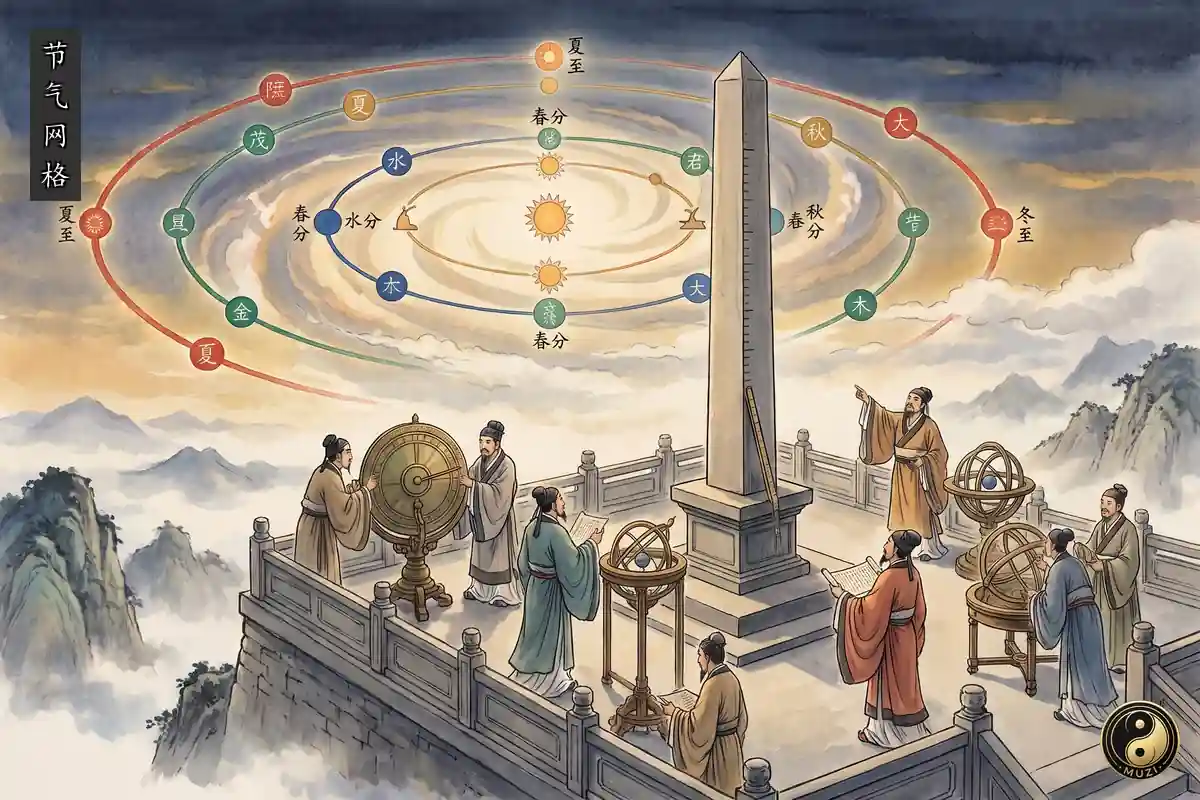
The internal logic of the solar-term grid takes the sun's annual motion along the ecliptic as the most fundamental temporal ruler, slicing the tropical year into twenty-four equally-angled precision nodes, then extending downward into seventy-two phenological markers, forming a complete temporal knowledge system spanning from celestial mechanics to the field's edge, from imperial calendar computation to farmers' proverbs. This is precisely why the twenty-four solar terms could earn the shared recognition of farmers, poets, emperors and UNESCO alike: they are at once the most precise mechanism and the most clear experience, time written upon the earth in the language of mathematics.