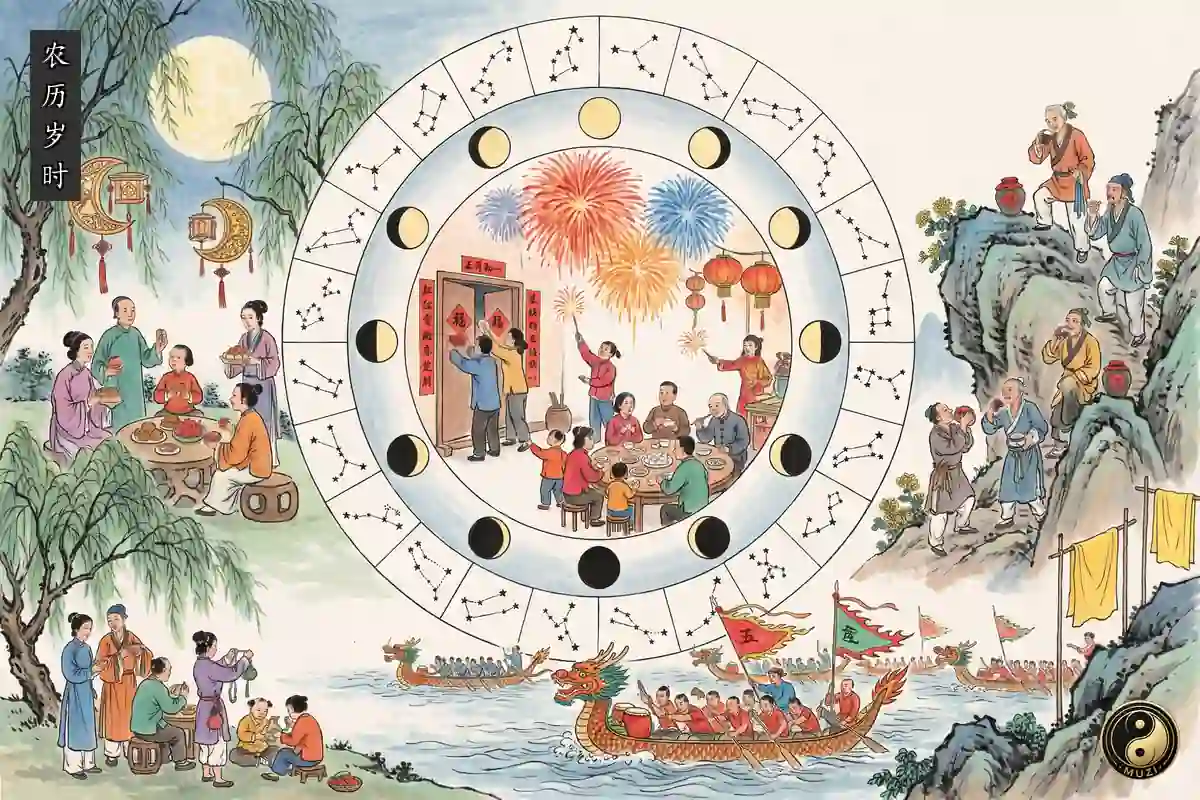
The Chinese lunisolar calendar is the only lunisolar calendrical system in the history of human civilization to have been in continuous use for over four thousand years. Its core technical challenge lies in reconciling two incommensurable natural cycles: the moon's orbit around the earth at approximately 29.53 days (synodic month) and the earth's orbit around the sun at approximately 365.24 days (tropical year). A purely lunar calendar drifts from the seasons year by year; a purely solar calendar abandons the clear marker of lunar phases. Only the ancient Chinese devised a dual-track solution using intercalary months as the regulating valve: the synodic month acts as the primary daily timekeeping axis, the twenty-four solar terms serve as agricultural anchor points, and the nineteen-year seven-intercalation cycle acts as the system calibration period.
The core documentary origin of this calendar traces back to the *Shangshu*, *Yao Dian*. The passage He then commanded Xi and He to reverently observe the heavens, calculate and represent the movements of the sun, moon and stars, and respectfully deliver the seasons to the people established calendar-making as the most fundamental political responsibility of the Son of Heaven. The four characters *jing shou min shi* (respectfully deliver the seasons to the people) became the overarching mandate for all Chinese calendrical reform over the following four thousand years. The *Shijing*, *Binfeng*, *Qi Yue*, In the seventh month, the Fire star descends; in the ninth month, winter clothes are distributed, is the earliest literary record linking solar terms with agricultural work, proving that by the Western Zhou at the latest, ordinary farmers already arranged their production rhythms by stellar markers. The oracle bone inscriptions from Yinxu, which record a thirteenth month (c. 1200 BCE), provide material proof that intercalary month insertion predates any transmitted text.
The core of the *Taichu Li* reform was establishing an operable intercalation mechanism. Nineteen-year seven-intercalation means that exactly 235 synodic months fit within 19 tropical years (235 synodic months equals approximately 6,939.69 days; 19 tropical years equals approximately 6,939.60 days), with a discrepancy of only about 0.09 days. The intercalation criterion was later made explicit in the Eastern Han *Sifen Li*: any month containing no medial qi is designated intercalary. This simple mechanism proved extremely reliable in practice: the intercalary month functions like a pluggable temporal regulator, pulling the drifting lunar calendar back onto the seasonal track. By the time of the Qin bamboo slips known as the *Rishu* (excavated from the Shuihudi Qin tomb, c. 217 BCE), ordinary people were already using calendars to select auspicious days and avoid ill-omened ones.
The precision of the twenty-four solar terms was achieved by Liu An, Prince of Huainan, and his retainers in the *Huainanzi*, *Tianwen Xun* (139 BCE). Liu An fixed the tropical year at precisely 365.25 days and for the first time provided the twenty-four solar term names and sequence identical to those used today, *Lichun*, *Yushui*, *Jingzhe*, *Chunfen*, *Qingming*, *Guyu*, unchanged for two thousand years thereafter. The winter solstice is the first of the twenty-four solar terms; accurately measuring its exact moment therefore became the most important and most sacred annual task of every imperial astronomical observatory, because the winter solstice is the day of the sun's rebirth: from this day forward, daylight lengthens, *yang* energy returns, and the entire rhythm of agriculture and society recalibrates from this starting point.
In the first year of the *Taichu* era of Emperor Wu of Han (104 BCE), the *Taichu Li* reform led by Luoxia Hong, Deng Ping, and Sima Qian constituted the first systematic engineering project in Chinese calendrical history. The *Taichu Li* designated the first month as the start of the year (a practice still in use today), formally established the nineteen-year seven-intercalation rule, and set the first day of each month at the new moon (the day of sun-moon conjunction). Luoxia Hong is honored by the people of Langzhong, Sichuan, as the Old Man of Spring Festival. Over the following two thousand years, from Zu Chongzhi's *Daming Li* (462 CE), which first introduced the concept of precession, to the monk Yixing's *Dayan Li* (727 CE), which used unequal-interval interpolation to compute the sun's motion, to Guo Shoujing's *Shoushi Li* (1280 CE), which yielded a tropical year of 365.2425 days (differing from the modern value by only 26 seconds), each improvement represented a simultaneous leap in observational precision and mathematical tools.
The other thread in calendrical history runs from astronomical mechanisms to the grounding of annual festivals and customs. The *Liji*, *Yueling*, wove the phenology, government decrees, and sacrificial rites of all twelve months into a complete annual temporal script. Zong Lin's *Jingchu Suishi Ji* (c. sixth century) is the earliest monograph to systematically record popular annual customs; the early forms of Dragon Boat Festival, *Qixi*, and Double Ninth Festival all appear in this work. In the Song dynasty, Meng Yuanlao's *Dongjing Meng Hua Lu* documented the year-round festival pageantry of Bianjing from New Year's Day to New Year's Eve, marking the definitive transition of the annual cycle system from official ritual into the life of the marketplace. In 2016, the twenty-four solar terms were inscribed on the UNESCO Representative List of the Intangible Cultural Heritage of Humanity.
The internal logic of the lunisolar annual cycle system is this: using a computable, observable and transmissible algorithmic grid, it weaves the sun's agricultural rhythm and the moon's social rhythm into a single timetable, so that farmers know when to sow, officials know when to sacrifice, and the common people know when to reunite. From the Han dynasty *Taichu Li* to the Qing dynasty *Shoushi Li*, from successive court-issued calendars to every farmer's almanac, this lunisolar framework was never replaced and never abandoned. It proved that two unrelated celestial cycles can be harmoniously woven together by ingenious mathematical design. This is precisely why it has endured unbroken across four thousand years, from the thirteenth month in oracle bone inscriptions to the lunar calendar on today's smartphones.