The Orthodox Meaning of the Five Classics (*Wujing Zhengyi*) in the cognitive map of the great unified empire of Huaxia is the cognitive framework that forcibly consolidated the philosophical fragments of the Hundred Schools of pre-Qin thought into five functional units and a single authoritative source of legitimacy verification, the foundational platform of state ideology. Three lines must be traced separately: the first is the line of the formation and functional positioning of each of the Five Classics (from the Western Zhou to the Spring and Autumn period's poetry and music as one primitive form, through the late Warring States' collapse of ritual and dissolution of music (*li huai yue beng*) and the contending of the Hundred Schools. The Han dynasty's definitive editions of the Five Classics and the transmission lineages and editorial histories of each canonical text). The second is the line of the state-ification of Han-dynasty classical scholarship and the welding-shut of standard commentaries (from Emperor Wu of Han's dismissing the Hundred Schools and honoring Confucianism alone (*bai chu bai jia, du zun ru shu*) and Dong Zhongshu's *Tian Ren San Ce* and the establishment of the Five Classics Erudites, through the Eastern Han Zheng Xuan's annotating the *Zhouli* with the *Liji* and glossing the *Shijing* with the Mao Commentary, Wei-Jin Wang Bi's *Zhouyi Zhu* and He Yan's *Lunyu Jijie*. The Tang-dynasty Kong Yingda's *Wujing Zhengyi* as the state-sanctioned welding-shut of standard commentaries); and the third is the line of civil-service examinations and the definitive sequencing of the canonical corpus (from the Sui-Tang Mingjing examination using the Five Classics, to the Tang Kaicheng Stone Classics carved in 837 at the Imperial Academy, to the Southern Song Zhu Xi's *Sishu Zhangju Jizhu* of 1190 replacing the Five Classics with the Four Books as the examination core, to the Yuan, Ming and Qing finalization of Four Books plus Five Classics plus eight-legged essay). To see the true weight of the *Wujing Zhengyi* in Chinese civilization, all three lines must be followed.
The first line, the formation and functional positioning of each of the Five Classics. The earliest textual anchor is the *Shi* (i.e., the *Shijing*, the Classic of Poetry), whose poetry and music as one (*shi yue yi ti*) primitive form spanning the early Western Zhou to the mid-Spring and Autumn period (approximately the 11th to 6th century BCE) comprised three categories of *feng*, *ya*, and *song* (160 *Guofeng* airs, 74 *Xiaoya* lesser odes, 31 *Daya* greater odes, and 40 *Song* hymns, totaling 305 poems) as the lyric record collection of the ritual-music civilization of the Zhou. This gave the *Shi* its foundational position as the mother-text of the emotional units of Huaxia society at the time of its assembly. The most definitive systematization of the *Shi* as the core vehicle of Zhou ritual-music civilization was Confucius's (551--479 BCE) editing of the *Shi*, using there is nothing deviant in its thoughts (*si wu xie*) as the editorial principle for the 300 poems and Confucius's correction of the music, giving the *Shi* in the late Spring and Autumn period its foundational position as the foundational Confucian social-emotional norm. The *Shu* (i.e., the *Shangshu*, the Classic of Documents), with its four divisions of *Yushu*, *Xiashu*, *Shangshu*, and *Zhoushu* covering the political archives from high antiquity to the Spring and Autumn period, gave the *Shu* its foundational position as the mother-text of Huaxia political archives. The earliest canonization landmark of the *Shu* was Confucius's (551--479 BCE) ordering of the *Shu*, using the decrees and commands of ancient rulers, oaths of military campaigns, and records of governance as the genres of the *Shu*, giving it its foundational position as the foundational Confucian political-archive norm. The *Li* (i.e., the Three Rituals, *Yili*, *Zhouli*, and *Liji* combined), with the seventeen chapters of the *Yili* covering the capping ceremony of a gentleman, the marriage ceremony of a gentleman, the ceremony for receiving guests, the village drinking ceremony, the village archery ceremony, the banquet ceremony, the grand archery ceremony, the diplomatic mission ceremony, the lord's feast for a grandee, the audience ceremony, mourning dress, the funeral of a gentleman, the evening rites, the memorial sacrifice, the special-victim meal offering, the lesser-victim meal offering. The sacrificial ceremony as the daily behavioral norms for the gentleman class, gave the *Li* its foundational position as the mother-text of Huaxia behavioral norms. The systematization of ritual as the core normative framework of Zhou ritual-music civilization was accomplished by the *Zhouli* (assembled in the late Warring States, with six offices of *Tianguan*, *Diguan*, *Chunguan*, *Xiaguan*, *Qiuguan*, and *Dongguan* as the institutional text of the state administrative structure, encompassing 358 official positions) and the *Liji* (edited by Dai Sheng of the Western Han, 49 chapters covering the meaning of ritual, the institutions of ritual, the principles of ritual. The music of ritual), giving ritual in the Han dynasty its foundational position as the foundational Confucian behavioral-norm norm. The *Yi* (i.e., the *Zhouyi*, the Classic of Changes), with the tradition of four sages completing the *Yi*, Fuxi drawing the trigrams, King Wen elaborating the hexagrams, the Duke of Zhou appending the line statements, and Confucius composing the commentaries, and the *Zhouyi* base text of 64 hexagrams and 384 lines, gave the *Yi* its foundational position as the mother-text of Huaxia cosmic computation. The canonization of the *Yi* as cosmogonic theory was accomplished by the *Zhouyi Xici* (Commentary on the Appended Phrases): The *Yi* has the Supreme highest (*taiji*); this generates the Two Modes (*liang yi*); the Two Modes generate the Four Images (*si xiang*); the Four Images generate the Eight Trigrams (*ba gua*), giving the *Yi* its foundational position as the foundational Confucian cosmic-computation norm. The *Chunqiu* (Spring and Autumn Annals), with its 242-year chronological history of the state of Lu from 722 BCE to 481 BCE, gave the *Chunqiu* its foundational position as the mother-text of Huaxia historical adjudication. The canonization of the *Chunqiu* as a text of subtle phrasing and great significance (*weiyan dayi*) was accomplished by three commentaries: the *Chunqiu Gongyang Zhuan* (Warring States Gongyang Gao and Han-dynasty He Xiu), the *Chunqiu Guliang Zhuan* (Warring States Guliang Chi and Jin-dynasty Fan Ning), and the *Chunqiu Zuoshi Zhuan* (Warring States Zuo Qiuming), giving the *Chunqiu* in the Han dynasty its foundational position as the foundational Confucian historical-adjudication norm.
The second line, the state-ification of Han-dynasty classical scholarship and the welding-shut of standard commentaries. The earliest state-ification action was Emperor Wu of the Western Han's (approximately 136--121 BCE) dismissing the Hundred Schools and honoring Confucianism alone and establishing the Five Classics Erudites (*Wujing Boshi*), with the *Shi* erudites (four schools: Lu, Qi, Han and Mao), the *Shu* erudites (three schools: Ouyang, Greater Xiahou, and Lesser Xiahou), the *Li* erudites (Hou Cang, Dai De, and Dai Sheng), the *Yi* erudites (Shi Chou, Meng Xi, Liangqiu He, Jing Fang, and others). The *Chunqiu* erudites (Gongyang, Guliang and Zuo), the Fourteen Erudites as the official vehicles of state-ified classical scholarship, giving the Five Classics under Emperor Wu their foundational position as the sole legitimate canonical sequence of the state. The emergency preservation of the Five Classics as the rescued torch of transmission was accomplished in the early Western Han (after the First Emperor of Qin's book-burning of 213--208 BCE), most notably by Fu Sheng of Jinan (268--178 BCE), who concealed the *Shangshu* within the walls (*bi cang Shangshu*), and by the oral transmission and exegesis of classicists such as Fu Sheng, Mao Heng, and Kong Anguo at the Qin-Han transition. This gave the Five Classics at the Qin-Han transition their foundational position as the core texts of Chinese civilization that survived catastrophe.
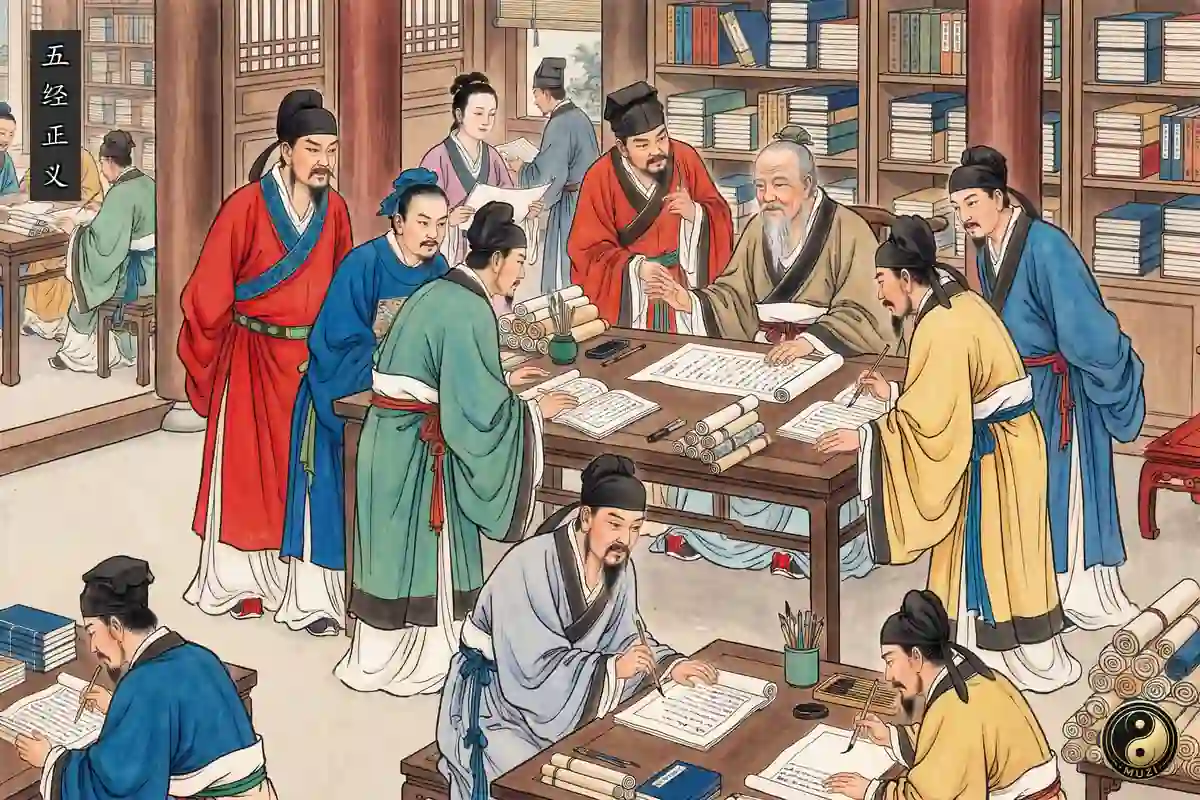
The state-ification and systematization of the Five Classics as authoritative standard commentaries was accomplished by the Eastern Han Zheng Xuan (127--200 CE) and his Zheng commentary (*Zheng shi zhu*), comprising the *Maoshi Jian* (glossing the *Shijing* through the Mao Commentary), the *Sanli Zhu* (annotating the *Zhouli*, *Yili*, and *Liji*), the *Shangshu Dazhuan Zhu*, and the *Zhouyi Zhu* (later lost), as a complete commentary system. This gave the Five Classics in the Eastern Han their foundational position as the official standard commentary. The transformation of the Five Classics into philosophical commentaries in the Wei-Jin style was represented by Wang Bi (226--249 CE) and his *Zhouyi Zhu* and He Yan (?--249 CE) and his *Lunyu Jijie*, using the philosophical approach of sweeping away images, interpreting the *Yi* through Xuanxue metaphysics, and interpreting the *Lunyu* through Laozi and Zhuangzi, giving the Five Classics in Wei-Jin Xuanxue their foundational position as replacing exegesis with ontological philosophy. The absolute welding-shut of the Five Classics as state-sanctioned standard commentaries was accomplished by Kong Yingda (574--648 CE) and other scholars during the Zhenguan era of the Tang dynasty, who assembled the *Wujing Zhengyi*: the *Zhouyi Zhengyi* (based on Wang Bi's and Han Kangbo's commentary), the *Shangshu Zhengyi* (based on Kong Anguo's *Guwen Shangshu* commentary), the *Maoshi Zhengyi* (based on the Mao commentary and Zheng Xuan's gloss), the *Liji Zhengyi* (based on Zheng Xuan's commentary). The *Chunqiu Zuozhuan Zhengyi* (based on Du Yu's commentary) as the definitive standard-commentary editions of the Five Classics. Through the official authority of unifying Northern and Southern classical scholarship, unifying commentary and sub-commentary, and promulgating them nationwide, this gave the Five Classics in the Tang dynasty their foundational position as the imperially sanctioned commentary and the standard examination text, the definitive moment of the Five Classics as the national norm of the great unified empire.
The third line, civil-service examinations and the definitive sequencing of the canonical corpus. The earliest link between the Five Classics and examinations was the Sui dynasty's (approximately 605 CE) Mingjing examination, with demonstrating mastery of two classics and answering policy questions as its shape, giving the Five Classics in the Sui dynasty their foundational position as examination subjects for civil-service selection. The systematization of the Five Classics as the state-mandated examination standard in the Tang and Song dynasties was accomplished by the Tang (from Emperor Gaozong's Xianqing era onward, the Mingjing examination used the Nine Classics, the Five Classics plus the *Lunyu*, *Xiaojing*, and *Erya*, as the examination scope) and the Song (where classical interpretation used the Five Classics and the *Lunyu* and *Mengzi* as the examination core), giving the Five Classics in the Tang and Song their foundational position as the core subjects of the civil-service examination system.
The permanent state-ification of the Five Classics as stone-carved definitive editions was the Kaicheng Stone Classics, carved from the seventh year of Dahe to the second year of Kaicheng under Emperor Wenzong of Tang (833--837 CE), comprising the *Zhouyi*, *Shangshu*, *Maoshi*, *Zhouli*, *Yili*, *Liji*, *Chunqiu Zuozhuan*, *Chunqiu Gongyang Zhuan*, *Chunqiu Guliang Zhuan*, *Lunyu*, *Xiaojing*, and *Erya*, twelve classics inscribed in regular script and erected at the Imperial Academy. This gave the Five Classics in the Tang dynasty their foundational position as stone-carved definitive editions to prevent transmission errors, the material anchoring of the Five Classics as standardized texts.
The paradigm shift of the canonical sequence from a Five Classics center of gravity to a Four Books center of gravity was completed by the Southern Song Zhu Xi (1130--1200) and his *Sishu Zhangju Jizhu* (completed 1190), which designated the *Daxue*, *Zhongyong*, *Lunyu*, and *Mengzi* as the Four Books (taking the *Daxue* and *Zhongyong* from the *Liji* and the *Lunyu* and *Mengzi* as separate works), and established the Four Books graduated reading method: first read the *Daxue* to set the scope; next read the *Lunyu* to establish the root; then read the *Mengzi* to observe its flourishing; finally read the *Zhongyong* to seek the subtleties of the ancients. This gave the Four Books in the Song dynasty their foundational position as the Confucian introductory sequence that is more foundational and more central than the Five Classics, the paradigm revolution shifting the canonical sequence from the Five Classics to the Four Books. The finalization of Four Books plus Five Classics as the definitive examination shape across the Yuan, Ming and Qing dynasties was accomplished by the Yuan (the 1313 *Keju Chengshi* requiring the Four Books as compulsory and the Five Classics as supplementary), the Ming (the 1370 Hongwu-era examination shape specifying Four Books interpretation, discourse, imperial edicts and memorials, and judicial decisions with Zhu Xi's *Sishu Zhangju Jizhu* as the sole standard commentary), and the Qing (continuing the Ming system until the abolition of the examinations in 1905). This gave the Four Books and Five Classics in the Ming and Qing their foundational position as the definitive examination shape with Zhu Xi's commentary as the sole imperially sanctioned standard, the final completed form of the *Wujing Zhengyi* as the foundational platform of state ideology.
,、《》、《》,,:、、,《》《》《》《》《》,、、。,、、、,。