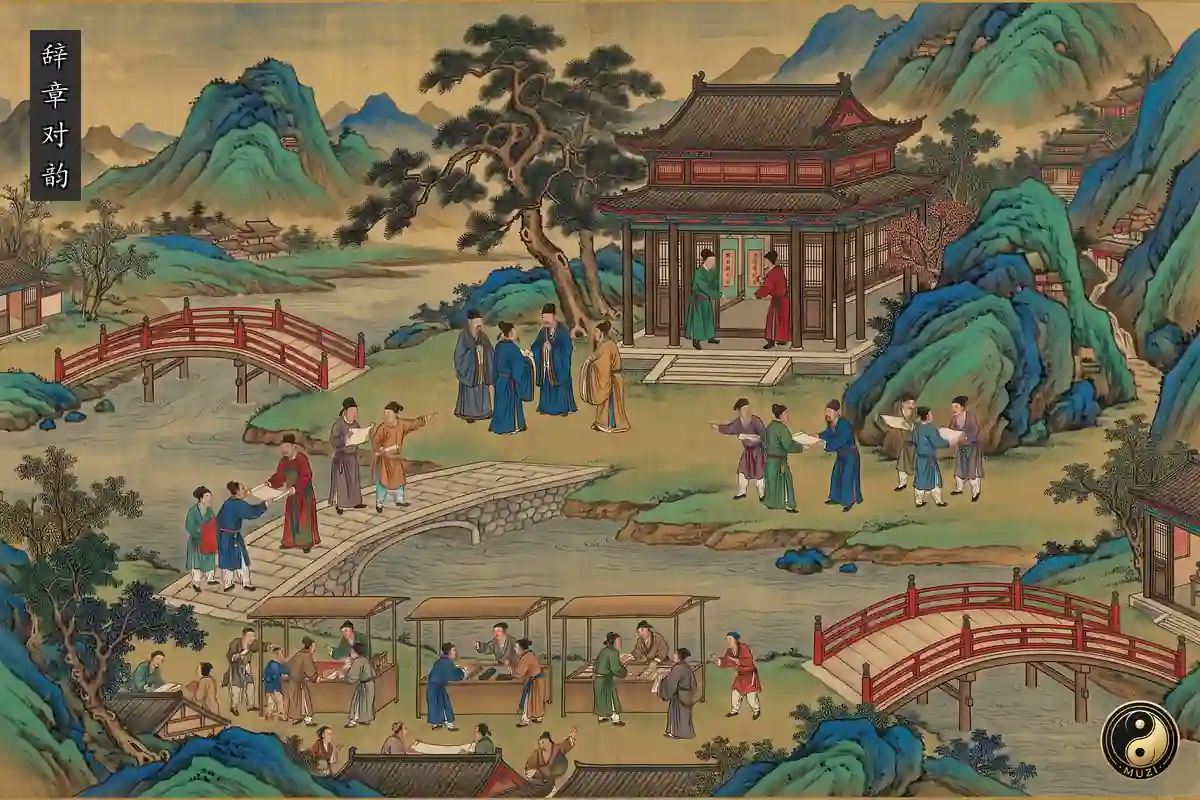
Rhetoric and Antithetical Rhyme (*cizhang duiyun*) in the landscape of classical Chinese rhetoric and antithetical acoustics is the first-generation guideline of the Huaxia tradition of classical antithetical prosody, born of the historical pressures, from the pre-Qin to the Qing dynasty, of the maturation of the square-block physical matrix of Chinese characters, the refinement of the tonal system, the pressure for antithetical prosody generated by the civil-service examinations, and the twin demands of court ceremony and marketplace custom, defined as the antithetical-acoustic rhetorical operating system shared by the three branches of parallel prose (*pianwen*), regulated rhapsody (*lufu*), and couplets (*duilian*). A single continuous line must be traced to the end: from the rhapsodic origins of the pre-Qin Songs of Chu and Song Yu through the great Han rhapsodies (Sima Xiangru, Yang Xiong, Ban Gu, and Zhang Heng), through Wei-Jin parallel prose (Lu Ji, Pan Yue, and Bao Zhao), through the Southern Dynasties' Yongming style (Shen Yue, Zhou Yong, and Liu Xie), through the Four Outstanding Poets of the Early Tang (Wang Bo, Luo Binwang, Yang Jiong, and Lu Zhaolin), to Song-dynasty four-six prose (Ouyang Xiu and Wang Anshi), then adding couplets as a lateral extension of the parallel-prose trunk. from the peach-plaque couplet of Meng Chang of Later Shu in 964 to Zhu Yuanzhang's promotion of spring couplets during the Hongwu era of the Ming to Sun Ranweng's 180-character long couplet at the Daguan Pavilion in the Qing and Liang Zhangju's *Yinglian Conghua*. The earliest textual anchor of this line is the rhapsodic origins in the pre-Qin Songs of Chu, with Song Yu (approximately 298--222 BCE) as the representative figure of the late Songs of Chu. His *Feng Fu* (Rhapsody on the Wind), *Gaotang Fu* (Rhapsody on Gaotang), and *Shennyu Fu* (Rhapsody on the Goddess), all from the late Warring States, approximately the 3rd century BCE, with their host-guest dialogue structure, alternation of rhymed and unrhymed passages, and lavishly ornamental diction, gave the rhapsody (*fu ti*) in the late Warring States its foundational position as the common mother form of parallel prose and regulated rhapsody. The founding of the Han grand rhapsody as the first peak in the maturation history of parallel prose was accomplished by Sima Xiangru of the Western Han (179--117 BCE), whose *Shanglin Fu* and *Zixu Fu* (mid-Western Han, approximately 150--130 BCE), with host-guest dialogue, extravagant amplification, encyclopedic enumeration, and alternation of rhymed and unrhymed passages, gave Sima Xiangru and the *Shanglin Fu* and *Zixu Fu* in the mid-Western Han their foundational position as the first peak of parallel prose maturation. The continuation of the Han grand rhapsody as the other pole of parallel prose was accomplished by Yang Xiong (53 BCE to 18 CE), whose *Ganquan Fu*, *Changyang Fu*, *Hedong Fu*, and *Yulie Fu* (approximately 30 BCE to 10 CE) gave Yang Xiong in the late Han his foundational position as the mid-to-late continuator of the Han grand rhapsody. The advancement of parallel prose toward conscious antithesis and theorized prosody was accomplished by Ban Gu (32--92 CE) and his *Liangdu Fu* (approximately 60--80 CE), giving Ban Gu and the *Liangdu Fu* in the Eastern Han their foundational position as the historian's rhapsody. The closing of the Han grand rhapsody as the pinnacle of the mature period was accomplished by Zhang Heng (78--139 CE), whose *Erjing Fu*, the *Xijing Fu* and the *Dongjing Fu* (approximately 100--120 CE), gave Zhang Heng and the *Erjing Fu* in the Eastern Han their foundational position as the most mature work of the Han grand rhapsody and the pinnacle of parallel prose's mature period. The advancement of parallel prose toward conscious antithesis and theorized prosody was accomplished by Lu Ji of the Western Jin (261--303 CE), whose *Wenfu* (Rhapsody on Literature, approximately 280--290 CE), the first systematic essay discussing the theory of parallel prose composition in China, gave Lu Ji and the *Wenfu* in the Western Jin their foundational position as the ancestor of Chinese parallel-prose theory. The realization of parallel prose as the supreme exemplar of antithesis was accomplished by Pan Yue of the Western Jin (approximately 247 to approximately 300 CE), whose three *Daowang Shi* (Poems Mourning the Departed, approximately 290--300 CE) and *Xianju Fu* and *Daowang Fu* gave Pan Yue and the *Daowang Shi* their foundational position as the exemplar of lyrical parallel prose. The advancement of Southern Dynasties parallel prose toward prosodic self-consciousness and the perfection of antithesis was accomplished by Bao Zhao of the Liu-Song dynasty (414--466 CE), whose *Wucheng Fu* (approximately 450--460 CE) and *Deng Dalei An Ji Mei Shu* gave Bao Zhao and the *Wucheng Fu* their foundational position as the exemplar of landscape parallel prose. The theoretical foundation of prosody as the conscious theorization of the dual encryption of antithesis and acoustics was laid by Shen Yue of the Southern Dynasties (441--513 CE) and his four tones and eight defects theory (*si sheng ba bing shuo*, during the Yongming era, approximately 483--493 CE), China's first systematic theory of poetic prosody, classifying the four tones (*ping*, *shang*, *qu*, *ru*) and specifying eight types of tonal defects to be avoided. This gave Shen Yue and the 'four tones and eight defects' theory in the Southern Qi their foundational position as the foundation of regulated-verse prosodic theory. The systematization of tonal classification was accomplished by Zhou Yong, a contemporary of Shen Yue, whose *Sisheng Qieyun* (approximately 483--493 CE) gave Zhou Yong and the *Sisheng Qieyun* their foundational position as the standard for prosodic classification. The grand synthesis of parallel-prose theory as the systematic summation of Yongming-style prosodic theory was accomplished by Liu Xie of the Southern Liang (approximately 465--522 CE) and his *Wenxin Diaolong* (The Literary Mind and the Carving of Dragons, approximately 501--502 CE, 50 chapters in 10 scrolls), the first systematic magnum opus of literary theory in China, with its complete framework of 50 chapters including *Yuan Dao* (Tracing the Origin in the Way), *Zong Jing* (Venerating the Classics), *Shensi* (Spiritual Thought), *Tixing* (Style and Nature), *Fenggu* (Wind and Bone), *Tongbian* (Penetrating Change), *Qingcai* (Emotion and Ornament), *Shixu* (Temporal Sequence). *Wuse* (Colors of Things), and *Cailue* (Talents in Brief), with *Shensi* discussing artistic imagination, *Tixing* discussing style, *Qingcai* discussing the relation between emotion and diction, *Lici* devoted to antithesis, and *Shenglyu* devoted to prosody. This gave Liu Xie and the *Wenxin Diaolong* in the Southern Liang their foundational position as the grand synthesis of Chinese parallel-prose theory and the theorization of Yongming-style prosody. The advancement of Early Tang parallel prose to the golden-age pinnacle was accomplished by the Four Outstanding Poets of the Early Tang: Wang Bo (650--676 CE), whose *Tengwang Ge Xu* (Preface to the Pavilion of Prince Teng, 676 CE) produced the immortal line Sunset clouds and a lone wild duck fly together; the autumn waters merge with the endless sky (*luoxia yu guwu qi fei, qiushui gong changtian yi se*), and whose *Song Du Shaofu zhi Ren Shuzhou* produced the immortal line Within the four seas there exist true friends; at the ends of the earth, as if next door (*hainei cun zhiji, tianya ruo bilin*); Luo Binwang (640--684 CE), whose *Tao Wu Zhao Xi* (Denunciation of Wu Zhao. 684 CE) exemplified parallel-prose political polemic; Yang Jiong (650--694 CE), with his five *Congjun Xing* poems and the long poem *Hualiu*; and Lu Zhaolin (634--684 CE), with his *Chang'an Guyi* (approximately 670--680 CE). This gave the Four Outstanding Poets of the Early Tang their foundational position as the golden-age pinnacle of parallel prose and the seeds of regulated rhapsody and couplets. The advancement of Song-dynasty parallel prose as the second peak was accomplished by Ouyang Xiu (1007--1072 CE), whose *Zuiweng Ting Ji* (Record of the Old Drunkard's Pavilion, 1046 CE) produced the immortal line The Old Drunkard's meaning is not in the wine, but among the mountains and waters (*zuiweng zhi yi bu zai jiu, zai hu shanshui zhi jian ye*). This gave Ouyang Xiu and the *Zuiweng Ting Ji* in the Northern Song their foundational position as the representative work of Song parallel prose. The maturation of Song-dynasty four-six prose was accomplished by Wang Anshi (1021--1086 CE) and his *Da Sima Jianyi Shu* and *Du Meng Changjun Zhuan* and other four-six essays (approximately 1069--1076 CE), giving Wang Anshi and 'four-six prose' in the Northern Song their foundational position as the maturation of Song four-six prose. The origination of couplets as a lateral branch of rhetoric and antithetical rhyme was accomplished by Meng Chang (919--965 CE), the last ruler of Later Shu in the Five Dynasties and Ten Kingdoms, who in 964 CE inscribed on a peach-plaque the line In the new year, receive lingering blessings; at the auspicious festival, proclaim enduring spring (*xinnian na yuqing, jiajie hao changchun*), universally recognized as China's first spring couplet. This gave Meng Chang and the couplet 'xinnian na yuqing, jiajie hao changchun' their foundational position as the origin of couplets. The popularization of couplets as the folklorization of rhetoric and antithetical rhyme was accomplished by Ming Taizu Zhu Yuanzhang (reigned 1368--1398 CE), whose Hongwu-era imperial edict mandating that officials, scholars, and commoners must all hang spring couplets on their gates (*gongqing shishu men shang xu jia chunlian*) gave Zhu Yuanzhang and the spring-couplet mandate in the early Ming their foundational position as the popularization of couplets. The realization of couplets as the apex of rhetoric and antithetical rhyme was accomplished by Sun Ranweng of the Qing dynasty (approximately the late 17th to mid-18th century), whose 180-character long couplet (90 characters in each half) at the Daguan Pavilion in Kunming, Yunnan (approximately the 1790s), opening with Five hundred *li* of Dianchi Lake, rushing before the eyes; opening the lapels and lifting the headband, rejoicing in the boundless, vast expanse (*wubai li Dianchi, benlai yandi, pijin anzi, xi mangmang kongkuo wubian*), gave Sun Ranweng and the Daguan Pavilion long couplet in the Qing their foundational position as couplets at their absolute zenith. The theoretical systematization of couplets was accomplished by Liang Zhangju of the Qing dynasty (1775--1849 CE), whose *Yinglian Conghua* (Collected Notes on Couplets, 1840, Daoguang 20th year, 12 scrolls) and *Qiaodui Lu* gave Liang Zhangju and the *Yinglian Conghua* in the Qing their foundational position as the grand synthesis of couplet theory. ,、、,、、,:、、,、、。,、、,。