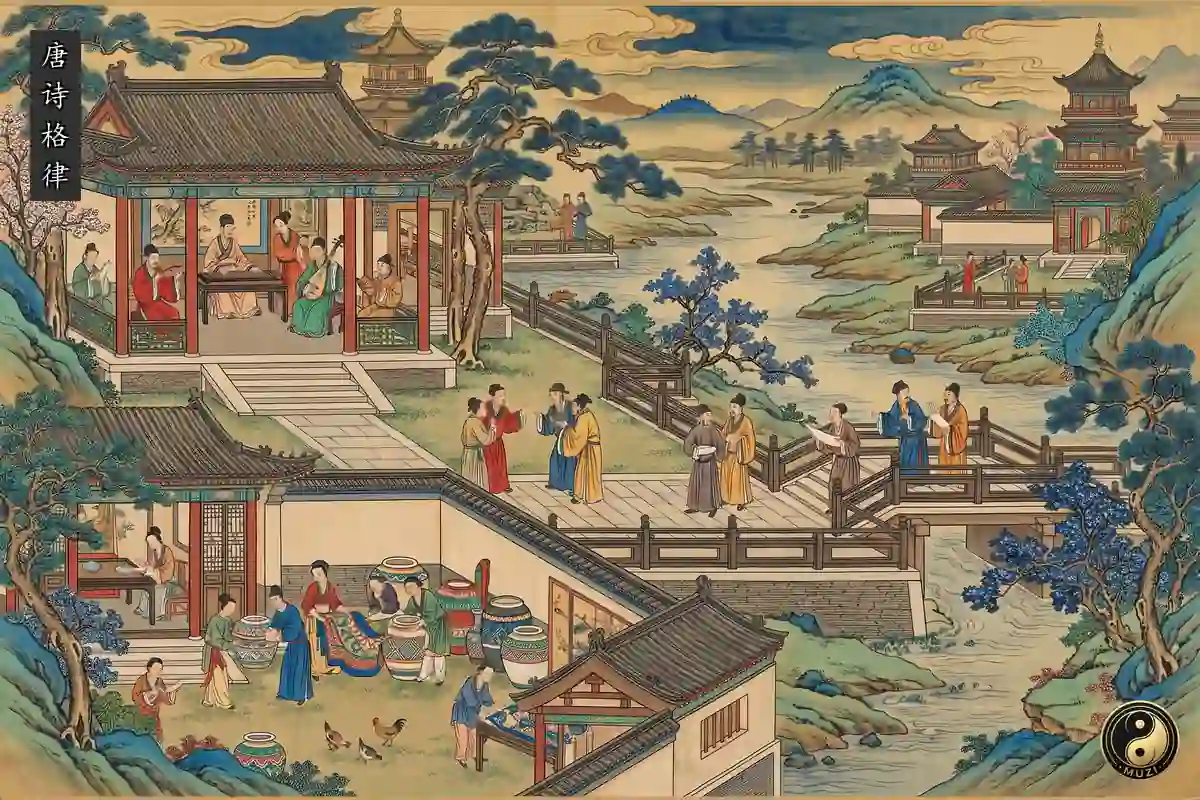
Tang Poetry Prosody (*Tangshi gelyu*) in the landscape of classical Chinese poetry is the first-generation guideline of the Huaxia tradition of regulated verse (*jintishi*) prosody, born of the historical pressures, from the Six Dynasties to the High Tang, of the theorization of the four-tones-and-eight-defects prosody, the civil-examination standard of regulated verse. The overflow of the High Tang empire's spiritual computational power, defined as the prosodic-acoustic norm of Chinese classical poetry in the six forms of five-character regulated verse, seven-character regulated verse, five-character extended regulated verse (*pailyu*), five-character quatrain (*jueju*), and seven-character quatrain, as formalized by Shen Quanqi and Song Zhiwen. A single continuous line must be traced to the end: from the Six Dynasties' Yongming style (Shen Yue. Zhou Yong, and Liu Xie) and the theorization of the four-tones-and-eight-defects prosody through Early Tang formal foundations (Shangguan Yi's 'six pairings' and Cui Rong's 'ten styles') through the definitive formalization of regulated verse by Shen Quanqi and Song Zhiwen during the Jinglong era (707--710) through the Four Outstanding Poets of the Early Tang through the Twin Peaks of the High Tang (Li Bai and Du Fu) through the High Tang landscape-pastoral school (Wang Wei and Meng Haoran) through the High Tang frontier school (Gao Shi. Cen Shen, and Wang Changling) through the Mid-Tang (Wei Yingwu, Han Yu. The Ten Talents of the Dali Era) to the Late Tang afterglow (Du Mu and Li Shangyin), tracing Tang Poetry Prosody as the prosodic-acoustic norm of regulated verse through every poet and text. The earliest textual anchor of this line is the Six Dynasties' Yongming style, with Shen Yue (441--513 CE) as the founder of Yongming-style prosodic theory. His four tones and eight defects theory (*si sheng ba bing shuo*, during the Yongming era of the Southern Qi, approximately 483--493 CE), China's first systematic theory of poetic prosody, classified the four tones (*ping*, *shang*, *qu*, *ru*) and specified eight tonal defects to be avoided (*pingtou*, *shangwei*, *fengyao*, *hexi*, *dayun*, *xiaoyun*, *pangniu*, and *zhengniu*), giving Shen Yue and the 'four tones and eight defects' theory in the Southern Qi their foundational position as the foundation of regulated-verse prosodic theory. The systematization of tonal classification was accomplished by Zhou Yong, a contemporary of Shen Yue, whose *Sisheng Qieyun* (approximately 483--493 CE) gave Zhou Yong and the *Sisheng Qieyun* in the Southern Qi their foundational position as the standard for prosodic classification. The integration of prosodic theory into systematic literary theory was accomplished by Liu Xie of the Southern Liang (approximately 465--522 CE), whose *Wenxin Diaolong* (approximately 501--502 CE, 50 chapters in 10 scrolls) contained a dedicated *Shenglyu* (Prosody) chapter, the first dedicated discussion of poetic prosody within a systematic literary-theory work in China, giving Liu Xie and the *Wenxin Diaolong, Shenglyu* chapter their foundational position as the literary-theoretical integration of prosodic theory. The formal foundations of Early Tang regulated verse were laid by Shangguan Yi (608--664 CE) and his six pairings (*liu dui*) or eight pairings theory (proposed during Emperor Gaozong's Yifeng era, approximately 676--679 CE, while Shangguan Yi served as a direct academician of the Hongwen Academy, specifying six methods of antithesis: *zhengming dui*, *tongshi dui*, *yilei dui*, *shuangsheng dui*, *dieyun dui*, and *shuangni dui*), giving Shangguan Yi and the 'six pairings' in Emperor Gaozong's reign their foundational position as the formal foundation of Early Tang regulated verse. The further refinement of Early Tang regulated-verse theory was accomplished by Yuan Jing and Cui Rong (?--690 CE), whose *Tang Chao Xinding Shige* (New Poetic Standards of the Tang Court, during the Empress Wu to Emperor Zhongzong transition, approximately 690 CE) specified the ten styles (*shi ti*: *xingsi*, *zhiqi*, *qingli*, *zhizhi*, *diaozao*, *yingdai*, *feidong*, *wanzhuan*, *qingqie*, and *feichen*) as the refinement of tonal-defect theory for regulated verse, giving Cui Rong and the 'ten styles' of the *Tang Chao Xinding Shige* their foundational position as the refinement of regulated-verse tonal-defect theory. The definitive formalization of regulated verse was accomplished by Shen Quanqi (approximately 650--714 CE) and Song Zhiwen (approximately 656--664 CE) of the late Early Tang, Emperor Zhongzong's reign. During the Jinglong era (707--710 CE), their principle of avoiding tonal defects and standardizing lines and stanzas (*hui ji shengbing, yue ju zhun pian*, from Tang-dynasty theoretical assessments of Shen and Song) definitively formalized the five-character regulated verse, seven-character regulated verse, and five-character extended regulated verse forms, giving Shen Quanqi, Song Zhiwen, and the Jinglong-era definitive formalization of regulated verse their foundational position as the definitive formalization of regulated-verse prosody. The other facet of Early Tang regulated poetry, seven-character songs (*gexing*) and short regulated verse (*duan lyu*), was advanced by the Four Outstanding Poets of the Early Tang: Wang Bo (650--676 CE) with the five-character regulated verse *Song Du Shaofu zhi Ren Shuzhou* and the seven-character song-form *Tengwang Ge Xu*. Yang Jiong (650--694 CE) with the five-character *Congjun Xing* and short regulated verse, Lu Zhaolin (634--684 CE) with the seven-character song-form *Chang'an Guyi*, and Luo Binwang (640--684 CE) with the five-character regulated verse *Zai Yu Yong Chan* and the parallel prose *Tao Wu Zhao Xi*, giving the Four Outstanding Poets of the Early Tang their foundational position as the transitional forms of seven-character song and short regulated verse on the eve of full regulated verse. The High Tang landscape-pastoral school was brought to its highest expression by Wang Wei (701--761 CE) and Meng Haoran (689--740 CE): Wang Wei's five-character regulated verse and quatrains (*Shanju Qiuming*, *Luchai*, *Zhuli Guan*, and *Song Yuan'er Shi Anxi*) and seven-character regulated verse (*Jiyu Wangchuan Zhuang Zuo*), and Meng Haoran's five-character regulated verse and quatrains (*Guo Guren Zhuang*, *Chunxiao*, and *Su Jiande Jiang*), giving Wang Wei and Meng Haoran in the High Tang their foundational position as the highest expression of landscape-pastoral regulated verse. The High Tang frontier school was brought to its highest expression by Gao Shi (704--765 CE), Cen Shen (approximately 715--770 CE), and Wang Changling (approximately 698--756 CE): Gao Shi's seven-character song-form *Yan Ge Xing* and seven-character quatrain *Bie Dong Da*; Cen Shen's seven-character song-form *Baixue Ge Song Wu Panguan Gui Jing* and *Zouma Chuan Xing Feng Song Chushi Xi Zheng*. And Wang Changling, the sage of the seven-character quatrain (*qijue shenghou*), with his four *Chusai* poems and seven *Congjun Xing* poems, giving Gao Shi, Cen Shen, and Wang Changling in the High Tang their foundational position as the highest expression of frontier regulated verse. The Twin Peaks of High Tang regulated verse were Li Bai (701--762 CE) and Du Fu (712--770 CE): Li Bai, the Immortal of Poetry (*shixian*), with his seven-character quatrains (*Wang Lushan Pubu*, *Zao Fa Baidicheng*, and *Huanghelou Song Meng Haoran zhi Guangling*) and seven-character songs (*Shudao Nan* and *Jiang Jin Jiu*); Du Fu, the Sage of Poetry (*shisheng*) and sage of regulated verse, with his five-character regulated verse (*Chunwang* and *Yueye*), seven-character regulated verse (*Denggao* and *Qiuxing Ba Shou*), five-character extended regulated verse (hundreds of rhymes, thousands of characters), and approximately 1,450 poems. giving Li Bai and Du Fu in the High Tang their foundational position as the Twin Peaks of regulated verse and the coexistence of the Immortal and the Sage of Poetry. The Mid-Tang ascent of regulated verse was accomplished by the Ten Talents of the Dali Era (ten poets active during the Dali years: Lu Lun, Ji Zhongfu, Han Hong, Qian Qi, Sikong Shu, Miao Fa, Cui Dong, Geng Wei, Xiahou Shen, and Li Duan), Wei Yingwu (737--792 CE), and Han Yu (768--824 CE): the Dali Ten Talents' five-character regulated verse (Qian Qi's *Shengshi Xiangling Guse* and Han Hong's *Hanshi*), Wei Yingwu's five-character regulated verse (*Chuzhou Xijian*), and Han Yu's composing poetry as prose (*yi wen wei shi*) regulated verse (*Zuo Qian zhi Languan Shi Zhisun Xiang*, a seven-character regulated verse), giving the Dali Ten Talents, Wei Yingwu, and Han Yu in the Mid-Tang their foundational position as the Mid-Tang ascent of regulated verse. The Late Tang afterglow of regulated verse was realized by Du Mu (803--852 CE) and Li Shangyin (approximately 813--858 CE): Du Mu's seven-character quatrains (*Bo Qinhuai*, *Chibi*, *Shanxing*, and *Qingming*) and Li Shangyin's seven-character regulated verse and quatrains (*Wuti*, *Jinse*, and *Yeyu Ji Bei*), the ancestor of obscurantist poetry (*menglong shi zu*), giving Du Mu and Li Shangyin in the Late Tang their foundational position as the Late Tang afterglow of regulated verse. The theorization of Tang poetry prosody was accomplished by Wang Changling (approximately 698--756 CE), whose *Shige* (Standards of Poetry, approximately 750 CE), the first systematic treatise on regulated-verse prosody in China, used the framework of three realms of poetry (*shi you san jing*: the realm of objects (*wujing*), the realm of emotions (*qingjing*). The realm of ideas (*yijing*)) and two methods of poetry (*shi you er ge*: the method of word usage (*yongzi ge*) and the method of idea usage (*yongyi ge*)), giving Wang Changling and the *Shige* in the Mid-Tang their foundational position as the theorization of regulated-verse poetics. The systematic summation of Tang poetry prosody was accomplished by the Japanese monk Henjo Kongo / Kukai (774--835 CE), whose *Bunkyo Hifuron* (The Mirror of Letters, Secret Treasury; assembled in Japan, approximately 819 CE, Konin 6th year, 6 scrolls), the Japanese systematic summation of Chinese Tang poetry prosody, used a tripartite heaven-earth-human (*sancai*) classification (the Heaven volume on tonal prosody, the Earth volume on 17 types of poetic defects. The Human volume on 14 types of stylistic modes), giving Henjo Kongo/Kukai and the *Bunkyo Hifuron* in Japan's Heian period their foundational position as the Japanese systematization of Tang poetry prosody. The definitive anthology of High Tang poetry was assembled by Yin Fan (active approximately 750 CE), whose *Heyue Yingling Ji* (Collection of Outstanding Talents between River and Mountain, assembled in the 12th year of Tianbao, 753 CE, 2 scrolls selecting 234 poems by 24 High Tang poets), giving Yin Fan and the *Heyue Yingling Ji* in the late Tianbao era their foundational position as the definitive anthology of High Tang poetry. ,、()、,,:、、,,。,,。