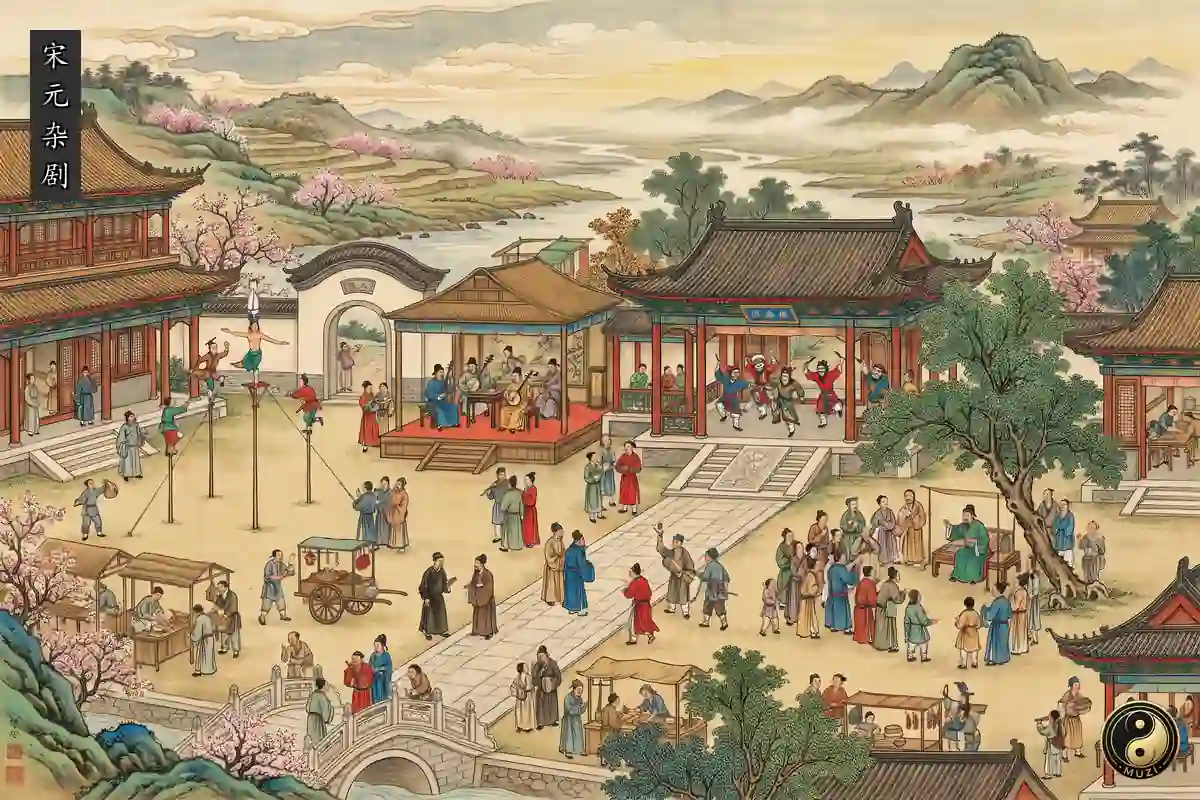
Song-Yuan Za-ju (Song-Yuan Variety Theater: the fully-mature stage-narrative art, the 4-gong-5-fa and 4-zhe-1-xie-zi multi-act-narrative and sheng-dan-jing-mo-chou role-typology complex) is, in the map of the Chinese classical stage-narrative-art tradition, the first-generation source-rule of the four-gong-five-fa-module-containment and object-oriented-narrative-engine tradition that. under the historical pressure of can-jun-xi rudiment and za-ju name-origin and Wenzhou Yongjia Southern-Xi and Jin-dynasty Yuan-ben and Yuan-dynasty Four-Masters peak and four-zhe-one-xie-zi structuring and chang-nian-zuo-da modularization and sheng-dan-jing-mo-chou role-typology from Tang-dynasty to Qing-dynasty (8th century to 19th century CE). defined as the Zhang-xie-zhuang-yuan as the first-complete Yongjia Za-ju and Guan Han-qing and Bai Pu and Ma Zhi-yuan and Zheng Guang-zu as the Yuan-Qu Four-Masters and Dou-e-yuan and Xi-xiang-ji as the canonical scripts and four-zhe-one-xie-zi and chang-nian-zuo-da and sheng-dan-jing-mo-chou as the standard-script rule-library the most-fundamental civilizational answer that, in the Chinese classical long-form stage-narrative-art system. the Song-Yuan Za-ju is the four-gong-five-fa-module-containment and object-oriented-narrative-engine that hard-rules script and performance as the four-zhe-one-xie-zi multi-act-structure and chang-nian-zuo-da 4-gong module and shou-yan-shen-fa-bu 5-fa module and sheng-dan-jing-mo-chou 5-class role-type module and Yuan-Qu Four-Masters 150 and playwrights 500 and works mechanism. To trace a single coherent lineage down to its source, you have to start from the Tang can-jun-xi (c. 8-9c) za-ju rudiment to the Tang Duan An-jie Yue-fu Za-lu (c. 9c) za-ju name mention to the Northern-Song Bian-jing Za-ju performance (c. 11c, per Meng Yuan-lao Dong-jing Meng-hua-lu Chong-guan since, in-the-capital Tile-House arts... emphasized Za-ju) to the Northern-Song Za-ju and Southern-Xi rudiment (c. 12c, per Zhou Mi Wu-lin Jiu-shi Southern-Xi mention) to the Southern-Song Wenzhou Yongjia Za-ju (per Ye Zi-qi Cao-mu-zi Southern-Xi out-of Xuan-he after, Southern-crossing moment, called 'Wenzhou Za-ju'. Yongjia people composed Zhao-zheng-nu and Wang-kui first-big-spread in Zhejiang-region) THE canonical founding to the Southern-Song Zhang-xie-zhuang-yuan (c. 12-13c, the first surviving Yongjia Za-ju, per Qian Ceng Ye-shi-yuan Shu-mu and Yong-le Da-dian juan 13991 inclusion) to the Jin-dynasty Yuan-ben rudiment (c. 12-13c, the Jin-dynasty Za-ju rudiment, per Yuan Tao Zong-yi Nan-cun Chuo-geng-lu Jin had Yuan-ben, Za-ju actually-began-this) to the Yuan-dynasty Yuan Za-ju peak (Yuan-Qu Four-Masters and 150 and playwrights and 500 and works) to the Yuan Guan Han-qing Dou-e-yuan and Dan-dao-hui and Jiu-feng-chen and Wang-jiang-ting (c. 1250-1290) the 4 most-cited Yuan-Za-ju to the Yuan Wang Shi-fu Xi-xiang-ji (c. 1290-1310) 5-ben 21-zhe the first 5-ben long-form Yuan-Za-ju to the late-Yuan Zhong Si-cheng Lu-gui-bu (1330 CE) 150 and playwright biographies to the late-Yuan Xia Ting-zhi Qing-lou-ji (c. 1360 CE) 120 and performer biographies to the early-Ming Zhu Quan Tai-he-zheng-yin-pu (1398 CE) 585 qu-pai and 12-ke Za-ju classification to the Ming Zhu You-dun (1379-1439) 31 Za-ju to the Ming Wang Ji-de Qu-lu (c. 1620 CE) Za-ju-system-treatise to the Qing Jiao Xun Ju-shuo (c. 1810 CE) Za-ju-textology. To trace Song-Yuan Za-ju as the four-gong-five-fa-module-containment and object-oriented-narrative-engine you have to do the most-complete back-trace author-by-author book-by-book. The earliest textual anchor is the Tang can-jun-xi: with the Tang can-jun-xi (c. 8-9c) Za-ju rudiment as the marker , so that can-jun-xi in the Tang first acquires the fundamental position of the Za-ju rudiment. The late-Tang Za-ju name mention: the late-Tang Duan An-jie (9c) , with Yue-fu Za-lu Za-ju name mention (Xian-tong since, namely-had Fan's Female-Knight, Za-ju's beginning also) as the marker of the Za-ju written-ization , so that Duan An-jie and Yue-fu Za-lu in the late-Tang first acquires the fundamental position of the Za-ju written-ization. The Northern-Song Bian-jing Za-ju performance: the Northern-Song Bian-jing Tile-House and Bian-jing Za-ju (c. 11c, per Meng Yuan-lao Dong-jing Meng-hua-lu Chong-guan since, in-the-capital Tile-House arts... emphasized Za-ju) , so that Northern-Song Bian-jing Za-ju in the Northern-Song first acquires the fundamental position of the Bian-jing performance. The Northern-Song Za-ju and Southern-Xi rudiment: the Northern-Song Zhou Mi (1232-1298) , with Wu-lin Jiu-shi (1270s-1290s) Southern-Xi mention and early Wenzhou and Hang-zhou Za-ju rudiment as the marker of the Southern-rudiment , so that Zhou Mi and Wu-lin Jiu-shi in the late-Southern-Song first acquires the fundamental position of the Southern-rudiment. The Southern-Song Wenzhou Yongjia Za-ju THE canonical founding: the Southern-Song Ye Zi-qi (active early 14c) , with Cao-mu-zi (c. 1378 CE completed) Southern-Xi out-of Xuan-he after, Southern-crossing moment, called 'Wenzhou Za-ju'. Yongjia people composed Zhao-zheng-nu and Wang-kui first-big-spread in Zhejiang-region as the marker of Wenzhou Za-ju THE canonical founding , so that Ye Zi-qi and Cao-mu-zi in the late-Southern-Song first acquires the fundamental position of Wenzhou Za-ju THE canonical founding. The Southern-Song Zhang-xie-zhuang-yuan first-Yongjia-Za-ju: the Southern-Song Zhang-xie-zhuang-yuan author (anonymous, c. 12-13c, per Qian Ceng Ye-shi-yuan Shu-mu and Yong-le Da-dian juan 13991 inclusion, 53-chu and first Yongjia-Za-ju complete-script, the first surviving Yongjia-Za-ju and the first-known Chinese-dramatic-script to-reach-the-modern-age) , so that Zhang-xie-zhuang-yuan in the late-Southern-Song first acquires the fundamental position of the first-Yongjia-Za-ju. The Jin-dynasty Yuan-ben rudiment: the Jin-dynasty anonymous (c. 12-13c) , with Jin-dynasty Yuan-ben (the Za-ju rudiment, per Yuan Tao Zong-yi Nan-cun Chuo-geng-lu Jin had Yuan-ben, Za-ju actually-began-this) and 5-roles and brief-plot and comedic-dialogue and hundreds-of-Yuan-ben titles preserved as the marker of the Jin-dynasty Za-ju rudiment , so that Jin-dynasty Yuan-ben in the Jin-dynasty first acquires the fundamental position of the Jin-dynasty Za-ju rudiment. The Yuan-dynasty Yuan Za-ju peak THE canonical peak: the Yuan-dynasty Yuan-Qu Four-Masters (c. late-13c-early-14c) , with Guan Han-qing (c. 1220-1300, Qu-sheng) and Bai Pu (1226-1306) and Ma Zhi-yuan (1250-1321, Qu-zhuangyuan) and Zheng Guang-zu (?-1330) , containing 18-surviving Guan Han-qing Za-ju and 15-surviving Bai Pu Za-ju and 7-surviving Ma Zhi-yuan Za-ju and 6-surviving Zheng Guang-zu Za-ju (the Yuan-dynasty Za-ju peak and 50 and surviving Yuan-Za-ju and 500 and lost Yuan-Za-ju) as the marker of THE canonical peak , so that Guan Han-qing and Bai Pu and Ma Zhi-yuan and Zheng Guang-zu in the Yuan-dynasty first acquires the fundamental position of THE canonical peak. The Yuan-dynasty Guan Han-qing Za-ju canonical-scripts: the Yuan-dynasty Guan Han-qing (c. 1220-1300) , with Dou-e-yuan and Dan-dao-hui and Jiu-feng-chen and Wang-jiang-ting (c. 1250-1290, 4-zhe standard Yuan-Za-ju 4-scripts, the most-cited Yuan-Za-ju 4-scripts) as the marker of the canonical-scripts , so that Guan Han-qing in the Yuan-dynasty first acquires the fundamental position of the canonical-scripts. The Yuan-dynasty Wang Shi-fu Xi-xiang-ji first-long-form-Za-ju: the Yuan-dynasty Wang Shi-fu (c. 1260-1336) , with Xi-xiang-ji (c. 1290-1310 completed, 5-ben 21-zhe, the first Yuan-Za-ju 5-ben long-form and the longest-surviving Yuan-Za-ju and the most-cited Yuan-Za-ju) as the marker of the first-long-form-Za-ju , so that Wang Shi-fu and Xi-xiang-ji in the Yuan-dynasty first acquires the fundamental position of the first-long-form-Za-ju. The late-Yuan Yuan-Qu playwright-biography Yuan-dynasty Yuan-Qu-history: the late-Yuan Zhong Si-cheng (c. 1275-1345) , with Lu-gui-bu (completed Zhi-shun first year 1330 CE, 2 juan, recorded 150 and Yuan-dynasty playwright biographies and 500 and works catalog) as the marker of the Yuan-dynasty Yuan-Qu-history , so that Zhong Si-cheng and Lu-gui-bu in the late-Yuan first acquires the fundamental position of the Yuan-dynasty Yuan-Qu-history. The late-Yuan performer-biography performer-history: the late-Yuan Xia Ting-zhi (?-?) , with Qing-lou-ji (completed Zhi-zheng period c. 1360 CE, 1 juan, recorded 120 and Yuan-dynasty za-ju performers and Qing-lou and Za-ju performance history) as the marker of the performer-history , so that Xia Ting-zhi and Qing-lou-ji in the late-Yuan first acquires the fundamental position of the performer-history. The Yuan-Ming Za-ju classification 12-ke classification: the early-Ming Zhu Quan (1378-1448) , with Tai-he-zheng-yin-pu (completed Hong-wu thirty-first year 1398 CE, 2 juan, recorded 585 qu-pai and 12-ke Za-ju classification and 200 and Yuan-dynasty and early-Ming Za-ju playwright reviews) as the marker of the 12-ke classification , so that Zhu Quan and Tai-he-zheng-yin-pu in the early-Ming first acquires the fundamental position of the 12-ke classification. The Ming-dynasty Za-ju Ming-echo: the Ming-dynasty Zhu You-dun (1379-1439) , with 31 Za-ju (c. 15c, the first complete 31 Ming-dynasty Za-ju and containing Feng-yue-mu-dan-xian and Xiang-nang-yuan and Ji-mu-da-xian and Bao-zi-he-shang and Mu-dan-yuan and Yan-hua-meng and Shi-mei-ren-qing-shang-mu-dan-yuan etc.) as the marker of the Ming-echo , so that Zhu You-dun in the Ming Yong-le Xuan-de first acquires the fundamental position of the Ming-echo. The Ming-dynasty Za-ju-system-treatise system-integration: the Ming-dynasty Wang Ji-de (c. 1560-1623) , with Qu-lu (completed c. 1620 CE, 4 juan, containing Za-ju system-treatise and Southern-Xi system-treatise and 40-chapter qu-xue discussion) as the marker of the system-integration , so that Wang Ji-de and Qu-lu in the Ming Wan-li first acquires the fundamental position of the system-integration. The Qing-dynasty Za-ju-textology Qing-textology-conclusion: the Qing-dynasty Jiao Xun (1763-1820) , with Ju-shuo (completed c. 1810 CE, 6 juan, containing Za-ju and dramatic-form data-textology 600 and entries) as the marker of the Qing-textology , so that Jiao Xun and Ju-shuo in the Qing Jia-qing first acquires the fundamental position of the Qing-textology. 《》,《》,《》、《》,《》、《》,:、,、、、。,《》,。