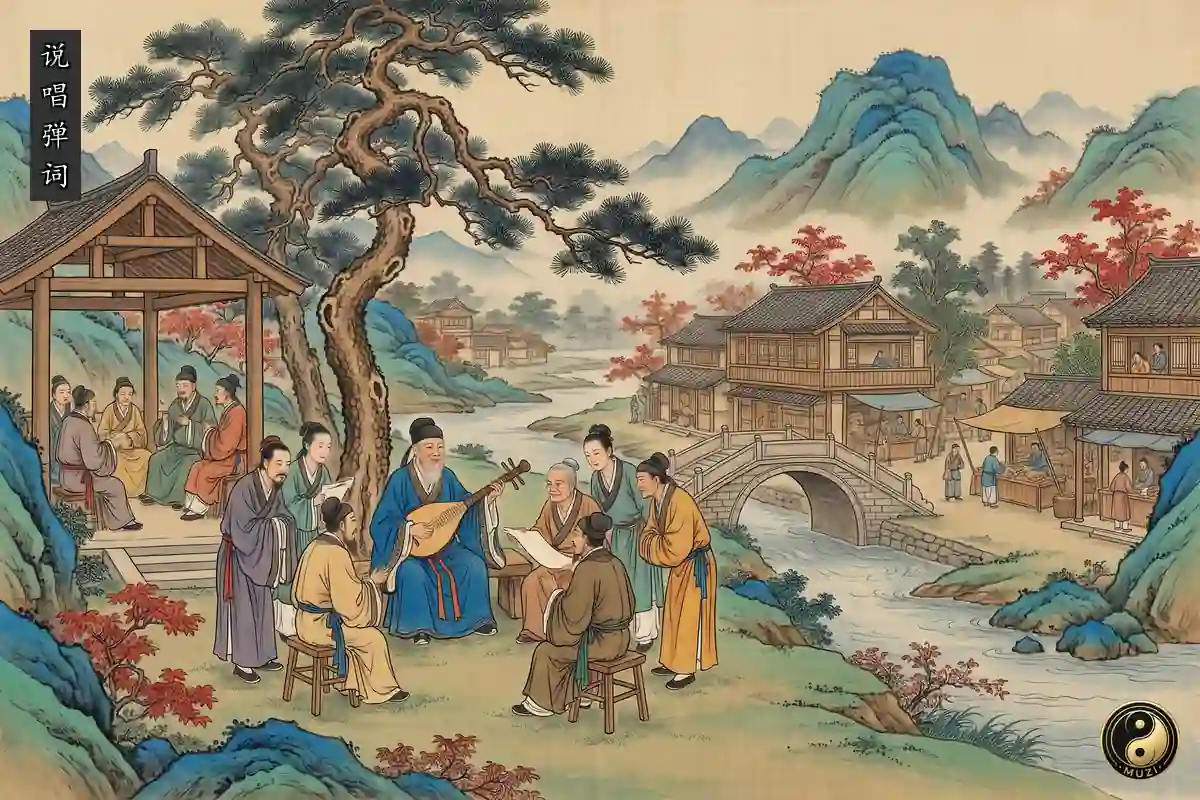
Shuo-chang Tan-ci (Storytelling-Singing Balled: the auditory-literature commoner-rooted-narrative-art with one-table and one-chair and one-xing-mu and one-pipa) is, in the map of the Chinese classical commoner-auditory-literature tradition, the first-generation source-rule of the single-point-minimalist-facilities-dependent-high-information-density-acoustic-rendering tradition that. under the historical pressure of You-ling shuo-chang origin and Xun-zi Cheng-xiang verse-narrative and Sima-qian Ji-ji Zhuan and Tang Bian-wen Su-jiang and Song-yuan shuo-hua 4-jia and Yuan-ping-hua and Ming Tan-ci and Qing Su-zhou-Yang-zhou 4-pai peak from Spring-and-Autumn-Warring-States to Qing-dynasty (5th century BCE to 19th century CE). defined as the Er-shi-yi-shi Tan-ci (Yang-shen) as the Tan-ci grand-systematization and Yu-qing-ting and Zhen-zhu-ta and San-xiao-yin-yuan and Bai-she-zhuan and Wo-pao-zhuan and Miao-jin-feng as the Su-zhou Tan-ci 6-canonicals and Chen Yu-gan and Yao Shi-zhang and Ma Ru-fei and Yu Xiu-lian as the Su-zhou Tan-ci 4-masters the most-fundamental civilizational answer that, in the Chinese classical commoner-auditory-literature system. the Shuo-chang Tan-ci is the single-point-minimalist-facilities-dependent-high-information-density-acoustic-rendering that hard-rules one-table and one-chair and one-xing-mu / one-pipa as the single-point edge-compute terminal and dialect voice-pack and sound-mimicry and speech-rate micro-operation and kou-zi / guan-zi suspense and 6-canonicals and 4-masters and 4-pai mechanism. To trace a single coherent lineage down to its source, you have to start from the Spring-and-Autumn-Warring-States You-ling shuo-chang rudiment (c. 5-3c BCE, per Guo-yu You-shi and Shi-ji Ji-ji Zhuan You-meng yi-guan story) to the Warring-States Xun-zi Cheng-xiang chapter (c. 4-3c BCE, the earliest shuo-chang verse) to the Western-Han Sima-qian Shi-ji Ji-ji Zhuan (c. 109 BCE, the earliest 3-illustrations: Qi Chun-yu-kun and Chu You-meng and Qin Zhu-ru You-zhan) to the Tang Bian-wen Su-jiang (c. 7-10c, per Dun-huang Bian-wen-ji 1900 Dun-huang Sutra-cave unearthed Tang Bian-wen 8 and kinds) to the late-Tang Duan Cheng-shi You-yang Za-zu (c. 9c) shi-ren xiao-shuo mention and the Tang 3-canonicals Bian-wen (Wu-zi-xu Bian-wen and Meng-jiang-nu Bian-wen and Wang-zhao-jun Bian-wen, c. 8-9c) to the Northern-Song Bian-jing shuo-hua 4-jia (c. 11-12c, per Meng Yuan-lao Dong-jing Meng-hua-lu Chong-guan since, in-the-capital Tile-House arts, emphasized xiao-shuo jiang-shi tan-jing he-sheng 4-jia) THE canonical shuo-hua 4-jia to the Southern-Song Hang-zhou shuo-hua 4-jia and Tan-ci rudiment (c. 12-13c, per Zhou Mi Wu-lin Jiu-shi) to the Yuan-dynasty San-guo-zhi Ping-hua and Da-tang-san-zang-qu-jing Shi-hua and Tan-ci (c. early 14c) to the Ming-dynasty Tan-ci and ci-hua form (c. 15-16c) to the Ming Yang-shen (1488-1559) Er-shi-yi-shi Tan-ci (c. 1530 CE, THE Tan-ci grand-systematization) THE Tan-ci grand-systematization to the Ming Jia-jing Su-zhou Tan-ci (the first Su-pai Tan-ci) to the Qing-dynasty Tan-ci 4-pai peak (Su-zhou and Yang-zhou and Hang-zhou and Shao-xing 4-pai) to the Qing Jia-qing and Dao-guang Su-zhou Tan-ci 6-canonicals (Yu-qing-ting and Zhen-zhu-ta and San-xiao-yin-yuan and Bai-she-zhuan and Wo-pao-zhuan and Miao-jin-feng) to the Qing Jia-qing and Dao-guang Su-zhou Tan-ci 4-masters (Chen Yu-gan and Yao Shi-zhang and Ma Ru-fei and Yu Xiu-lian) to the Qing Dao-guang and Xian-feng Su-zhou Tan-ci 3-masters (Lu Rui-ting and Zhao Xiang-zhou and Wang Shi-quan) to the late-Qing Su-zhou Tan-ci 2-masters (Wang Xiao-song and Xia Yin-bo). To trace Shuo-chang Tan-ci as the single-point-minimalist-facilities-dependent-high-information-density-acoustic-rendering you have to do the most-complete back-trace author-by-author book-by-book. The earliest textual anchor is the Spring-and-Autumn-Warring-States You-ling shuo-chang: with the Guo-yu You-shi story (c. 5-4c BCE) and the Shi-ji Ji-ji Zhuan You-meng yi-guan story (Chu Zhuang-wang era, You-meng imitated Sun-shu-ao yi-guan, remonstrated Chu Zhuang-wang) as the marker of the You-ling shuo-chang origin , so that You-ling shuo-chang in the Spring-and-Autumn-Warring-States first acquires the fundamental position of the You-ling shuo-chang origin. The Warring-States Cheng-xiang verse-narrative rudiment: the Warring-States Xun-zi (c. 313-238 BCE) , with the Xun-zi Cheng-xiang chapter Cheng-xiang, qing-bu-ji. Shi-zhi-yang, yu-an yu-an duo-xian-shi. Ren-zhu-wu-xian, ru-gu-wu-xiang-he-chang-chang as the marker of the verse-narrative shuo-chang rudiment , so that Xun-zi and Cheng-xiang in the late-Warring-States first acquires the fundamental position of the verse-narrative shuo-chang rudiment. The Western-Han Ji-ji Zhuan Ji-ji-history: the Western-Han Sima-qian (145-86 BCE) , with Shi-ji Ji-ji Zhuan (c. 109 BCE, containing 3-illustrations: Qi Chun-yu-kun and Chu You-meng and Qin Zhu-ru You-zhan) as the marker of the Ji-ji-history , so that Sima-qian and Ji-ji Zhuan in the mid-Western-Han first acquires the fundamental position of the Ji-ji-history. The Tang Bian-wen Su-jiang Bian-wen origin: the Tang-dynasty anonymous monastery monks and commoner artists (c. 7-10c, per Dun-huang Bian-wen-ji 1900 Dun-huang Sutra-cave unearthed Tang Bian-wen 8 and kinds, including Jiang-mo-bian-wen and Mu-lian-bian-wen and Wei-mo-jie-jing-bian-wen etc.) as the marker of the Bian-wen origin , so that Tang-dynasty Bian-wen Su-jiang in the Tang first acquires the fundamental position of the Bian-wen origin. The Tang Bian-wen 3-canonicals: the Tang-dynasty anonymous (c. 8-9c) , with Wu-zi-xu Bian-wen (c. 8c, Wu-zi-xu story) and Meng-jiang-nu Bian-wen (c. 8-9c, Meng-jiang-nu story) and Wang-zhao-jun Bian-wen (c. 8-9c, Wang-zhao-jun story) as the marker of the Bian-wen 3-canonicals , so that Tang-dynasty Bian-wen 3-canonicals in the Tang first acquires the fundamental position of the Bian-wen 3-canonicals. The late-Tang Duan Cheng-shi xiao-shuo commoner-xiao-shuo rudiment: the late-Tang Duan Cheng-shi (?-863) , with You-yang Za-zu shi-ren xiao-shuo mention as the marker of the commoner-xiao-shuo rudiment , so that Duan Cheng-shi and You-yang Za-zu in the late-Tang first acquires the fundamental position of the commoner-xiao-shuo rudiment. The Northern-Song shuo-hua 4-jia THE canonical shuo-hua 4-jia: the Northern-Song Bian-jing (c. 11-12c, per Meng Yuan-lao Dong-jing Meng-hua-lu Chong-guan since, in-the-capital Tile-House arts, emphasized xiao-shuo jiang-shi tan-jing he-sheng 4-jia) as the marker of THE canonical shuo-hua 4-jia , so that Northern-Song Bian-jing shuo-hua 4-jia in the Northern-Song first acquires the fundamental position of THE canonical shuo-hua 4-jia. The Southern-Song Hang-zhou shuo-hua 4-jia Southern-continuation: the Southern-Song Zhou Mi (1232-1298) , with Wu-lin Jiu-shi (1270s-1290s) xiao-shuo jiang-shi tan-jing he-sheng 4-jia and Tan-ci rudiment mention as the marker of the Southern-continuation , so that Zhou Mi and Wu-lin Jiu-shi in the late-Southern-Song first acquires the fundamental position of the Southern-continuation. The Yuan-dynasty Ping-hua and Tan-ci rudiment Yuan-rudiment: the Yuan-dynasty anonymous (c. early 14c) , with San-guo-zhi Ping-hua and Da-tang-san-zang-qu-jing Shi-hua and Tan-ci (the Yuan-dynasty Tan-ci rudiment, oral-transmission and manuscript-transmission dual-track) as the marker of the Yuan-rudiment , so that Yuan-dynasty Ping-hua and Tan-ci rudiment in the Yuan-dynasty first acquires the fundamental position of the Yuan-rudiment. The Ming-dynasty Tan-ci Ming-Tan-ci-form: the Ming-dynasty (c. 15-16c) , with the Ming Tan-ci and ci-hua form (the Tan-ci and ci-hua rudiment, containing Su-zhou and Hang-zhou and Nanjing and Beijing various-region Tan-ci and ci-hua performance) as the marker of the Ming-Tan-ci-form , so that Ming-dynasty Tan-ci and ci-hua form in the Ming first acquires the fundamental position of the Ming-Tan-ci-form. The Ming Yang-shen Er-shi-yi-shi Tan-ci THE Tan-ci grand-systematization: the Ming-dynasty Yang-shen (1488-1559) , with Er-shi-yi-shi Tan-ci (c. 1530 CE completed, 2-3 wan-character, 3 juan, containing 21-shi verse-summary and singing-words and san-yan er-yan qi-yan form) as the marker of THE Tan-ci grand-systematization , so that Yang-shen and Er-shi-yi-shi Tan-ci in the Ming Jia-jing first acquires the fundamental position of THE Tan-ci grand-systematization. The Qing-dynasty Tan-ci 4-pai peak: the Qing-dynasty (c. 17-19c) , with Su-zhou pai (Qing-early to Qing-late, main-city Su-zhou, containing 4-masters Chen Yu-gan and Yao Shi-zhang and Ma Ru-fei and Yu Xiu-lian) and Yang-zhou pai (Qing-mid, main-city Yang-zhou, containing Zhang Jing-xuan etc.) and Hang-zhou pai (Qing-mid, main-city Hang-zhou, containing Wang Chun-zhou etc.) and Shao-xing pai (Qing-mid, main-city Shao-xing, containing Wang Zheng etc.) as the marker of the Qing Tan-ci 4-pai peak , so that Qing-dynasty Tan-ci 4-pai in the Qing first acquires the fundamental position of the Qing Tan-ci 4-pai peak. The Qing Jia-qing and Dao-guang Su-zhou Tan-ci 6-canonicals: the Qing-dynasty anonymous (c. 18-19c) , with Yu-qing-ting (containing 2-key-parts 60 and hui) and Zhen-zhu-ta (containing 30 and hui) and San-xiao-yin-yuan (containing 30 and hui) and Bai-she-zhuan (containing 30 and hui) and Wo-pao-zhuan (containing 30 and hui) and Miao-jin-feng (containing 30 and hui) as the marker of the 6-canonicals , so that Qing Jia-qing and Dao-guang Su-zhou Tan-ci 6-canonicals in the mid-Qing first acquires the fundamental position of the 6-canonicals. The Qing Jia-qing and Dao-guang Su-zhou Tan-ci 4-masters: the Qing-dynasty Chen Yu-gan and Yao Shi-zhang and Ma Ru-fei and Yu Xiu-lian (c. 18-19c, the Jia-qing Dao-guang Su-zhou Tan-ci 4-masters) as the marker of the 4-masters , so that Qing Jia-qing and Dao-guang Su-zhou Tan-ci 4-masters in the mid-Qing first acquires the fundamental position of the 4-masters. The Qing Dao-guang and Xian-feng Su-zhou Tan-ci 3-masters mid-continuation: the Qing-dynasty Lu Rui-ting and Zhao Xiang-zhou and Wang Shi-quan (c. mid-19c, the Dao-guang Xian-feng Su-zhou Tan-ci 3-masters) as the marker of the mid-continuation , so that Qing Dao-guang and Xian-feng Su-zhou Tan-ci 3-masters in the mid-Qing first acquires the fundamental position of the mid-continuation. The late-Qing Su-zhou Tan-ci 2-masters late-Qing-conclusion: the late-Qing Wang Xiao-song and Xia Yin-bo (c. late 19c-early 20c, the late-Qing Su-zhou Tan-ci 2-masters) as the marker of the late-Qing-conclusion , so that late-Qing Su-zhou Tan-ci 2-masters in the late-Qing first acquires the fundamental position of the late-Qing-conclusion. 《》,《》、、,《》、,、、、,:、、,、、、。,,。