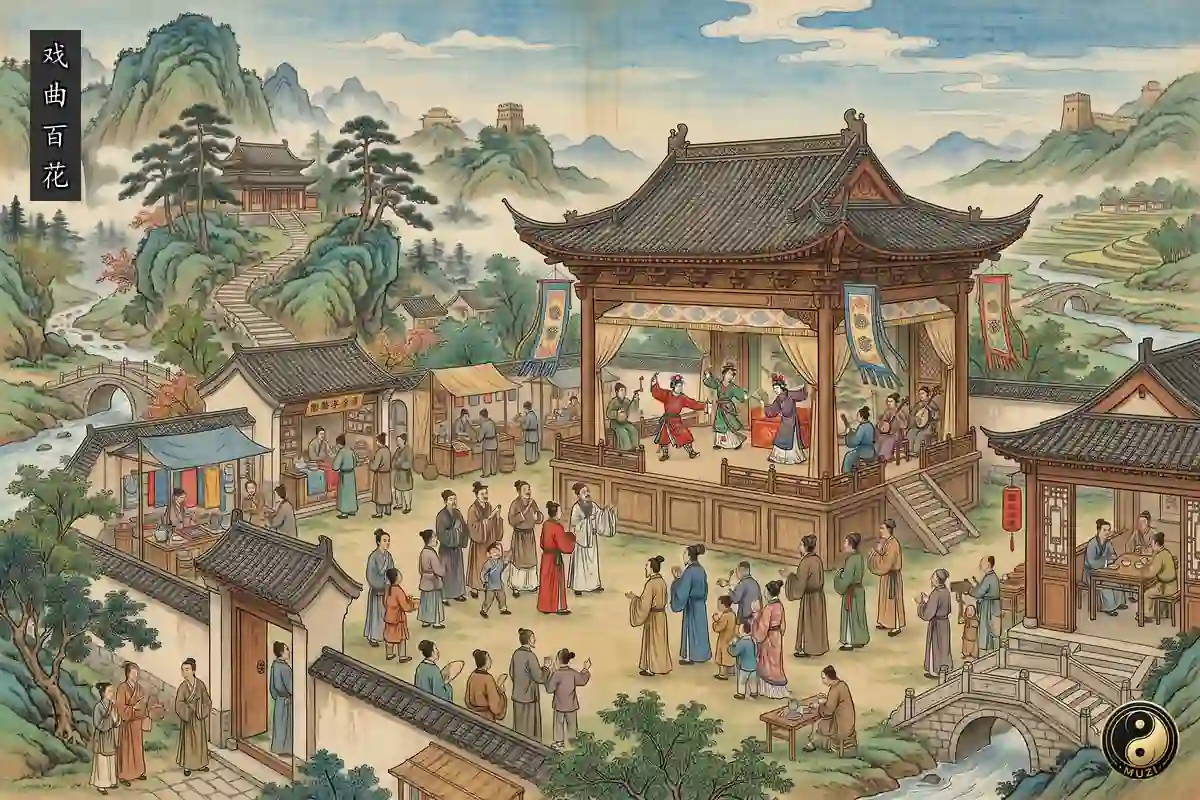




















Xi-qu Bai-hua (Regional Operas: the system-integration of Kun-qu and Jing-ju and Chuan-ju and Yue-ju and 300 and drama schools, the cheng-shi-hua and xu-ni-hua and xie-yi aesthetic Eastern-drama peak) is, in the map of the Chinese classical regional-opera-system tradition, the first-generation source-code of the reality-physical-formatting-compression and high-dimensional-virtual-interface-mapping tradition that, under the historical pressure of four-sheng-qiang rudiment and Kun-qu reform and Kun-qu script and Kun-qu performance-treatise and Qing chuan-qi double-peak and Jing-ju formation and cheng-shi-hua and xu-ni-hua and xie-yi aesthetic from late-Yuan to late-Qing (14th to 19th century CE), defined as the Wei Liang-fu reformed Kun-qu as Kun-qu canonical founding and Tang Xian-zu Lin-chuan Four-Dreams as Kun-qu peak and Hong Sheng Chang-sheng-dian and Kong Shang-ren Tao-hua-shan as Qing chuan-qi double-peak and Qian-long 1790 Four-Hui-Troupes entering-Beijing as Jing-ju canonical founding and Cheng Chang-geng and Yu San-sheng and Zhang Er-kui as the three-laosheng and Tan Xin-pei as Jing-ju grand-systematization and 300 and regional schools as the bai-hua the most-fundamental civilizational answer that, in the Chinese classical regional-opera-system, the Xi-qu Bai-hua is the reality-physical-formatting-compression and high-dimensional-virtual-interface-mapping that hard-codes drama and stage as the cheng-shi-hua code and xu-ni-hua code and xie-yi aesthetic mechanism. To trace a single coherent lineage down to its source, you have to start from the late-Yuan early-Ming four-sheng-qiang rudiment (per Gu Qi-yuan Ke-zuo Zhui-yu Wan-li era, Hai-yan-qiang and Yu-yao-qiang and Yi-yang-qiang and Kun-shan-qiang four-sheng-qiang parallel) to the early-Ming Zhu Quan Tai-he-zheng-yin-pu (1398) 12-ke za-ju classification to the Ming-Jia-jing Wei Liang-fu (1489-1566) reformed Kun-qu (shui-mo-diao and 8 qu-pai systems) THE canonical Kun-qu founding to the Ming-Jia-jing Liang Chen-yu (1519-1591) Huan-sha-ji THE Kun-qu-script first to the Ming-Wan-li Tang Xian-zu (1550-1616) Lin-chuan Four-Dreams THE Kun-qu peak to the late-Ming Pan Zhi-heng Gen-shi and Luan-xiao Xiao-pin Kun-qu performance-treatise to the late-Ming Shen Chong-sui Du-qu Xu-zhi Kun-qu pitch-treatise to the early-Qing Hong Sheng (1645-1704) Chang-sheng-dian and Kong Shang-ren (1648-1718) Tao-hua-shan Qing chuan-qi double-peak to the early-Qing Suzhou Kun-qu troupe and Qing Kang-xi court Kun-qu to the Qing Qian-long 1790 Four-Hui-Troupes entering-Beijing THE Jing-ju canonical founding to the Qing 4-emperor Jing-ju maturation to the Qing Cheng Chang-geng and Yu San-sheng and Zhang Er-kui THE three-laosheng to the Qing Tan Xin-pei THE Jing-ju grand-systematization to the Qing cheng-shi-hua and xu-ni-hua systems to the Qing-mid-late 300 and regional schools , to trace the Xi-qu Bai-hua as the reality-physical-formatting-compression and high-dimensional-virtual-interface-mapping back to its complete author-and-book roots.
The earliest textual anchor is the late-Yuan early-Ming four-sheng-qiang: with the late-Yuan early-Ming (per Gu Qi-yuan Ke-zuo Zhui-yu) four-sheng-qiang parallel as the marker of the four-sheng-qiang rudiment , so that four-sheng-qiang in the late-Yuan early-Ming first acquires the fundamental position of the four-sheng-qiang rudiment. The early-Ming za-ju classification: the early-Ming Zhu Quan (1378-1448) , with Tai-he-zheng-yin-pu (1398) 12-ke za-ju classification as the marker , so that Zhu Quan and Tai-he-zheng-yin-pu in the early-Ming first acquires the fundamental position of the early-Ming za-ju classification. The Ming-Jia-jing Wei Liang-fu Kun-qu reform THE canonical Kun-qu founding: the Ming-Jia-jing Wei Liang-fu (1489-1566) , with reformed Kun-qu (shui-mo-diao and 8 qu-pai systems) as the marker , so that Wei Liang-fu in the Ming-Jia-jing first acquires the fundamental position of THE canonical Kun-qu founding. The Ming-Jia-jing Liang Chen-yu Huan-sha-ji THE Kun-qu-script first: the Ming-Jia-jing Liang Chen-yu (1519-1591) , with Huan-sha-ji (the first Kun-qu script and 28 chu) as the marker , so that Liang Chen-yu and Huan-sha-ji in the Ming-Jia-jing first acquires the fundamental position of THE Kun-qu-script first.
The Ming-Wan-li Tang Xian-zu Lin-chuan Four-Dreams THE Kun-qu peak: the Ming-Wan-li Tang Xian-zu (1550-1616) , with Lin-chuan Four-Dreams (Lin-chuan-pai founding) as the marker , so that Tang Xian-zu and Lin-chuan Four-Dreams in the Ming-Wan-li first acquires the fundamental position of THE Kun-qu peak. The late-Ming Pan Zhi-heng Kun-qu performance-treatise: the late-Ming Pan Zhi-heng , with Gen-shi and Luan-xiao Xiao-pin as the marker , so that Pan Zhi-heng in the late-Ming first acquires the fundamental position of the Kun-qu performance-treatise. The late-Ming Shen Chong-sui Kun-qu pitch-treatise: the late-Ming Shen Chong-sui , with Du-qu Xu-zhi (c. 1630s) as the marker , so that Shen Chong-sui and Du-qu Xu-zhi in the late-Ming first acquires the fundamental position of the Kun-qu pitch-treatise.
The early-Qing Hong Sheng Chang-sheng-dian Qing chuan-qi double-peak-1: the early-Qing Hong Sheng (1645-1704) , with Chang-sheng-dian (1688, 50-zhe Chang-hen-ge) as the marker , so that Hong Sheng and Chang-sheng-dian in the early-Qing first acquires the fundamental position of the Qing chuan-qi double-peak-1. The early-Qing Kong Shang-ren Tao-hua-shan Qing chuan-qi double-peak-2: the early-Qing Kong Shang-ren (1648-1718) , with Tao-hua-shan (1699, 44-chu Hou-Li story) as the marker , so that Kong Shang-ren and Tao-hua-shan in the early-Qing first acquires the fundamental position of the Qing chuan-qi double-peak-2. The early-Qing Suzhou Kun-qu troupe folk Kun-qu: the early-Qing Suzhou Kun-qu troupe (folk Kun-qu performance) , so that early-Qing Suzhou Kun-qu troupe in the early-Qing first acquires the fundamental position of the folk Kun-qu. The Qing Kang-xi court Kun-qu: the Qing Kang-xi reign (1662-1722) court Kun-qu , so that Qing Kang-xi court Kun-qu in the Qing-Kang-xi first acquires the fundamental position of the court Kun-qu.
The Qing Qian-long 1790 Four-Hui-Troupes entering-Beijing THE Jing-ju canonical founding: the Qing Qian-long (r. 1735-1796) , with the Qian-long fifty-fifth year (1790) Four-Hui-Troupes (San-qing and Si-xi and Chun-tai and He-chun) entering-Beijing and Jia-qing and Dao-guang period Hui-Han-merger forming Jing-ju as the marker , so that Qian-long and Four-Hui-Troupes in the Qing-Qian-long first acquires the fundamental position of THE Jing-ju canonical founding. The Qing Dao-guang and Xian-feng and Tong-zhi and Guang-xu Jing-ju maturation: the Qing 4-emperor (1821-1908) Jing-ju maturation (4-emperor Jing-ju replacing Kun-qu as mainstream) as the marker , so that Qing 4-emperor Jing-ju maturation in the mid-late-Qing first acquires the fundamental position of the Jing-ju maturation. The Qing Cheng Chang-geng and Yu San-sheng and Zhang Er-kui THE three-laosheng: the Qing Cheng Chang-geng (1811-1880, Jing-ju ancestor) and Yu San-sheng (1802-1866, Han-diao laosheng) and Zhang Er-kui (1814-1864, Jing-qiang laosheng) , so that Cheng Chang-geng and Yu San-sheng and Zhang Er-kui in the mid-Qing first acquires the fundamental position of THE three-laosheng. The Qing Tan Xin-pei THE Jing-ju grand-systematization: the Qing Tan Xin-pei (1847-1917, Jing-ju grand-systematization and Jing-ju Tan-pai founding) , so that Tan Xin-pei in the Qing-Guang-xu first acquires the fundamental position of THE Jing-ju grand-systematization. The Qing cheng-shi-hua system: the mid-late-Qing (c. 19c) cheng-shi-hua system (the cheng-shi-hua code-base) as the marker , so that Qing cheng-shi-hua system in the mid-late-Qing first acquires the fundamental position of the cheng-shi-hua code-base. The Qing xu-ni-hua system: the mid-late-Qing xu-ni-hua system (the xu-ni-hua code-base) as the marker , so that Qing xu-ni-hua system in the mid-late-Qing first acquires the fundamental position of the xu-ni-hua code-base. The Qing-mid-late 300 and regional schools: the Qing-mid-late , with Qin-qiang (Shan-xi c. 18c) and Chuan-ju (Si-chuan c. 18c) and Xiang-ju (Hu-nan c. 18c) and Gui-ju (Guang-xi c. 18c) and Yue-ju (Guang-dong c. 19c) and Yue-opera (Zhe-jiang c. 19c) and Hu-ju (Shang-hai c. 19c) and Ping-ju (He-bei c. 19c) and Huang-mei-xi (An-hui c. 19c) and Hua-gu-xi (Hu-nan c. 19c) 300 and regional schools forming and cheng-shi-hua and xu-ni-hua and xie-yi aesthetic common bai-hua qi-fang as the marker , so that Qing-mid-late 300 and regional schools in the mid-late-Qing first acquires the fundamental position of the bai-hua qi-fang.
The line of Xi-qu Bai-hua , from late-Yuan early-Ming four-sheng-qiang rudiment to early-Ming Zhu Quan Tai-he-zheng-yin-pu to Ming-Jia-jing Wei Liang-fu reformed Kun-qu THE canonical Kun-qu founding to Ming-Jia-jing Liang Chen-yu Huan-sha-ji THE Kun-qu-script first to Ming-Wan-li Tang Xian-zu Lin-chuan Four-Dreams THE Kun-qu peak to late-Ming Pan Zhi-heng and Shen Chong-sui to early-Qing Hong Sheng and Kong Shang-ren Qing chuan-qi double-peak to early-Qing Suzhou Kun-qu troupe and Qing Kang-xi court Kun-qu to Qing Qian-long 1790 Four-Hui-Troupes entering-Beijing THE Jing-ju canonical founding to Qing 4-emperor Jing-ju maturation to Qing Cheng Chang-geng and Yu San-sheng and Zhang Er-kui THE three-laosheng to Qing Tan Xin-pei THE Jing-ju grand-systematization to Qing cheng-shi-hua and xu-ni-hua systems to Qing-mid-late 300 and regional schools ; the internal logic has always been the same single statement: under the historical pressure of four-sheng-qiang and Kun-qu and Qing chuan-qi and Jing-ju and cheng-shi-hua and xu-ni-hua and 300 and schools, to hard-wire drama and stage as the cheng-shi-hua code (face-pattern and water-sleeve and battle-flag and stylized-movement) and xu-ni-hua code (one-table-two-chairs and one-horsewhip and four-soldiers and boat-crossing and stair-climbing) and xie-yi aesthetic reality-physical-formatting-compression and high-dimensional-virtual-interface-mapping mechanism (i.e., cheng-shi-hua and xu-ni-hua and xie-yi), is the most-fundamental mechanism by which the Chinese classical regional-opera-system could carry the real-physical-burden and stage-resource and cross-dialect-demand three-pressure catalyzed most-abstract and most-concise drama-aesthetic tradition on a single cheng-shi-hua and xu-ni-hua and xie-yi protocol. The reason the four characters xi qu bai hua can endure in Chinese as the perennially-cited reality-physical-formatting-compression and high-dimensional-virtual-interface-mapping name-phase is precisely because it gathers the sixteen-cluster author-and-date thread onto the simplest four characters.