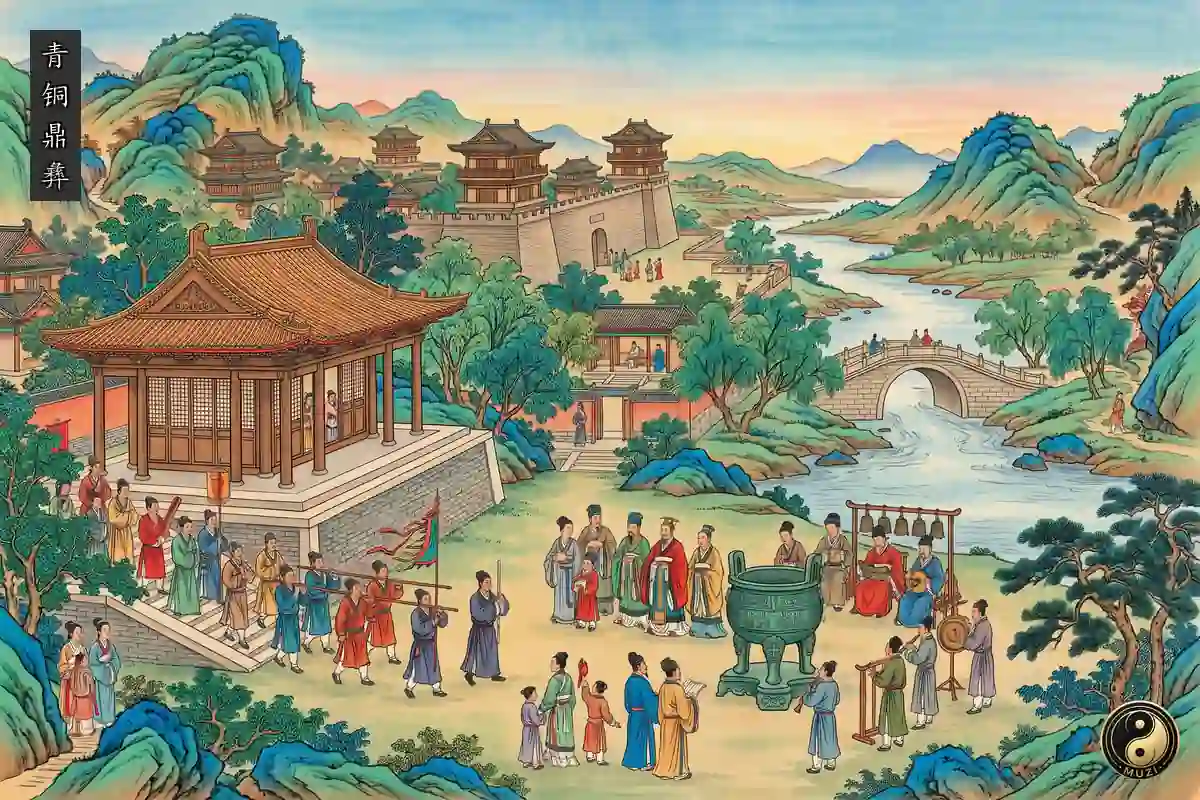
Within the landscape of the ancient Chinese bronze ritual vessel system, Ritual Bronzes represents the foundational guideline of the tradition of extremely high barrier materials science and patriarchal hierarchy facilities verification. Under the historical pressures of early copper object emergence, maturation of piece mold casting, institutionalization of ritual vessels, the documentary function of bronze inscriptions, and the material embodiment of patriarchal hierarchy, spanning from the late Neolithic to the Qin Han period (c. 3000 BCE to the 2nd century CE), this tradition is defined by the Erlitou bronze jue goblet as the late Xia early Shang landmark, the Yinxu Simuwu ding and Lady Fu Hao's rectangular fangyi vessel as the Shang culmination, the Western Zhou Da Yu ding and Mao Gong ding as the Zhou dynasty canonization of ritual vessel institutions, the Spring and Autumn Lotus and Crane Square Hu and the Marquis of Cai ding as the Spring and Autumn transitional landmarks, the Warring States Marquis Yi of Zeng's chime bells and zun pan vessel as the Warring States craft pinnacle. The Qin Shihuang mausoleum bronze chariots as the imperial ritual vessel finale. To trace a single coherent lineage to its source: from Yangshao and Longshan culture early copper rudiments. The Erlitou culture bronze jue as the bronze ritual vessel prototype. The Erligang culture early bronze ritual vessels. The Yinxu Simuwu ding, Lady Fu Hao's fangyi, the Li gui, and the Tian Wang gui as the Shang culmination. The Western Zhou Da Yu ding, Mao Gong ding, San Shi pan, and Guo Ji Zi Bai pan as the Zhou ritual vessel canonization. The Artificers' Record (*Kaogongji*) and its six alloy ratios for metals (*jin you liu qi*) as the alloy theory. The Spring and Autumn Zeng Bo fu, Duke Qin bo bell, Lotus and Crane Square Hu, and Marquis of Cai ding as the Spring and Autumn transition, to the Warring States Marquis Yi of Zeng's chime bells, zun pan, and bronze hu as the Warring States craft pinnacle, to the Qin Shihuang mausoleum bronze chariots as the imperial finale, to Han bronze mirrors as the continuation, tracing Ritual Bronzes as an extremely high barrier materials science and patriarchal hierarchy facilities verification system through every author and text to its roots.
The earliest textual anchor of this lineage is the late Neolithic early copper object emergence. The Yangshao culture (Shaanxi, Xi'an, Banpo site, c. 5000 to 3000 BCE) and the Longshan culture (Shandong, Zhangqiu, Longshan site, c. 3000 to 1900 BCE) yielded copper fragments, copper knives, and copper awls as the earliest copper rudiments. The Erlitou culture (Henan, Yanshi, Erlitou site, c. 1900 to 1500 BCE) advanced the bronze ritual vessel prototype with the Erlitou bronze jue (the earliest known Chinese bronze vessel), along with bronze jia, bronze he, and bronze bells. The Erligang culture (Henan, Zhengzhou, Erligang site, c. 16th to 14th century BCE) consolidated early bronze ritual vessels with bronze ding, bronze gui, and bronze li tripods.
The Shang culmination was achieved during King Wu Ding's reign (c. 1250 to 1192 BCE). The Simuwu ding (excavated 1939, Yinxu, Anyang, Henan; 1.33 m tall, 832.84 kg, the largest known Chinese bronze ritual vessel) and the Lady Fu Hao tomb's rectangular fangyi, Simu Xin ding, Fuhao fangding, Fuhao paired fangyi, Fuhao triple yan steamer, and Fuhao bronze mirror represent the Shang climax. The early Western Zhou Li gui and Tian Wang gui (the Li gui bearing an inscription commemorating King Wu's conquest of Shang) established the early Zhou ritual vessel system. The mid Western Zhou Da Yu ding (King Kang period, 153.5 kg, 291 character inscription) and Mao Gong ding (King Xuan period, 34.7 kg, 497 character inscription, the longest bronze inscription known) canonized the Western Zhou ritual institution. The late Western Zhou San Shi pan (King Li period, 21.312 kg, 357 character inscription, the earliest physical evidence of a land contract) and Guo Ji Zi Bai pan (King Xuan period, 215.3 kg, 111 character inscription recording military merit) supplemented the practical function of Western Zhou ritual vessels.
The alloy theory was formalized by anonymous compilers during the Warring States period in the Artificers' Record, Metalworkers section (*Kaogongji, Gong Jin Zhi Gong*): *jin you liu qi: liu fen qi jin er xi ju yi, wei zhi zhong ding zhi qi* (Six are the alloy ratios for metals: divide the metal into six parts with tin as one, and you have the ratio for bells and ding vessels); five parts metal to one part tin for axes; four to one for dagger axes and halberds; three to one for large blades; five parts metal to two parts tin for arrowheads; and equal parts metal and tin for mirrors. The Spring and Autumn transition was achieved in the 7th to 6th centuries BCE: the Lotus and Crane Square Hu (c. 6th century BCE, excavated at Xinzheng, Henan; a bronze hu vessel topped by a crane standing among lotus petals, marking the transition in vessel form), the Marquis of Cai ding (c. 6th century BCE, excavated at Shouxian, Anhui, with a ritual inscription), the Zeng Bo fu (c. 7th to 6th century BCE, 176 character inscription), and the Duke Qin bo bell (c. 7th century BCE, excavated in Lixian, Gansu, an early Spring and Autumn musical instrument).
The Warring States craft pinnacle was achieved by Marquis Yi of Zeng (? to 433 BCE). The 1978 excavation of his tomb at Suizhou, Hubei, yielded the 65 piece chime bell set (over 2,500 kg total), 32 piece chime stone set, the zun pan vessel (a masterpiece of lost wax casting with openwork intertwined dragons and serpents), bronze jian basins, and bronze hu vessels. The imperial finale was achieved by Qin Shihuang (259 to 210 BCE): the 1980 excavation at the Qin Shihuang mausoleum in Lintong, Shaanxi, yielded bronze chariots No. 1 and No. 2 (No. 1: 1.06 m tall, 2.25 m long, 1,061 kg; No. 2: 1.04 m tall, 3.17 m long, 1,241 kg; over 2,000 parts all in bronze, half scale replicas of real chariots). The Han continuation was carried by Han bronze mirrors (mature mirror casting technique, inscriptions and mythical beast motifs on the reverse), Han bronze lamps (the wild goose fish lamp, the Changxin Palace lamp), Han bronze hu, and Han bronze washing basins.
,、、《》,、、,:、、、,、、、。,,。