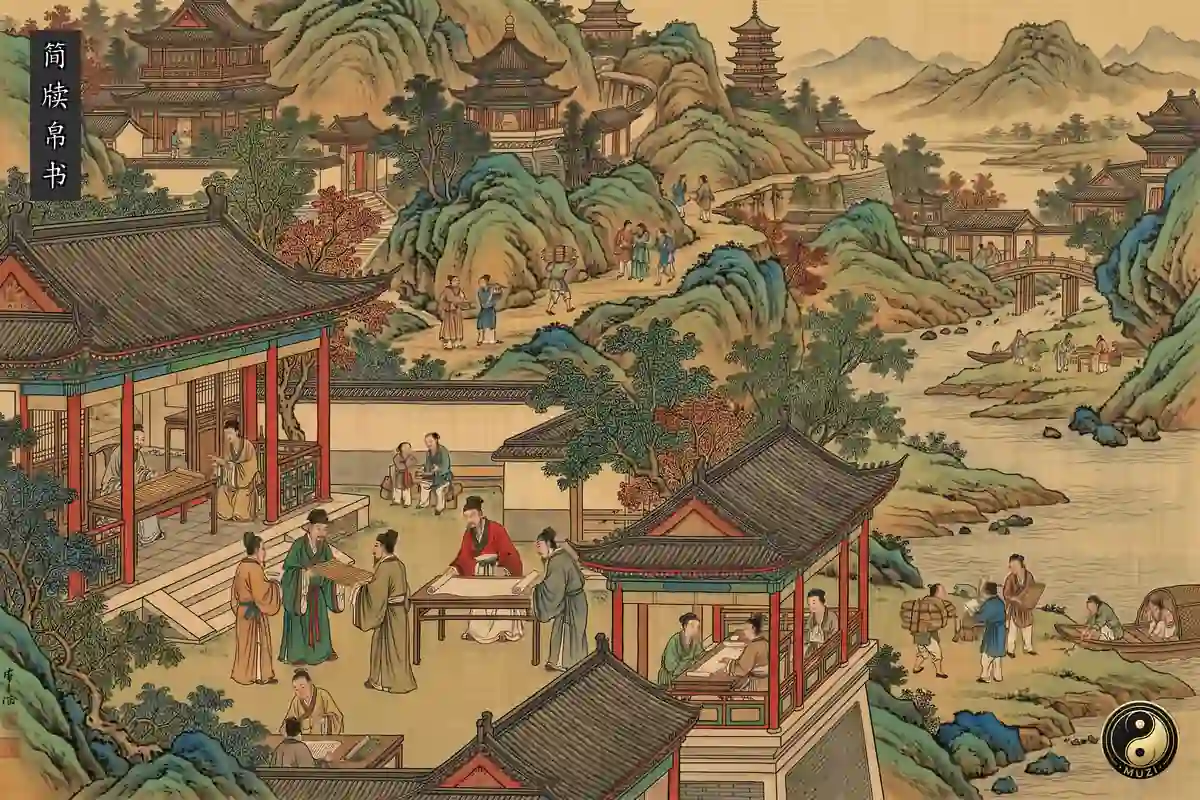
Within the landscape of the ancient Chinese writing substrate system, Slips and Scrolls represents the foundational guideline of the tradition of physical cutting and linear binding norm. Under the historical pressures of oracle bone inscriptions, bronze inscriptions, bamboo and wooden slips, silk writing, and the cursivization of clerical script, spanning from the Shang dynasty to the Wei Jin period (c. 13th century BCE to the 4th century CE), this tradition is defined by the Yinxu oracle bone script as the Shang origin, the Western Zhou bronze vessel inscriptions as the Zhou mainstream, the Warring States Guodian Chu slips, Shuihudi Qin slips, and Baoshan Chu slips as the Warring States bamboo slip maturation, the Western Han Yinqueshan Han slips and the Mawangdui silk manuscripts as the Han dynasty parallel use of slips and silk, and the Eastern Han Xu Shen's Shuowen Jiezi and Cai Lun's papermaking as the bamboo slip finale. To trace a single coherent lineage to its source: from the Yinxu oracle bone script as the Shang origin. The Western Zhou bronze vessel inscriptions as the Zhou mainstream. The Warring States bamboo slip prototype, to the Shuihudi Qin slips, Guodian Chu slips, Baoshan Chu slips, and the Marquis Yi of Zeng tomb bamboo slips as the Warring States maturation, to the Western Han Yinqueshan slips and Mawangdui silk manuscripts alongside the Juyan Han slips and Dunhuang Han slips as the Han parallel system, to the Eastern Han Xu Shen's Shuowen Jiezi and Cai Lun's papermaking as the slip finale, to the Wei Jin complete replacement by paper, tracing Slips and Scrolls as a physical cutting and linear binding norm through every author and text to its roots.
The earliest textual anchor of this lineage is the Yinxu oracle bone script. Discovered in 1899, the oracle bone inscriptions from Yinxu, Anyang, Henan (divination records inscribed on turtle shells and animal bones by the Shang royal house) first established the fundamental position of oracle bones as the origin of the writing substrate tradition. The Western Zhou bronze vessel inscriptions (the Mao Gong ding with 497 characters, the San Shi pan with 357, the Da Yu ding with 291, the Guo Ji Zi Bai pan with 111) advanced bronze as the Zhou dynasty mainstream writing medium. The Warring States bamboo slip prototype emerged with the Baoshan Chu slips (c. 4th century BCE, Tomb No. 2, Baoshan, Jingmen, Hubei), the Guodian Chu slips (c. 4th to 3rd century BCE, Tomb No. 1, Guodian, Jingmen, Hubei), the Shuihudi Qin slips (c. 217 BCE, Tomb No. 11, Shuihudi, Yunmeng, Hubei), and the Marquis Yi of Zeng tomb bamboo slips (c. 5th to 4th century BCE, Suizhou, Hubei).
The Warring States bamboo slip maturation was achieved in the mid Warring States. The 1975 excavation of Tomb No. 11 at Shuihudi, Yunmeng, Hubei, yielded 1,155 Qin slips with over 40,000 characters of Qin legal documents, chronicles and daybooks. The 1993 excavation at Guodian, Jingmen, Hubei, yielded 804 Chu slips with over 13,000 characters including Daoist and Confucian texts such as the Laozi (Daodejing), Zhuangzi, Zisizi and Ziyi. The 1987 excavation at Baoshan, Jingmen, Hubei, yielded 448 Chu slips with over 12,000 characters of Chu judicial documents, divination records, and sacrificial texts. The 1978 excavation of the Marquis Yi of Zeng tomb yielded over 240 bamboo slips. The Han dynasty parallel use of slips and silk was established by the Western Han: the 1972 excavation at Yinqueshan, Linyi, Shandong, yielded 4,942 Han slips with over 100,000 characters including Sun Tzu's Art of War, Sun Bin's Military Methods, the Six Secret Teachings, Wei Liaozi, Yanzi Chunqiu, Yin Yang texts, Han calendars, and Han mathematics. The 1973 excavation at Mawangdui, Changsha, Hunan, yielded silk manuscripts with over 120,000 characters including two copies of the Laozi, the Zhanguoce, Chunqiu Shiyu, the Yijing, the Huangdi Neijing, Yin Yang and Five Elements texts, the Daoyin exercise chart, and texts on chamber arts.
The Han frontier bamboo slip system was supplemented by the Juyan and Dunhuang slips. The Juyan Han slips (discovered 1930, Ejina Banner, Inner Mongolia; over 11,000 slips with over 300,000 characters of frontier garrison administrative documents, courier records, weapon registries, salary records, name registers, and documents on the beacon fire signaling system) and the Dunhuang Han slips (discovered 1907, Gansu; over 2,500 slips with over 100,000 characters of Dunhuang prefecture administrative documents, courier records, calendar notations, divination texts, and medical formulae) together established the Han frontier slip institution. The Eastern Han Xu Shen (c. 58 to 147 CE) formalized the grand systematization of slip era script with his Shuowen Jiezi (9,353 characters, 1,163 variant forms, 540 radicals, an integrated analysis of character form, sound and meaning, and seal script standardization). Cai Lun (? to 121 CE) achieved the bamboo slip finale when in the first year of the Yuanxing era (105 CE) he presented his improved papermaking technique using tree bark, hemp ends, rags and old fishing nets to Emperor He; the technique was promoted in the fifth year of the Yuanchu era (118 CE) and became known as Marquis Cai's paper. The Wei Jin complete replacement by paper (Western Jin completion of the paper for slip transition, Eastern Jin full popularization of paper, and Loulan and Turfan excavated Wei Jin paper documents) verified the bamboo slip finale.
,、,、《》、,:、、、,、、、。,,。