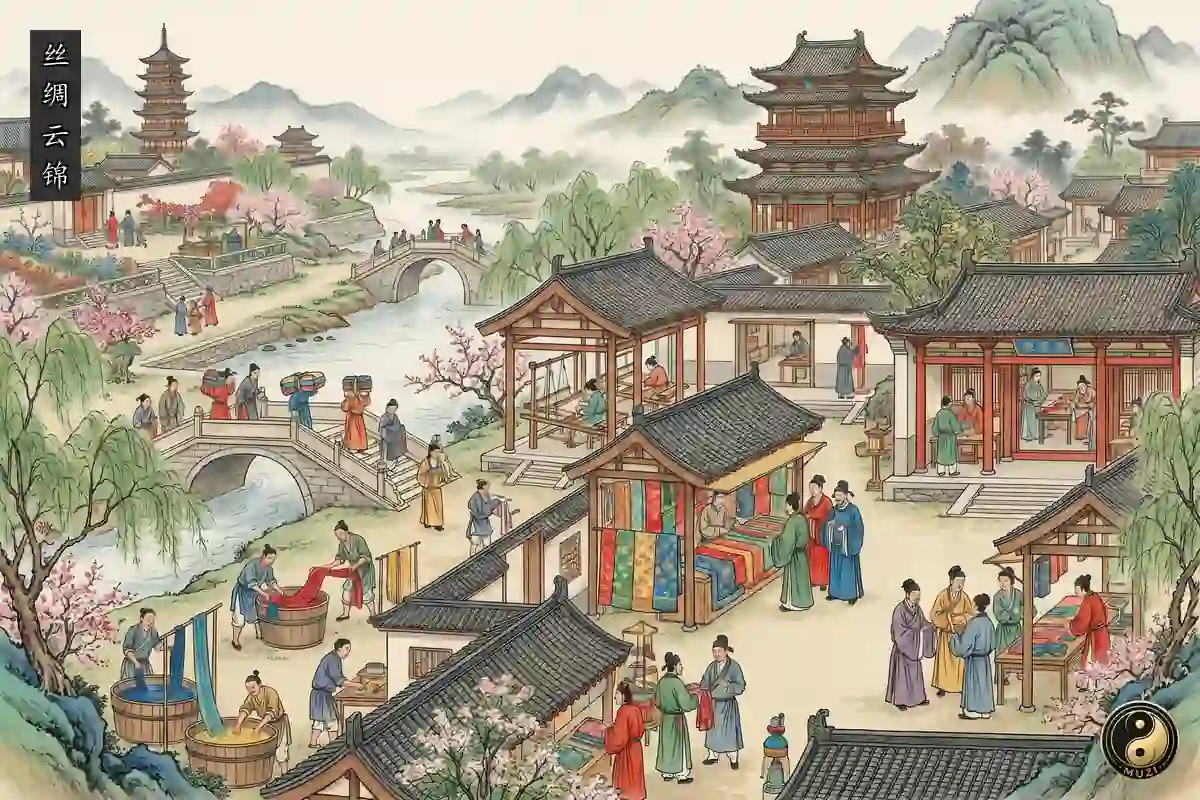
The silk and brocade technology chain consists of two core stages: the upstream biosynthesis of silk fiber and the downstream information encoding of weaving.
The domestic silkworm, through millennia of artificial selection, has evolved its silk gland into an exceptionally efficient protein spinning organ. A single filament consists of two fibroin fibers bound by sericin. Its triangular cross section creates a natural prismatic effect: light entering the fiber undergoes soft, multiple diffuse reflections across the surface, giving silk its characteristic luster. Silk's tensile strength is comparable to steel wire of equivalent diameter, combining high strength with high toughness.
The domestication of silkworms began in the late Neolithic. The Qianshanyang site in Huzhou, Zhejiang (c. 2700 BCE) yielded the earliest silk artifacts, silk ribbons and silk fragments. The Qingtai site in Zhengzhou, Henan (c. 3500 BCE) yielded leno weave fabric showing that silk weaving was already quite advanced. The Xiyincun site in Xia County, Shanxi (c. 3000 BCE) yielded a half cocoon that had been cut by a human implement, indicating that silkworm use had moved beyond gathering.
Shang oracle bone inscriptions already include the characters for silkworm, mulberry, silk thread, and silk cloth. Bronze vessels excavated at Yinxu, Anyang, bear traces of adhered silk textiles including plain weave silk and twill pongee. From the Western Zhou through the Spring and Autumn period, silk technology advanced further. The Book of Songs (*Shijing*) records: *chun ri zai yang, you ming cang geng. nv zhi yi kuang, zun bi wei xing, yuan qiu rou sang* (Spring days bring warmth, the oriole sings. The maiden takes her deep basket, follows the narrow path, seeking tender mulberry leaves), a vivid depiction of the sericulture tradition.
During the Warring States period silk textiles became an important gift and trade commodity among the aristocracy. Chu Tomb No. 1 at Mashan, Jiangling, Hubei (c. 4th century BCE) yielded a large quantity of silk textiles including brocade, leno, gauze and figured silk, with the Dancing Figures and Animals Brocade celebrated for its complex jacquard technique.
Han dynasty silk weaving reached maturity. The Mawangdui tomb in Changsha (c. 168 BCE) yielded a plain gauze robe weighing just 49 grams. After Zhang Qian's missions to the Western Regions, silk was exported westward along the Hexi Corridor to Central Asia, Western Asia, and the Mediterranean world, formally opening the Silk Road.
Tang dynasty weft faced compound weave (weft brocade) replaced Han dynasty warp faced weave (warp brocade), allowing freer and richer pattern expression. Song dynasty silk weaving developed further, with the three great brocades, Suzhou Song Brocade, Nanjing Cloud Brocade, and Sichuan Shu Brocade, taking definitive form during this era. Lou Shu's Gengzhi Tu (Pictures of Tilling and Weaving, 1145 CE) illustrated the full sericulture and silk production process in 45 panels.
In the Yuan Ming transition the jacquard loom was perfected. Nanjing Cloud Brocade's pattern book (*huaben*), a pattern control program assembled by tying silk thread into knots, is arguably the world's earliest dual storage and reading system. In the pattern book process, patterns are encoded as silk knots at each warp weft intersection point; during weaving, a draw boy reads the pattern book signals to raise the designated warp threads while the weaver throws the shuttle to insert the weft, enabling the production of extraordinarily complex patterns incorporating gold thread, peacock feather thread, and colored silk.
Ming dynasty Song Yingxing's Tiangong Kaiwu (Works of Heaven and the Inception of Things, 1637 CE), in its clothing chapter, provided a systematic account of silk technology. The Qing dynasty's three Jiangnan Weaving Bureaus pushed silk production to unprecedented scale. The family of Cao Xueqin, author of the Dream of the Red Chamber, served as hereditary directors of the Jiangning Weaving Bureau for three generations, and the novel's extensive descriptions of Cloud Brocade derive from this background.
In civilizational impact, the silk trade directly gave birth to the Silk Road. Pliny the Elder's Natural History (77 CE) records that silk was transported from the land of the Seres to Rome and valued at its weight in gold. After the mid Tang, Chinese silk technology spread westward, with the Sassanid Persian Empire and the Byzantine Empire subsequently developing independent silk industries. Zheng He's maritime expeditions carried large quantities of silk. After the 16th century, Chinese silk reached the Americas via the Manila Galleons, becoming the first truly globalized industrial product.
The history of silk technology transmission is itself a microcosm of cross civilizational exchange. After Zhang Qian's missions to the Western Regions (c. 138 BCE), Chinese silk and weaving techniques first reached Dayuan (Ferghana) and Anxi (Parthia). Pliny the Elder recorded in his Natural History (77 CE) that the Roman Empire's annual trade deficit with India, Arabia and China reached 100 million sesterces, most of it for silk purchases. In the 6th century, Byzantine Emperor Justinian I dispatched two monks who smuggled silkworm eggs inside hollow bamboo canes to Constantinople, enabling the Eastern Roman Empire to establish its own silk industry.
The Tang dynasty was the golden age of Chinese silk art. The maturation of weft faced compound weave brought Tang silk textiles to unprecedented artistic heights. The Shoso in Treasury in Nara, Japan, preserves a magnificent collection of Tang silk textiles including brocade, twill, gauze and damask. Among them, the Four Heavenly Kings Hunting Lion Brocade and the Deer Amid Plants and Trees Clamp Resist Screen are outstanding representatives of Tang silk craftsmanship and material evidence of Sino Japanese textile exchange.
After the Tang, Chinese silk techniques spread further to the Korean Peninsula and Japan. Korea's Goryeo dynasty silk industry developed distinct local varieties while based on Chinese methods. Japanese kento shi (envoy weavers) brought back Tang weaving techniques and loom types, directly spurring the development of Japan's silk industry. By the late Heian period, Japanese silk technique had reached high maturity.
During the Ming Qing period, the Jiangnan silk industry became highly commercialized. The three cities of Suzhou, Hangzhou and Nanjing employed tens of thousands of silk weavers, producing millions of bolts annually for both domestic consumption and export to Japan, Southeast Asia, Europe and the Americas. The English word silk itself is a linguistic traveler along the Silk Road, tracing back to the Chinese *si* (silk) through Greek Seres and Latin sericum.
Silk's economic significance reached new heights in the Ming Qing period. After the Spanish opened the Manila Galleon trade in the 16th century, vast quantities of American silver flowed into China to purchase silk, porcelain and other goods, creating a global silver circulation; the Silk Road had evolved into a Silver Road. China's dominance in the global silk trade lasted until the 19th century, when Japanese raw silk exports rose and European artificial fibers were invented.
The internal logic of silk is the combination of severe micro operation on biological protein fibers with information encoding via the jacquard loom, while maintaining a core trade advantage through technology monopoly. That is why silk endured as the supreme material representation of Chinese civilization.