

















As the agricultural civilization of ancient Chinese ancestors matured, the dietary structure shifted from large chunks of roasted meat toward viscous millet porridge soups and finely sliced boiled vegetable broths. Using bare hands to grab solid residue from high temperature fluids not only posed an severe risk of physical scalding but was also extremely inefficient. At the same time, in a social system emphasizing ritual, music, moral cultivation, and *ren* (benevolence), directly wielding cold weapons with cutting and physical lethal attributes (knives and forks) at the dining table was regarded as extremely barbaric, high disorder behavior liable to trigger systemic bloodshed. The system urgently needed a peaceful, flexible feeding terminal tool capable of maintaining a safe physical distance.
What is most noteworthy about the Etiquette of Chopstick Dining is that it turns a seemingly familiar civilizational element into an entry point for understanding how society operates. Behind it are usually concrete people, institutions, technologies, ideas or scenes of daily life, rather than an empty label. Following this entry point, the reader will discover that Chinese civilization, when dealing with problems, often does not advance along a single line but instead connects inner cultivation, outer norms, and shared life. This gives it both historical warmth and mechanical clarity.
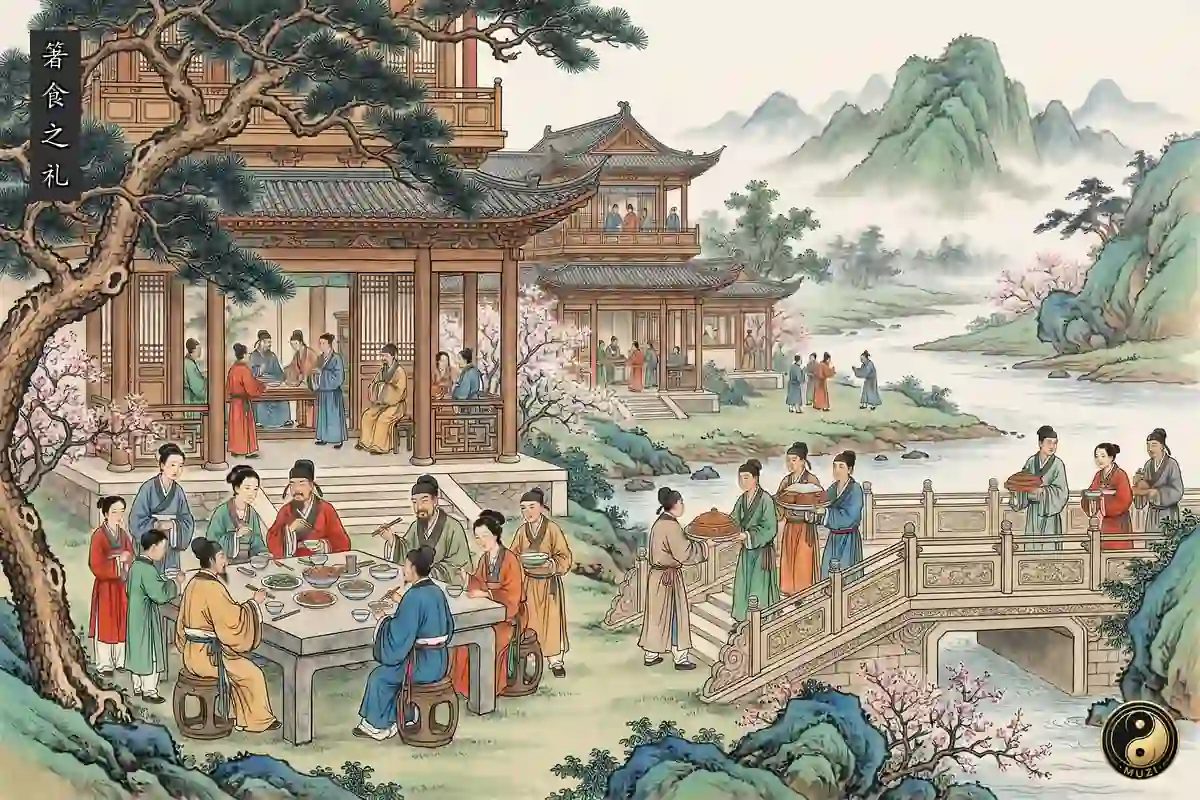
Chopsticks (*zhu*) are an extremely precision dual lever fingertip micro manipulation biomimetic exoskeleton. They consist of two perfectly equal slender rods (wood, bamboo or metal), forcibly extending beyond the physical length boundary of human fingers. In terms of operational mechanics, one chopstick acts as a passively anchored static fulcrum while the other acts as a dynamic lever. Through the torque matrix controlled by the thumb, catalogue finger, and middle finger, the dining node can execute complex physical grasping commands such as clamping, lifting, mixing, pushing and pinching with incredible flexibility and severe precision. The core underlying logic of this physical connection is soft grip extraction rather than violent cutting. It compels the kitchen system to complete food data slicing and preprocessing in the back end (the kitchen), so that the front layer user (the diner) need only execute an elegant transmission norm at the table. Simultaneously, it forcibly integrates ritual mechanisms: for instance, one must never strike bowls or plates with chopsticks (producing high disorder noise) or place them unevenly in length, fixing the Confucian principle of *ke ji fu li* (restraining the self and restoring propriety) directly into the highest frequency biological feeding action of daily life.
The operation of the Etiquette of Chopstick Dining depends on repeatable structure. Through learning, imitation, institutionalization and daily use, people transformed it from local experience into a more stable civilizational capacity. This process allows it to cross eras and continue shaping later ideas and practices. It also makes this chapter not merely historical knowledge but a clue to observing how civilization accumulates capability.
The Etiquette of Chopstick Dining also shapes different groups of people. Scholars, artisans, families, officials, merchants, soldiers or local communities may all participate at different levels in its organizeion and transmission. The flow of two wooden sticks embodies Eastern lever mechanics; the ordering of elder and younger manifests the tabletop ritual system. This is precisely why it can form connections with other chapters. It has its own functional boundary yet also generates echoes of ideas, institutions or technology outward, revealing its internal logic.
Chopstick Etiquette is a key node in Chinese civilization. A dual-utensil eating and etiquette system spanning thousands of years, embodying unique leverage physics and an orderly table ritual. Its importance lies not only in naming an idea, but in showing how people, families, social order, and civilizational values connect. It gives the reader a first doorway into the logic of this chapter. Through it, abstract values enter concrete life.