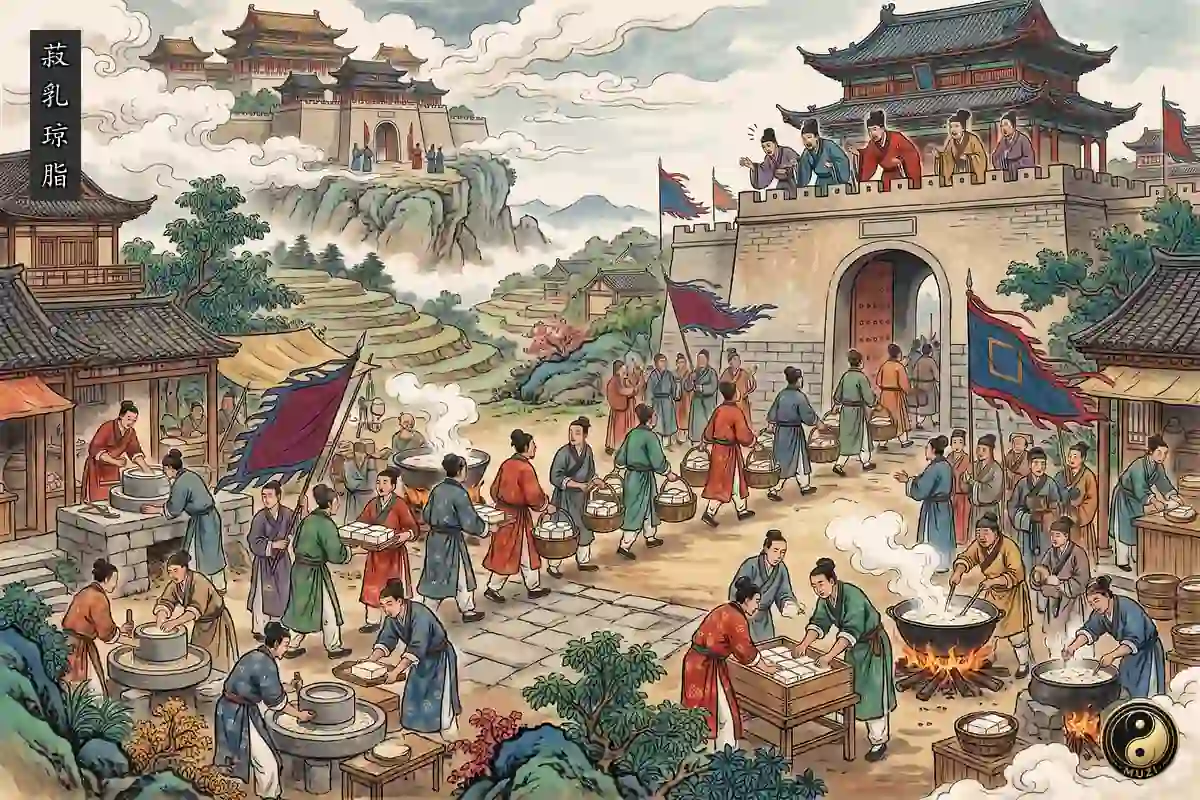






















Within the extremely vast and intensively developed agricultural grid, the empire lacked expansive pastures for large scale nomadic herding of cattle and sheep. Base level nodes chronically lacked input of high quality animal protein, facing a severe biological nutritional disconnection crisis. Soybeans (*shu*), though extremely easy to cultivate and rich in protein, had naturally extremely tough cell walls and contained large quantities of anti nutritional factors such as trypsin inhibitors. If consumed using the most primitive method of direct heated ingestion, not only was the texture extremely poor, but the human gastrointestinal hub would suffer severe indigestion and systemic bloating from the inability to decode them.
What is most noteworthy about Bean Curd is that it turns a seemingly familiar civilizational element into an entry point for understanding how society operates. Behind it are usually concrete people, institutions, technologies, ideas or scenes of daily life, rather than an empty label. Following this entry point, the reader will discover that Chinese civilization, when dealing with problems, often does not advance along a single line but instead connects inner cultivation, outer norms, and shared life. This gives it both historical warmth and mechanical clarity.
The birth of tofu was a hardcore physical cell wall breaching and ionic recombination chemistry experiment targeting plant cells. Engineers first employed water soaking and stone grinding, utilizing powerful physical shear forces to completely shatter the tough cell walls of soybeans, releasing internal protein molecules and filtering them into a suspended liquid colloid (soy milk). The subsequent step of *dian lu* (adding coagulant) was a stroke of genius in the history of human food chemistry. Engineers introduced bittern (rich in magnesium chloride) or gypsum (calcium sulfate) as inorganic electrolyte catalysts. When these positively charged metal ions were precisely injected into the negatively charged protein colloid, they instantly triggered a powerful charge neutralization reaction. Protein molecules, stripped of their charge repulsion, rapidly underwent physical collision, cross linking, and precipitation as water molecules were forcibly squeezed out of the system. Through mold pressing and filtering, the originally indigestible plant liquid waste was successfully recombined into blocks of white, soft, solid high quality protein systems with absorption rates exceeding 95 percent. It directly bypassed the inefficient animal husbandry cycle, completing a chemical leap from plant matter to meat analogous protein.
The operation of Bean Curd depends on repeatable structure. Through learning, imitation, institutionalization and daily use, people transformed it from local experience into a more stable civilizational capacity. This process allows it to cross eras and continue shaping later ideas and practices. It also makes this chapter not merely historical knowledge but a clue to observing how civilization accumulates capability.
Bean Curd also shapes different groups of people. Scholars, artisans, families, officials, merchants, soldiers or local communities may all participate at different levels in its organizeion and transmission. The inorganic chemistry of coagulant coagulation technology provided East Asia with a cheap yet high quality plant protein revolution. This is precisely why it can form connections with other chapters. It has its own functional boundary yet also generates echoes of ideas, institutions or technology outward, revealing its internal logic.
Tofu Revolution is a key node in Chinese civilization. Using specialized soaking, grinding, and salt-brine or gypsum coagulation to provide an exceptionally accessible and high-quality plant protein source. Its importance lies not only in naming an idea, but in showing how people, families, social order, and civilizational values connect. It gives the reader a first doorway into the logic of this chapter. Through it, abstract values enter concrete life.