




















As a high yielding foreign crop, wheat initially encountered a severe systemic adaptability crisis when promoted in the Central Plains. Ancient Chinese ancestors were accustomed to steaming and boiling whole grains with their husks intact (grain eating). But wheat was wrapped in an extremely hard outer seed coat rich in coarse fiber. If one forced grain eating of wheat (wheat rice), the texture was like swallowing gravel, rough and throat scraping, and the human digestive tract could barely extract its carbohydrate energy. If the physical defense of the wheat husk and the rigidity of gluten could not be cracked, this high yielding crop would be completely rejected by the base level system.
What is most noteworthy about the Wheat Flour Revolution is that it turns a seemingly familiar civilizational element into an entry point for understanding how society operates. Behind it are usually concrete people, institutions, technologies, ideas or scenes of daily life, rather than an empty label. Following this entry point, the reader will discover that Chinese civilization, when dealing with problems, often does not advance along a single line but instead connects inner cultivation, outer norms, and shared life. This gives it both historical warmth and mechanical clarity.
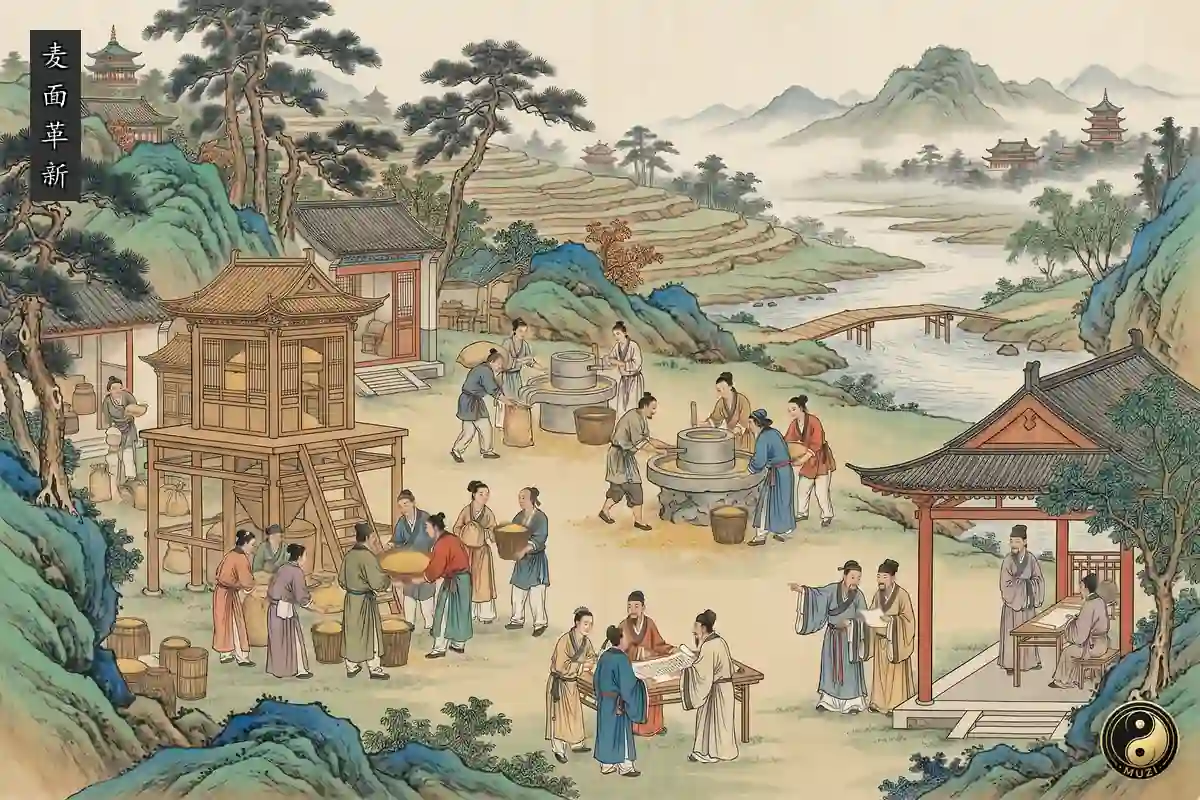
The Wheat Flour Revolution depended on the epic popularization of two heavy facilities systems and a biochemical plug in: the stone mill and yeast. The popularization of the Han dynasty stone mill was a violent rotational physical crushing dimension reduction. Massive gravitational stone discs interlocked, utilizing grinding and shear force to completely pulverize wheat grains, physically stripping away the hard seed coat (bran), extracting the pure endosperm within, and reducing it from a three dimensional granule to a micrometer level powder (flour), completely unleashing its starch administrative capability and the extensibility of gluten protein. The maturation of yeast fermentation technology during the Tang and Song dynasties was the second stage micro ecological gas expansion transformation. During the kneading process, gluten proteins formed a dense three dimensional elastic system. The ancestors introduced yeast fungi into it. These microscopic hackers frantically consumed sugars inside the dough and performed anaerobic respiration, expelling large volumes of carbon dioxide gas. The dense gluten system tightly trapped these gases, causing the dough to physically expand when heated during baking or steaming, multiplying in volume. The result was the transformation of dry, rigid blocks of dough into extremely fluffy supercarbohydrate carriers riddled with microscopic air pockets and easily and rapidly absorbed by human digestive fluids: *mantou* (steamed buns) and *baozi* (stuffed buns).
The operation of the Wheat Flour Revolution depends on repeatable structure. Through learning, imitation, institutionalization and daily use, people transformed it from local experience into a more stable civilizational capacity. This process allows it to cross eras and continue shaping later ideas and practices. It also makes this chapter not merely historical knowledge but a clue to observing how civilization accumulates capability.
The Wheat Flour Revolution also shapes different groups of people. Scholars, artisans, families, officials, merchants, soldiers or local communities may all participate at different levels in its organizeion and transmission. The popularization of the stone mill and the maturation of yeast fermentation reshaped the form of the northern staple food structure. This is precisely why it can form connections with other chapters. It has its own functional boundary yet also generates echoes of ideas, institutions or technology outward, revealing its internal logic.
Flour Innovation is a key node in Chinese civilization. The expansion of stone mills and yeast fermentation, transforming wheat from raw grains into diverse flour-based foods, reshaping northern diets. Its importance lies not only in naming an idea, but in showing how people, families, social order, and civilizational values connect. It gives the reader a first doorway into the logic of this chapter. Through it, abstract values enter concrete life.