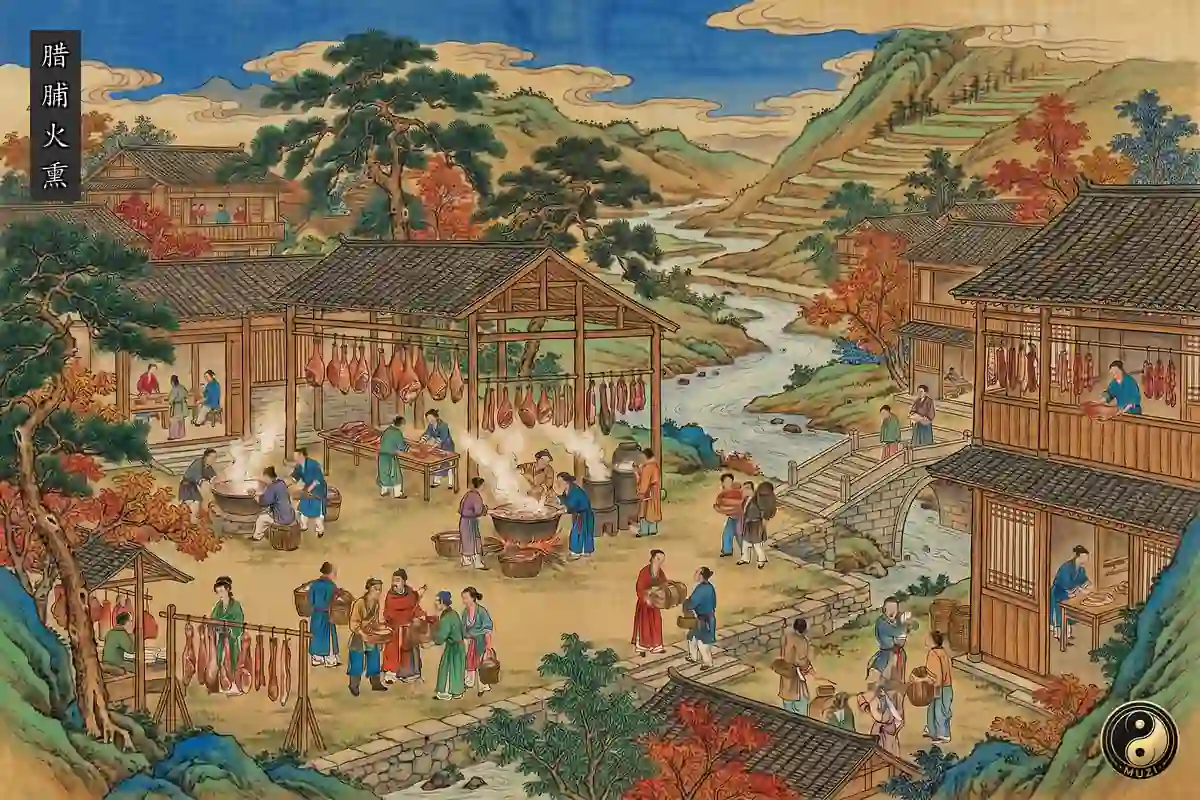






















During ancient winters or after large scale hunts and slaughters, the system would generate a massive overflow of meat data in a short period. Because animal flesh is rich in moisture and protein, it is an ideal culture medium for bacterial reproduction; without intervention, these precious meat assets would undergo irreversible decay and be zeroed out within days. The empire severely lacked infrastructure capable of maintaining frozen conditions. To cope with the protein supply cutoff crisis of long winters, the populace had to invent an offline data archival technology that completely severed the physical conditions for bacterial reproduction, forcibly extending the lifecycle of high value foodstuffs.
What is most noteworthy about Cured Meat and Smoke Preservation is that it turns a seemingly familiar civilizational element into an entry point for understanding how society operates. Behind it are usually concrete people, institutions, technologies, ideas or scenes of daily life, rather than an empty label. Following this entry point, the reader will discover that Chinese civilization, when dealing with problems, often does not advance along a single line but instead connects inner cultivation, outer norms, and shared life. This gives it both historical warmth and mechanical clarity.
The production of cured meat (*la pu*) is an extremely violent forced cellular dehydration and chemical smoke containment norm. The first layer of defense is high osmotic dehydration: artisans applied high concentration salt to the surface of the meat. According to the principles of osmotic pressure physics, the external high salt environment forcibly draws out the free fluid moisture within meat cells, completely stripping decay bacteria of their liquid medium for survival and reproduction. The air drying process further evaporated residual moisture. The second layer of defense is hardcore smoke molecular coating. The ancestors utilized pine and cypress branches, tangerine peel, or specific woods to perform incomplete combustion in enclosed spaces. The large quantities of complex chemical substances released in the smoke (such as phenols, aldehydes and organic acids) were forcibly adsorbed and permeated into the surface layer of the meat. This chemical outer garment constructed a lethal sterile preservative coating that directly killed invading microorganisms. It also underwent deep cross linking and oxidation reactions with the animal fats in the meat at high temperatures. It violently recombined originally rank and gamey raw meat into a top tier protein compression package with rich smoky flavor, firm structure, and the ability to be stored at room temperature for months or even years.
The operation of Cured Meat and Smoke Preservation depends on repeatable structure. Through learning, imitation, institutionalization and daily use, people transformed it from local experience into a more stable civilizational capacity. This process allows it to cross eras and continue shaping later ideas and practices. It also makes this chapter not merely historical knowledge but a clue to observing how civilization accumulates capability.
Cured Meat and Smoke Preservation also shapes different groups of people. Scholars, artisans, families, officials, merchants, soldiers or local communities may all participate at different levels in its organizeion and transmission. Salt curing, air drying, and smoke infused meat preservation are the crystallized dietary wisdom of the frontier zone between nomadic and agrarian civilizations. This is precisely why it can form connections with other chapters. It has its own functional boundary yet also generates echoes of ideas, institutions or technology outward, revealing its internal logic.
Cured Meats is a key node in Chinese civilization. Preserving meats and developing distinct savory characteristics through salting, air-drying, and smoking, reflecting environmental adaptation across frontiers. Its importance lies not only in naming an idea, but in showing how people, families, social order, and civilizational values connect. It gives the reader a first doorway into the logic of this chapter. Through it, abstract values enter concrete life.