



















As the population of the unified empire exploded, forests and vegetation were cleared on a massive scale for agriculture and construction, making fuel (firewood) extremely scarce and expensive. Traditional prolonged stewing and open flame roasting of whole cuts of meat faced the pain points of high energy costs and extremely low output efficiency. The populace urgently needed a cooking engine that could compress heat treatment time to the severe and squeeze every drop of administrative capability from fuel. At the same time, the agricultural grid produced large quantities of finely cut vegetables and carbohydrate based noodle foods that could not withstand prolonged exposure to fierce fire; the system needed a thermal grid capable of perfectly maintaining the integrity of food cell fibers and moisture content.
What is most noteworthy about the Twin Pillars of Thermal Cooking is that it turns a seemingly familiar civilizational element into an entry point for understanding how society operates. Behind it are usually concrete people, institutions, technologies, ideas or scenes of daily life, rather than an empty label. Following this entry point, the reader will discover that Chinese civilization, when dealing with problems, often does not advance along a single line but instead connects inner cultivation, outer norms, and shared life. This gives it both historical warmth and mechanical clarity.
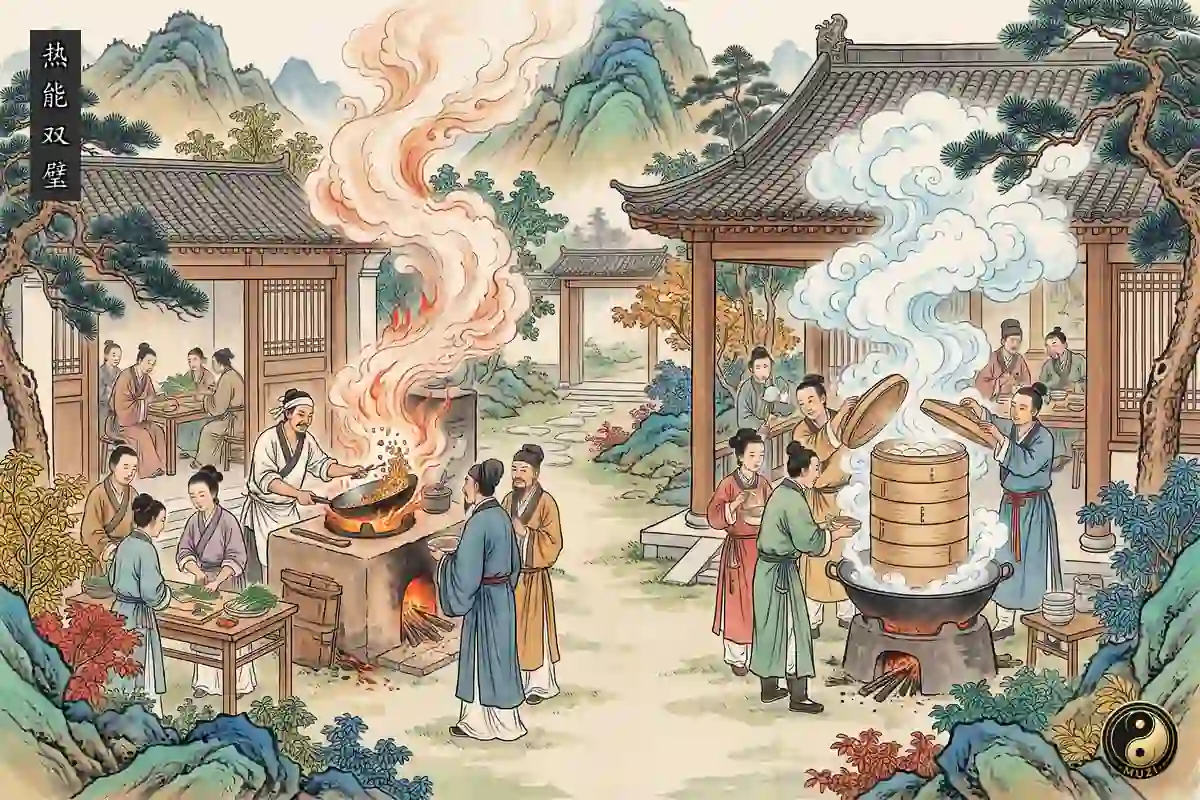
This is the highest bidirectional hack of heat conduction physics. The fierce pillar is the explosive stir fry engine. It depends on the maturation of wrought iron forging technology, placing a round bottomed iron wok with extremely thin walls over a heat concentrating stove. The metal base wall completes heat conduction instantaneously, allowing food cut into thin shreds and small pieces to undergo dozens of seconds of ultra rapid physical tumbling enveloped in an oil film at temperatures exceeding 200 degrees Celsius. This severe instantaneous thermal convection triggers a violent Maillard reaction in an extremely short time, instantly locking in internal moisture and endowing ingredients with the irreplicable soul rule *guoqi* (wok breath), exploiting the instantaneous burst power of fuel to its absolute limit. The gentle pillar is the steaming engine. It uses multi layered stacked bamboo steamers as its carrier, harnessing the enormous latent heat released when base layer boiling water vaporizes. High temperature steam circulates from bottom to top in high frequency thermal convection within the sealed micro ecological container. The steam envelope ensures absolutely uniform heat penetration, completely eliminating the error risk of open flame charring, and perfectly maintaining the physical form and original moisture content of carbohydrate noodle foods and delicate ingredients.
The operation of the Twin Pillars of Thermal Cooking depends on repeatable structure. Through learning, imitation, institutionalization and daily use, people transformed it from local experience into a more stable civilizational capacity. This process allows it to cross eras and continue shaping later ideas and practices. It also makes this chapter not merely historical knowledge but a clue to observing how civilization accumulates capability.
The Twin Pillars of Thermal Cooking also shape different groups of people. Scholars, artisans, families, officials, merchants, soldiers or local communities may all participate at different levels in its organizeion and transmission. The wrought iron wok's explosive stir fry locks in flavor, while the multi layered bamboo steamer maximally preserves the fresh, clean original taste of food. This is precisely why it can form connections with other chapters. It has its own functional boundary yet also generates echoes of ideas, institutions or technology outward, revealing its internal logic.
Frying & Steaming is a key node in Chinese civilization. The intense heat of stir-frying to lock in flavors via wok hei contrasted with multi-layered bamboo steaming to retain original nutrients. Its importance lies not only in naming an idea, but in showing how people, families, social order, and civilizational values connect. It gives the reader a first doorway into the logic of this chapter. Through it, abstract values enter concrete life.