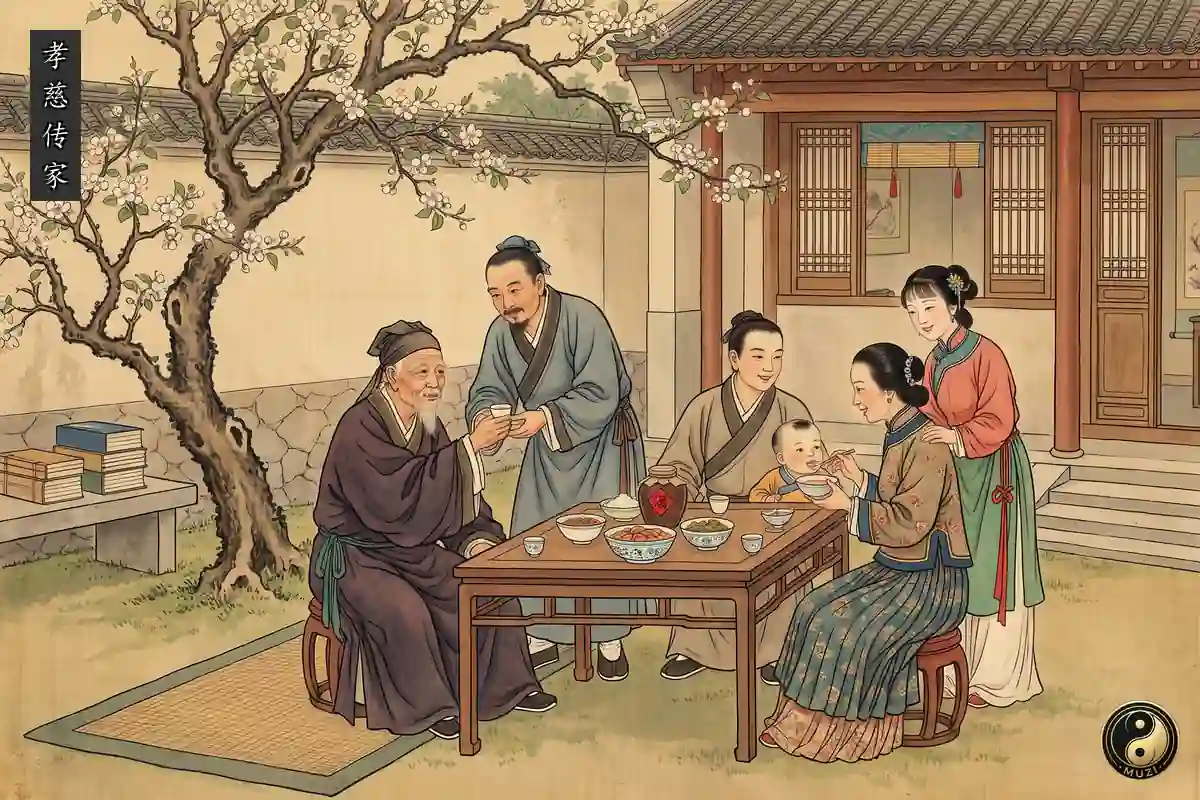
Within the orbit immediately below the Five Constants, filial devotion and parental kindness, passed down through the family (xiao ci chuan jia) is the operating chassis that pulls the five social-level rules of benevolence, righteousness, propriety, wisdom and trustworthiness back into the most micro-level unit: the family. If the Five Constants are the highest-level operating norm of social ethics, then filial devotion and parental kindness (xiao ci) is the lowest-level executable rule that must be fixed within the family itself. Passing down through the family (chuan jia) is the transmission mechanism that lets this rule propagate across generations without relying on external coercion. Breaking these three characters apart, filial devotion, parental kindness, and passing down through the family each have independent textual lineages. Taken together, they form the unique family-ethics thread of filial devotion and parental kindness, passed down through the family. Its origins require following three lines: the classicization of filial devotion (from the Book of Documents and the Book of Songs through the Analects, the Classic of Filial Piety, and the Mencius), the ethicalization of parental kindness (from the Book of Documents to the Zuo Commentary to the Mencius), and the textualization of passing down through the family (from the Letter of Admonition to His Son to Yan's Family Instructions to Zhu's Family Maxims to Zeng Guofan's Family Letters). To grasp the true weight of these four characters in Chinese civilization, all three lines must be followed.
The starting point of the classicization of filial devotion is far earlier than Confucius. The earliest political anchor is the Book of Documents, Canon of Yao, which in evaluating Shun's virtue gives: He was able to bring harmony through filial devotion; his filial piety was so constant that wickedness could not reach him (ke xie yi xiao, zheng zheng yi, bu ge jian). Shun used filial devotion to harmonize the relationship between family and court, making the family harmonious and the court orderly. This is the earliest record of filial devotion moving from family ethics into political evaluation; one of the key reasons Shun could succeed Yao was his filial devotion. The earliest emotional anchor is the famous mourning poem in the Book of Songs, Lesser Odes, Liao E: Grieving, grieving are my father and mother, who gave me life with such toil... I wish to repay their virtue, but Heaven's expanse knows no limit (ai ai fu mu, sheng wo qu lao ... yu bao zhi de, hao tian wang ji). This elevated the weight of parental nurture to a level comparable with the vastness of Heaven, giving filial devotion its heaviest emotional foundation.
The one who truly established filial devotion as the root of Confucian ethics was Youzi, a disciple in the Confucian school, with a line in the Analects, Xue Er chapter that has been repeatedly cited ever since: A person who is filial to parents and respectful to elders, yet who likes to oppose superiors, is rare indeed. One who does not like to oppose superiors yet likes to create disorder has never existed. The exemplary person attends to the root. When the root is established, the Way grows. Filial devotion and fraternal respect are surely the root of benevolence! (qi wei ren ye xiao ti, er hao fan shang zhe, xian yi; bu hao fan shang, er hao zuo luan zhe, wei zhi you ye. jun zi wu ben, ben li er dao sheng. xiao ti ye zhe, qi wei ren zhi ben yu!). This placed filial devotion and fraternal respect as the root of benevolence, elevating the position of filial devotion in Confucian ethics to the logical precondition for all other virtues. Confucius himself in the Analects, Wei Zheng chapter, drew a more precise boundary for filial devotion: Today people call it filial devotion if they can merely support their parents. But even dogs and horses receive support. Without reverence, how is there any difference? (jin zhi xiao zhe, shi wei neng yang. zhi yu quan ma, jie neng you yang, bu jing, he yi bie hu?). This elevated filial devotion from mere physical support (neng yang) to reverence (jing), pushing its substance from material provision to spiritual respect. This was the first time the conceptual boundary of filial devotion was refined.
The text that systematically expounded filial devotion as an independent classic was the Classic of Filial Piety, traditionally said to have been dictated by Confucius and transcribed by Master Zeng. Its opening chapter, Illuminating the Fundamental Meaning (Kai Zong Ming Yi), directly establishes the foundational verdict: Filial devotion is the root of virtue (fu xiao, de zhi ben ye). The Classic of Filial Piety then devotes eighteen chapters to extending filial devotion from family ethics layer by layer to every level of political ethics, from the Son of Heaven to feudal lords, ministers, scholars and common people. This was the critical leap by which filial devotion was elevated from family ethic to national ethic. The one who extended filial devotion from the family to the universal was Mencius, in the Mencius, King Hui of Liang, Part 1, with the most frequently cited political maxim: Treat your own elders as elders, and extend it to the elders of others; treat your own young as young, and extend it to the young of others (lao wu lao yi ji ren zhi lao, you wu you yi ji ren zhi you). This extended the objects of filial devotion from one's own parents to all elders, upgrading it from clan ethics to social ethics and making filial devotion the concrete social-level operation of Confucian benevolent governance (ren zheng).
The ethicalization of parental kindness (ci), though it does not occupy the center of the classics as filial devotion does, has an equally ancient pedigree. The earliest politicized expression of parental kindness as the unconditional sheltering of the young by the old is found in the Book of Documents, Announcement to Kang: as if protecting a newborn infant (ruo bao chi zi). This compared the ruler's governance of the people to parents protecting a newborn baby, extending kindness from family emotion to political emotion. The earliest fixed pairing of parental kindness and filial devotion (fu ci zi xiao) as a complementary ethical dyad is in the Zuo Commentary, Duke Zhao, Year 26: The father is kind and teaches; the son is filial and admonishes (fu ci er jiao, zi xiao er zhen). This explicitly paired kindness with filial devotion as complementary axes of family ethics, elevating kindness from one-sided care to care combined with instruction.
In the Analects, Xue Er chapter, where Confucius listed filial devotion and fraternal respect as the root of benevolence, he also in the Wei Zheng chapter, through multiple statements pairing solemnity that commands respect with filial devotion and parental kindness, embedded kindness into the overall structure of the exemplary person's virtue. The one who grounded the ethical root of kindness at the level of human nature was Mencius, in Gaozi, Part 1, with the repeatedly cited words: The heart of compassion is present in all people (ce yin zhi xin, ren jie you zhi). This made kindness the initial sprout of the moral instinct innate to all people. Aligned with the sprout of benevolence (ren zhi duan), kindness for the first time in the Confucian system attained a fully equal footing with benevolence at the level of human nature.
The textualization of passing down through the family (chuan jia) is the concrete vehicle by which filial devotion and parental kindness are transmitted from generation to generation within the family. From the textual perspective, the earliest mature example of passing down through the family as an independent genre of family education is the Letter of Admonition to His Son by Zhuge Liang of the Three Kingdoms period, a text copied again and again by later generations: The conduct of the exemplary person: cultivate the self through tranquility, nourish virtue through frugality. Without detachment, one cannot clarify ambition; without serenity, one cannot reach far. Learning requires tranquility; talent requires learning; without learning, talent cannot be broadened; without ambition, learning cannot be accomplished (fu jun zi zhi xing, jing yi xiu shen, jian yi yang de. fei dan bo wu yi ming zhi, fei ning jing wu yi zhi yuan. fu xue xu jing ye, cai xu xue ye, fei xue wu yi guang cai, fei zhi wu yi cheng xue). This early example, which transmitted specific methods of moral cultivation to the next generation in the form of a family letter, established passing down through the family as a distinct literary genre. The one who systematically assembled family instructions as a complete literary form was Yan Zhitui of the Northern Qi during the Northern and Southern Dynasties. His Family Instructions of Master Yan, composed of twenty chapters including preface, educating children, brothers, managing the household, and encouraging study, is the foundational work for all subsequent family instructions literature, elevating passing down through the family from scattered family letters to a systematic family pedagogy.
The one who pushed passing down through the family to its widest level of popular dissemination was Zhu Bailu's short text from the late Ming and early Qing, commonly called Zhu's Family Maxims or Maxims for Managing the Household: Rise at dawn and sweep the courtyard... With every bowl of porridge and every grain of rice, reflect on how hard they were to come by; with every half-thread and half-strand, always remember how difficult material resources are to produce (li ming ji qi, sa sao ting chu ... yi zhou yi fan, dang si lai chu bu yi; ban si ban lv, heng nian wu li wei jian). Written in neat maxim form, it became a family-ethics primer familiar to virtually every literate household from the Qing dynasty onward, giving passing down through the family its widest popular reach. The one who pushed passing down through the family from static maxims to dynamic family governance was Zeng Guofan of the Qing dynasty, whose millions of characters of Family Letters concretely discussed child education, sibling relations, household management, and neighborly relations, bringing passing down through the family from abstract ethical demands to concrete family-governance practice.
The institutional reinforcement that bound filial devotion, parental kindness, and passing down through the family together as a holistic family-ethics category was Emperor Wu of Han's establishment of the recommend the filial and incorrupt (ju xiao lian) system in 134 BCE. This made filial devotion and incorruptibility the two main categories for official recommendation, elevating filial devotion from family ethics to a formal examination subject for state talent selection. It became one of the main channels by which commoner scholars entered officialdom for nearly two thousand years from the Han through the Qing dynasty. At the popular level, the systematic narrativization of filial devotion stories, turning them into a family-ethics teaching material passed orally from generation to generation, was the Twenty-four Paragons of Filial Piety assembled by Wang Kexian of the Yuan dynasty. This reader, which distilled and assembled the stories of twenty-four exemplary filial figures from the ancient Shun through the Song-dynasty Huang Tingjian, served from the Yuan through the Qing as required reading for children and essential reference for family instructions, bringing filial devotion down from the ethical discourse of the intellectual elite to become a universally shared ethical common sense.
From the pre-Qin anchoring in the Book of Documents, Book of Songs, Analects and Classic of Filial Piety, through the Han institutionalization of recommend-the-filial-and-incorrupt, to the Ming-Qing family instructions of Yan Zhitui, Zhu Bailu, and Zeng Guofan, the internal logic has always been the same: in an agrarian civilization with no external social safety net, hard-rule the family as a cross-generational compulsory life-support norm and bidirectional energy-transmission closed loop. These four characters endure in Chinese precisely because they compress the entire lineage from canonical text to institutional code and popular practice into the simplest name.