
















The Western Zhou established an extremely rigorous feudal patrilineal system and enfeoffment grid. Within this precision hierarchy, a qualified lord or senior minister could not merely be a brute fighter; he had to be a composite CPU capable of operating state ritual with fluency, allocating logistical administrative capability, and even conducting diplomatic maneuvering through musical norm at banquets. As bronze ritual vessels, chariot technology, and the oracle bone and bronze inscription system matured, the complexity of state governance rose exponentially. The ruling bloc faced the pain point of how to transmit these high threshold, complex skills stably to the next generation of successors, and urgently needed a standardized full stack engineer training curriculum.
What is most worth noting about the Six Arts curriculum (*liu yi she jiao*) is that it turns a seemingly familiar civilizational element into an entry point for understanding how society operates. Behind it are usually concrete people, institutions, technologies, ideas or scenes of daily life, not an empty label. Following this entry point, the reader will discover that Chinese civilization, when handling problems, often does not advance on a single track, but instead connects inner cultivation, outer norms, and shared life. This gives it both historical warmth and mechanical clarity.
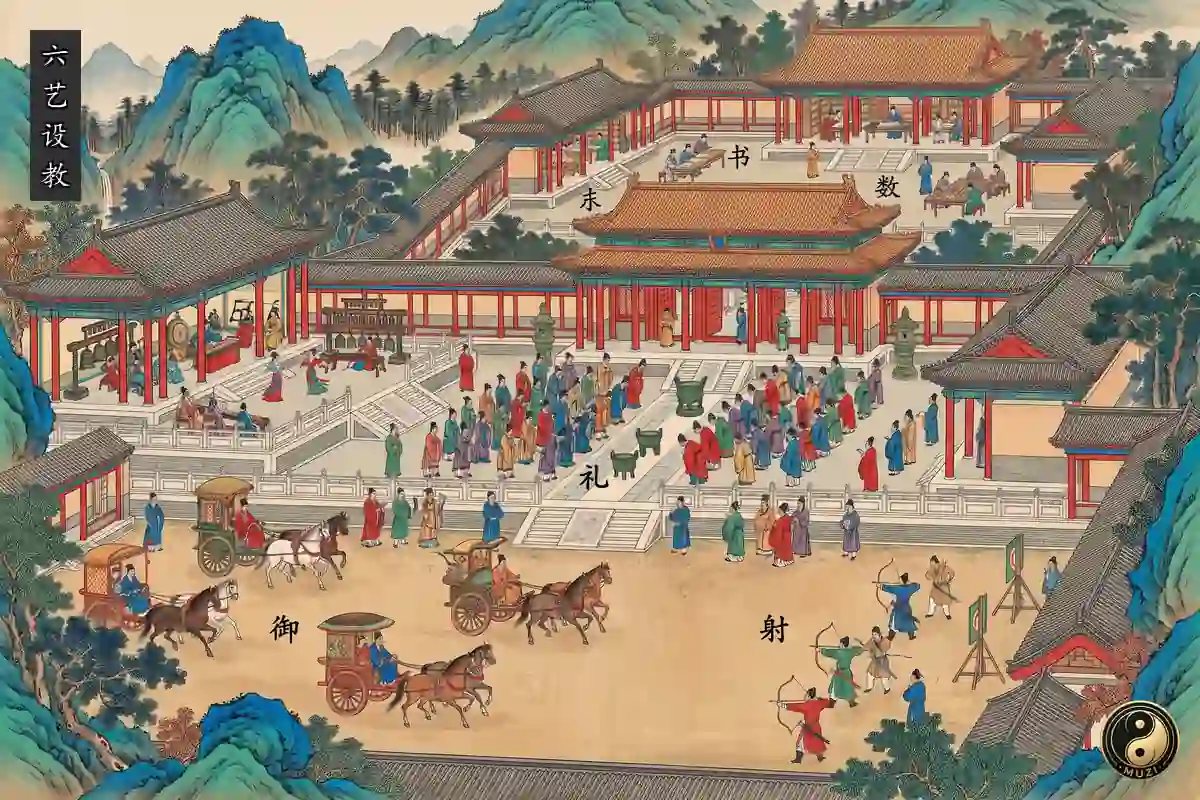
The Six Arts (*li*, *yue*, *she*, *yu*, *shu*, *shu*: ritual, music, archery, charioteering, calligraphy and arithmetic) formed an extremely hardcore full stack computing assembly norm. Among them, *li* and *yue* constituted the core logic layer of the operating system (the written tradition), responsible for forcibly flashing in awe for the patrilineal hierarchy and emotional resonance control rule, ensuring that no node ever exceeded its authority. *She* and *yu* were high frequency physical output tests (facilities drivers). They demanded that aristocrats achieve precision long range shooting atop chariots hurtling at full speed; this was not merely physical training, but an severe stress test of spatial geometry prediction, fluid mechanics, and multithreaded concurrent processing capacity. *Shu* (calligraphy) and *shu* (arithmetic) were the most foundational data exchange norms (the base level API). Calligraphy ensured the high fidelity transmission and decoding of government orders across vast territories; arithmetic directly interfaced with the state treasury's tax statistics, farmland surveys, and calendrical calculations. These six modules interlocked directly, forcibly compiling a biological human being into a standardized gear that could be directly plugged into the Zhou dynasty governing apparatus.
The operation of the Six Arts curriculum relies on repeatable structure. Through learning, imitation, institutionalization and daily use, people transform local experience into a more stable civilizational capacity. This process allows it to cross eras and continue shaping later ideas and practices. It also makes this chapter not merely historical knowledge, but a clue for observing how civilization accumulates capability.
The Six Arts curriculum also shapes different groups of people. Scholars, artisans, families, government offices, merchants, soldiers or local communities may all participate at different levels in its formation and transmission. It was an early aristocratic elite education program developing virtue, intellect, physique and aesthetics in a comprehensive manner, with mastery of both letters and arms as its overarching principle. This is precisely why it can form meaningful connections with other chapters. It has its own functional boundary, yet it also sends outward echoes in ideas, institutions or technique. This is its internal logic.
Six Arts Curriculum is a key node in Chinese civilization. Establishing ritual, music, archery, charioteering, calligraphy, and arithmetic under state management to train balanced, multifaceted elites. Its importance lies not only in naming an idea, but in showing how people, families, social order, and civilizational values connect. It gives the reader a first doorway into the logic of this chapter. Through it, abstract values enter concrete life.