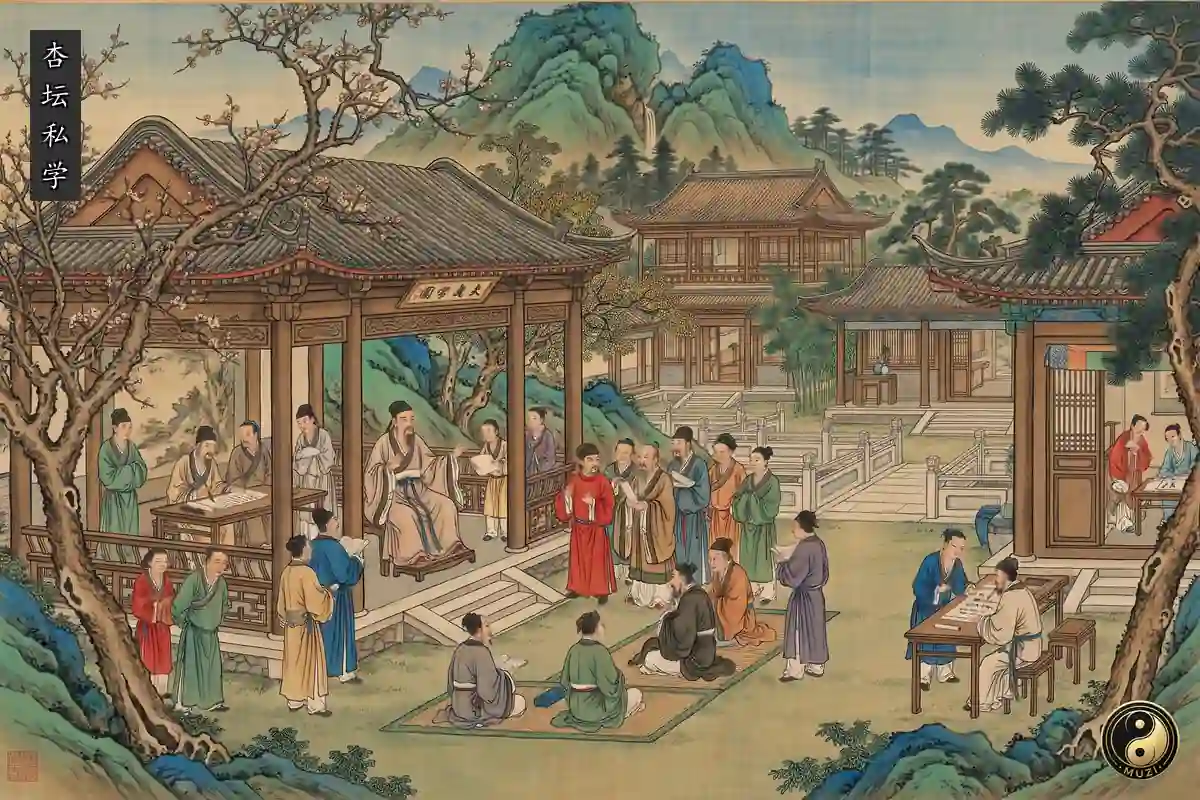






















In the late Spring and Autumn period, the imperial court of the Zhou Son of Heaven crashed completely. The collapse of rites and music (*li beng yue huai*) caused the official libraries and archives previously locked tightly within the princely courts to suffer physical destruction and leakage. The old blood aristocracy, degraded by prolonged inbreeding and declining administrative capability, could no longer maintain the system's normal operation. At the same time, as iron tools and ox plowing spread, civilian economic administrative capability exploded. Lower class commoners and the emerging landlord class, having obtained material wealth, desperately craved access to advanced knowledge rule to achieve upward class migration. The physical leakage of knowledge from official hubs to civilian local area systems had already become an irreversible tide of the era.
What is most worth noting about private tutoring at the Apricot Altar (*xing tan si xue*) is that it turns a seemingly familiar civilizational element into an entry point for understanding how society operates. Behind it are usually concrete people, institutions, technologies, ideas or scenes of daily life, not an empty label. Following this entry point, the reader will discover that Chinese civilization, when handling problems, often does not advance on a single track, but instead connects inner cultivation, outer norms, and shared life. This gives it both historical warmth and mechanical clarity.
The Apricot Altar private school was an extremely violent knowledge open source movement. Confucius directly bypassed the official identity verification system and set a devastatingly new access norm: *zi xing shu xiu yi shang, wu wei chang wu hui yan* (from anyone who has offered a bundle of dried meat upward, I have never refused instruction). As long as one paid the minimum physical tuition (a few strips of dried meat), whether one was a base level commoner, a merchant, or a fallen aristocrat, the system would unconditionally open the highest tier *li yue shu shu* API connection. In terms of administrative capability transmission mechanism, Confucius abandoned the one way data dumping of rote memorization and invented high frequency interactive Q and A (heuristic education). He dynamically adjusted the output rule flow according to each node's (student's) radically different personality parameters and computing bottlenecks (tailored instruction, *yin cai shi jiao*): throttling and speed limiting Zilu, while engaging turbo mode for Yan Hui. This operation of forcibly decoupling knowledge from bloodline directly incubated in the civilian sphere the first generation of independent rule auditors and system architects in Chinese history, the *shi* (scholar) class. It built up a massive pool of distributed civilian administrative capability in preparation for the coming great system overhaul of the Hundred Schools.
The operation of the Apricot Altar private school relies on repeatable structure. Through learning, imitation, institutionalization and daily use, people transform local experience into a more stable civilizational capacity. This process allows it to cross eras and continue shaping later ideas and practices. It also makes this chapter not merely historical knowledge, but a clue for observing how civilization accumulates capability.
The Apricot Altar private school also shapes different groups of people. Scholars, artisans, families, government offices, merchants, soldiers or local communities may all participate at different levels in its formation and transmission. It broke the aristocratic academic monopoly and promoted a commoner driven knowledge enlightenment revolution through universal instruction regardless of origin. This is precisely why it can form meaningful connections with other chapters. It has its own functional boundary, yet it also sends outward echoes in ideas, institutions or technique. This is its internal logic.
Private Academies is a key node in Chinese civilization. Confucius pioneering private tutoring and universal instruction, dismantling aristocratic text monopolies to democratize knowledge. Its importance lies not only in naming an idea, but in showing how people, families, social order, and civilizational values connect. It gives the reader a first doorway into the logic of this chapter. Through it, abstract values enter concrete life.