




















During the Wei, Jin and Northern and Southern Dynasties, the Nine Rank System (*jiu pin zhong zheng zhi*) produced the formidable reality of upper ranks without cold gate families, lower ranks without powerful clans (*shang pin wu han men, xia pin wu shi zu*). The highest administrator privileges of the state were physically monopolized by a handful of super gatekeeper clans, and imperial court commands could not penetrate these family barriers to reach the grassroots, leaving the empire facing a fatal crisis of systemic fragmentation. After the Sui and Tang reunification, imperial authority urgently needed to bypass the gatekeeper system and establish a direct channel connecting the central CPU to the vast grassroots administrative capability below. It had to invent a wholly new, objective selection mechanism independent of blood verification, forcibly nationalizing the finest brainpower resources across the entire system.
What is most worth noting about the imperial examination system (*ke ju xuan xian*) is that it turns a seemingly familiar civilizational element into an entry point for understanding how society operates. Behind it are usually concrete people, institutions, technologies, ideas or scenes of daily life, not an empty label. Following this entry point, the reader will discover that Chinese civilization, when handling problems, often does not advance on a single track, but instead connects inner cultivation, outer norms, and shared life. This gives it both historical warmth and mechanical clarity.
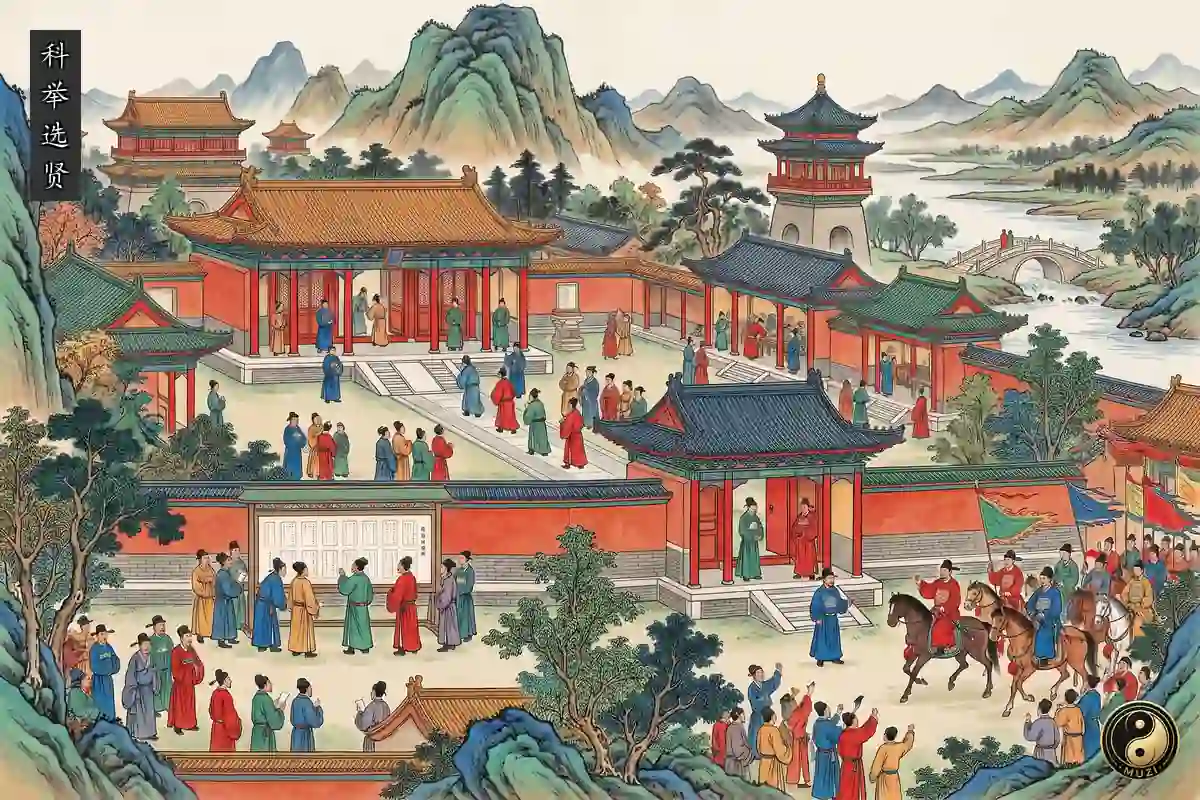
The imperial examination was an extremely cold blooded and rigorous standardized administrative capability test and norm docking system. It abolished the recommendation letter system and designated the Confucian classics (later the Four Books and Five Classics, *si shu wu jing*) along with poetry and prose as the sole examination rule standard. Through multiple tiers of distributed hub nodes such as the provincial exam (*xiang shi*), the metropolitan exam (*hui shi*), and the palace exam (*dian shi*), layer upon layer of filtering subjected millions of concurrent candidates' brains to severe stress testing. On the facilities side, the system enforced extremely strict physical separation (locking down the examination compound, *gong yuan suo yuan*) and anti cheating encryption mechanisms (name sealing, *hu ming fa*, and transcription, *teng lu fa*), completely severing any identity recognition backdoor on the grading end and ensuring absolute fairness in administrative capability evaluation. This design of extremely tightening pass rates produced a formidable side effect: it locked the attention and life administrative capability of every clever mind under heaven firmly onto rote memorization and logical dissection of the official standard documentation. It both selected the finest civil servant gears and, without shedding a drop of blood, standardized potential rebel hackers into guardians of the establishment.
The operation of the imperial examinations relies on repeatable structure. Through learning, imitation, institutionalization and daily use, people transform local experience into a more stable civilizational capacity. This process allows it to cross eras and continue shaping later ideas and practices. It also makes this chapter not merely historical knowledge, but a clue for observing how civilization accumulates capability.
The imperial examinations also shape different groups of people. Scholars, artisans, families, government offices, merchants, soldiers or local communities may all participate at different levels in their formation and transmission. Selecting officials through literary merit and dismantling hereditary clan privilege, they were a great mechanism for sustaining dynamic cross class mobility. This is precisely why they can form meaningful connections with other chapters. They have their own functional boundary, yet they also send outward echoes in ideas, institutions or technique. This is their internal logic.
Imperial Examinations is a key node in Chinese civilization. Dismantling dynastic aristocratic privilege by selecting talent through objective literary exams, creating a model for global meritocracy. Its importance lies not only in naming an idea, but in showing how people, families, social order, and civilizational values connect. It gives the reader a first doorway into the logic of this chapter. Through it, abstract values enter concrete life.