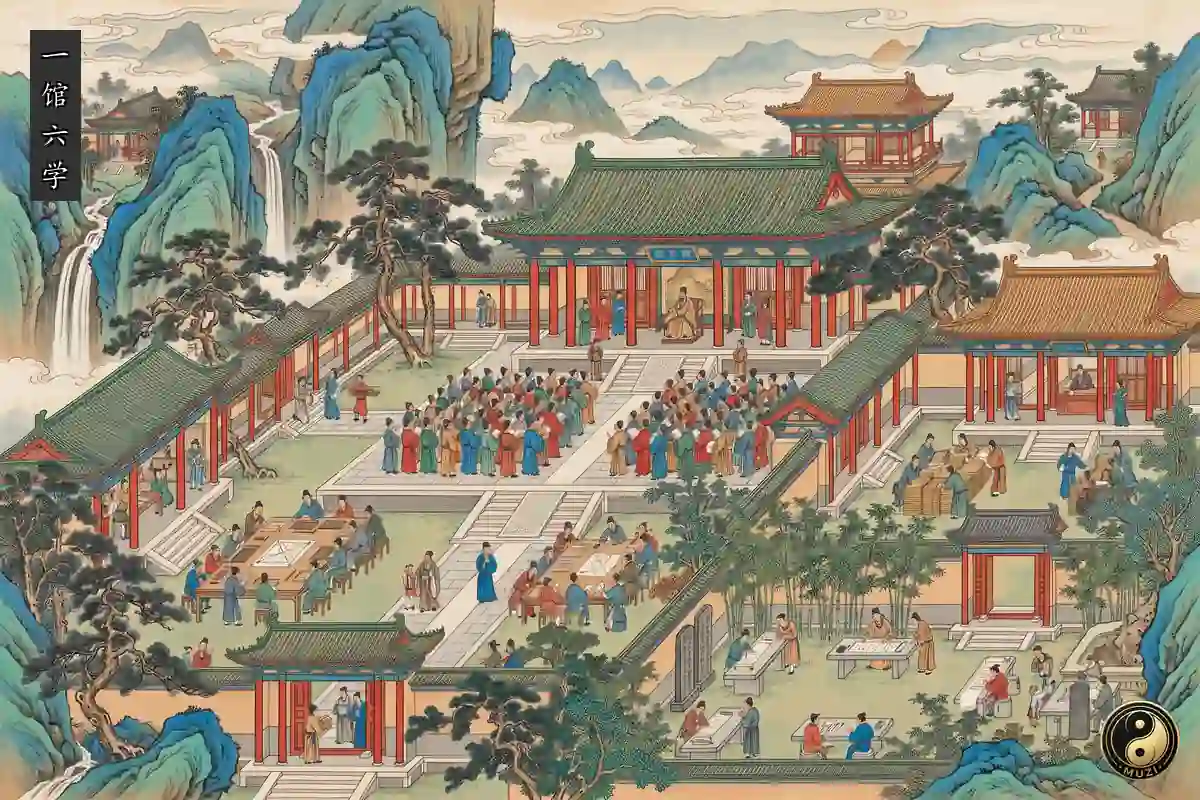





















As the Tang empire's territory expanded at breakneck speed and its economy underwent explosive growth, the data types the governing apparatus needed to process became enormously diverse. The vast judicial system required precision rule auditors (law studies), state finance and massive engineering projects demanded legions of numerical computation specialists (mathematics studies), and the standardized transmission of administrative documents depended on high precision visual output devices (calligraphy studies). Relying solely on Confucian macro architects versed only in the Four Books and Five Classics was no longer viable for addressing the high frequency errors popping up in vertical domains such as law, taxation and astronomy. The system urgently needed to open multithreaded, parallel tracks for training specialized hands on engineers alongside the generalist education pipeline.
What is most worth noting about the One Academy Six Schools (*yi guan liu xue*) system is that it turns a seemingly familiar civilizational element into an entry point for understanding how society operates. Behind it are usually concrete people, institutions, technologies, ideas or scenes of daily life, not an empty label. Following this entry point, the reader will discover that Chinese civilization, when handling problems, often does not advance on a single track, but instead connects inner cultivation, outer norms, and shared life. This gives it both historical warmth and mechanical clarity.
The One Academy Six Schools (*yi guan liu xue*: the Hongwen Academy, plus the Imperial Academy *guo zi xue*, the Grand Academy *tai xue*, the Four Gates Academy *si men xue*, Law School *lu xue*, Calligraphy School *shu xue*, and Mathematics School *suan xue*) formed a grid like facilities structure organized by hierarchical access permissions and professional specialization. Along the macro Confucian main line, it still enforced strict physical class filtering: the Imperial Academy opened only to the elite children of officials ranked third grade and above, while the Grand Academy and Four Gates Academy progressively admitted children of middle and lower tier bureaucrats. But its most hardcore system level innovation lay in spinning off independent specialized technical hubs (Law, Calligraphy and Mathematics). These technical colleges opened access to children of low ranking officials below the eighth grade and even commoner children, specifically teaching Tang dynasty legal rule, official document calligraphy parameters, and advanced mathematical computation models such as the *Jiu Zhang Suan Shu* (Nine Chapters on the Mathematical Art). This modular design of physically separating moral political general education (the macro CPU) from concrete execution skills (the graphics and arithmetic GPU) into distinct academies preceded Western modern specialized colleges by nearly a millennium, enormously boosting the empire's professional fault tolerance in complex governance scenarios.
The operation of the One Academy Six Schools system relies on repeatable structure. Through learning, imitation, institutionalization and daily use, people transform local experience into a more stable civilizational capacity. This process allows it to cross eras and continue shaping later ideas and practices. It also makes this chapter not merely historical knowledge, but a clue for observing how civilization accumulates capability.
The One Academy Six Schools system also shapes different groups of people. Scholars, artisans, families, government offices, merchants, soldiers or local communities may all participate at different levels in its formation and transmission. It was the prototype of a professionalized specialization matrix in disciplinary education, the law, mathematics and Grand Academy system established during the height of the Tang. This is precisely why it can form meaningful connections with other chapters. It has its own functional boundary, yet it also sends outward echoes in ideas, institutions or technique. This is its internal logic.
Imperial Academies is a key node in Chinese civilization. A professionalized higher education matrix under the Tang, establishing early specialized colleges for law, calligraphy, and mathematics. Its importance lies not only in naming an idea, but in showing how people, families, social order, and civilizational values connect. It gives the reader a first doorway into the logic of this chapter. Through it, abstract values enter concrete life.