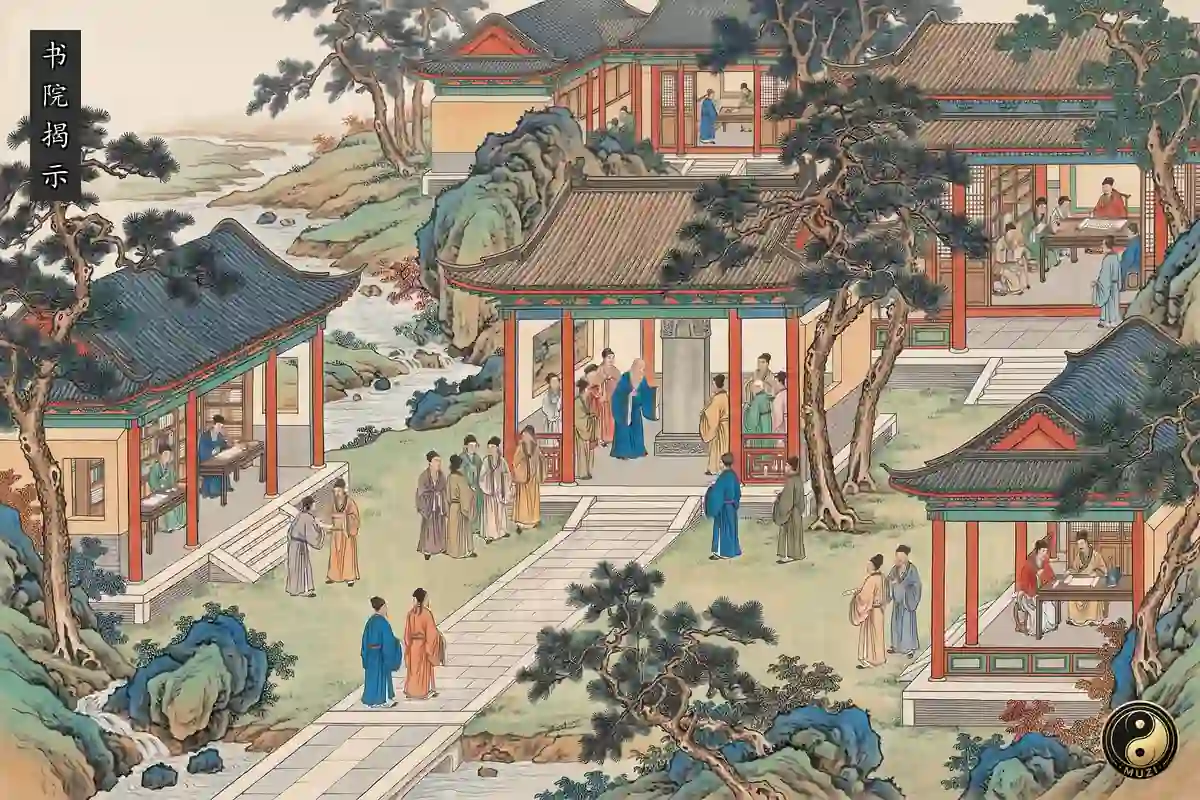






















By the Song dynasty, as the imperial examination became intensely competitive, official prefectural and county schools had entirely devolved into exam cramming factories, and the education system erupted with a severe utilitarian virus and moral hollowing out. Large numbers of Neo Confucian masters and senior system architects felt profound plight. In order to resist the rule ossification of the official education system, they urgently needed to retreat into mountain forests and establish an independent refuge, free from examination KPI assessment, devoted purely to exploring the highest truths of the universe (Neo Confucianism, *li xue*) and perfecting the individual's rule of heart and mind. This step shows the reader that it is not an isolated piece of knowledge, but a civilizational mechanism that continuously functions within real social relationships.
What is most worth noting about the Academy Regulations (*shu yuan jie shi*) is that they turn a seemingly familiar civilizational element into an entry point for understanding how society operates. Behind them are usually concrete people, institutions, technologies, ideas or scenes of daily life, not an empty label. Following this entry point, the reader will discover that Chinese civilization, when handling problems, often does not advance on a single track, but instead connects inner cultivation, outer norms, and shared life. This gives it both historical warmth and mechanical clarity.
The academy (*shu yuan*) was a de bureaucratized, highly autonomous civilian academic sandbox. It did not depend on court fiscal appropriations, but instead sustained itself and ran in the long term through collecting academy fields (*xue tian*, physical assets) and establishing private libraries (data centers). The *Jie Shi* (Regulations) drafted by Zhu Xi were, in essence, an extremely rigorous internalized error correction mechanism. They dispensed with cumbersome penal hard constraints and instead directly assembled into students' daily routines and mental reflex arcs the Confucian ethical grid of *fu zi you qin, jun chen you yi* (affection between father and son, righteousness between ruler and minister), as well as the cognitive iteration logic of *bo xue zhi, shen wen zhi, shen si zhi, ming bian zhi, du xing zhi* (study broadly, inquire carefully, think thoroughly, distinguish clearly, practice earnestly). This interactive open source community that prioritized seminar discussion over exam drilling, through its extremely hardcore moral discipline and spontaneous high frequency dialectical inquiry, constructed a physical barrier against secular utilitarianism, becoming the last bastion where later Confucian fundamentalists maintained the cultural bloodline.
The operation of the Academy Regulations relies on repeatable structure. Through learning, imitation, institutionalization and daily use, people transform local experience into a more stable civilizational capacity. This process allows it to cross eras and continue shaping later ideas and practices. It also makes this chapter not merely historical knowledge, but a clue for observing how civilization accumulates capability.
The Academy Regulations also shape different groups of people. Scholars, artisans, families, government offices, merchants, soldiers or local communities may all participate at different levels in their formation and transmission. They were autonomous scholarly incubators operating outside the official school system, perfectly fusing the investigation of things and extension of knowledge (*ge wu zhi zhi*) with the cultivation of heart and mind. This is precisely why they can form meaningful connections with other chapters. They have their own functional boundary, yet they also send outward echoes in ideas, institutions or technique. This is their internal logic.
Academy Regulations is a key node in Chinese civilization. Marking the rise of autonomous academies led by White Deer Grotto regulations, fusing self-cultivation with strict scholarship independent of state bureaucracy. Its importance lies not only in naming an idea, but in showing how people, families, social order, and civilizational values connect. It gives the reader a first doorway into the logic of this chapter. Through it, abstract values enter concrete life.