




















Although the Song dynasty imperial examination broke the gatekeeper clans, the one exam determines a lifetime randomness was extremely high, and candidates focused solely on memorizing standard answers, causing the state to consistently select officials who were high scoring but low capability. The empire's supreme reform committee (the Wang Anshi faction) needed to acquire pragmatic technical bureaucrats capable of driving comprehensive reform, and therefore had to perform a base level system reinstallation on the Grand Academy (*tai xue*), the state's core hub, introducing a dynamic assessment norm that could reflect real daily administrative capability. This step shows the reader that it is not an isolated piece of knowledge, but a civilizational mechanism that continuously functions within real social relationships.
What is most worth noting about the Three Hall examination system (*san xue she shi*) is that it turns a seemingly familiar civilizational element into an entry point for understanding how society operates. Behind it are usually concrete people, institutions, technologies, ideas or scenes of daily life, not an empty label. Following this entry point, the reader will discover that Chinese civilization, when handling problems, often does not advance on a single track, but instead connects inner cultivation, outer norms, and shared life. This gives it both historical warmth and mechanical clarity.
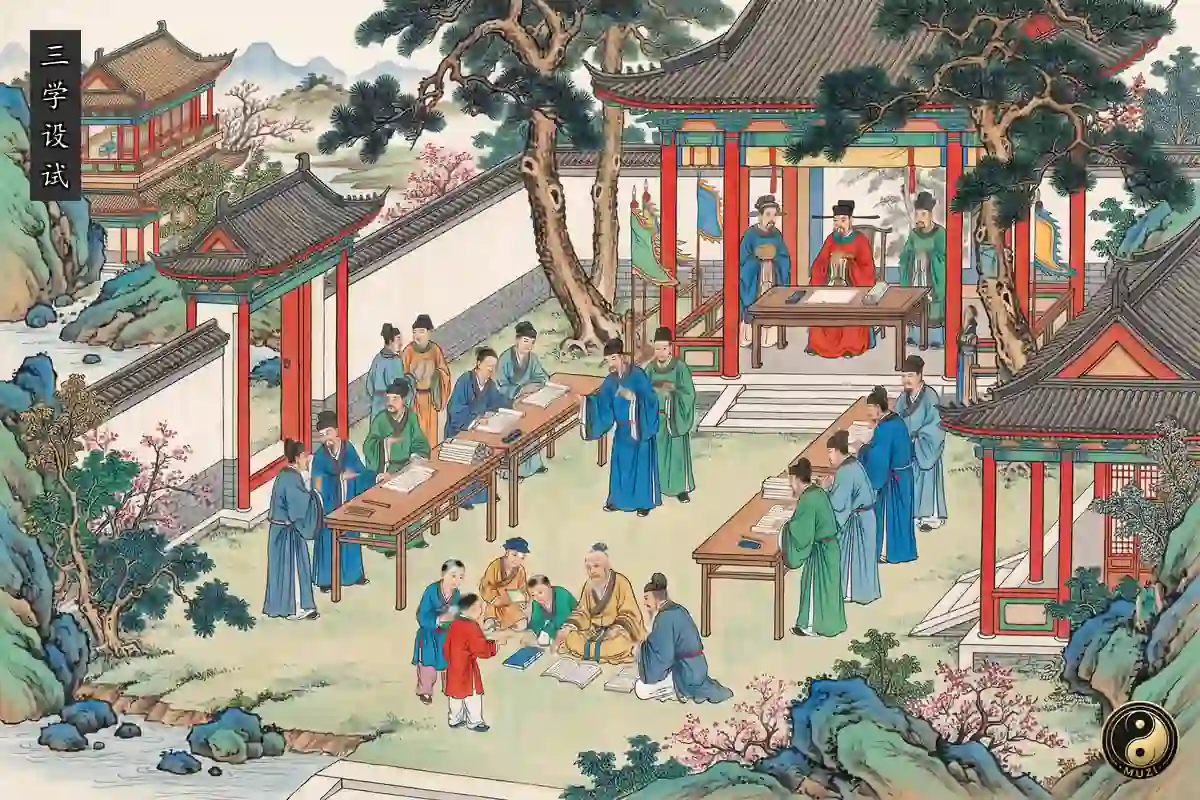
The Three Hall method (*san she fa*) completely shattered the static graduation assignment mechanism by physically dividing the Grand Academy into the Outer Hall, the Inner Hall, and the Upper Hall, three sandboxes with progressively increasing access privileges. All newly admitted nodes (students) had to first enter the Outer Hall and undergo the most basic system standardizing. Its core mechanism was high frequency monthly exams, quarterly exams, and annual elimination rounds. Only nodes whose daily assessment computing benchmarks met the standard could trigger the hall promotion norm, upgrading from the Outer Hall to the Inner Hall, and then from the Inner Hall to the Upper Hall. If benchmarks fell short, a demotion or even physical removal from the hub was immediately triggered as punishment. For the top tier academic prodigies who held the leaderboard in the highest level Upper Hall over extended periods, the system granted a rule transcending helicopter privilege: they could directly bypass the brutal imperial civil examination and have the system automatically issue administrator credentials (conferred the title of successful candidate, *ci ji di*, and directly appointed to office). This intensely competitive point based elimination mechanism forcibly maxed out the daily power consumption of Grand Academy students and maximized the execution capability of the bureaucratic reserve corps.
The operation of the Three Hall examination system relies on repeatable structure. Through learning, imitation, institutionalization and daily use, people transform local experience into a more stable civilizational capacity. This process allows it to cross eras and continue shaping later ideas and practices. It also makes this chapter not merely historical knowledge, but a clue for observing how civilization accumulates capability.
The Three Hall examination system also shapes different groups of people. Scholars, artisans, families, government offices, merchants, soldiers or local communities may all participate at different levels in its formation and transmission. It was a system of rolling credit transfer and dynamic promotion and demotion assessment, an efficient dynamic academic credit mechanism within classical higher learning institutions. This is precisely why it can form meaningful connections with other chapters. It has its own functional boundary, yet it also sends outward echoes in ideas, institutions or technique. This is its internal logic.
Three-Hall System is a key node in Chinese civilization. Wang Anshi's radical academic reform establishing rolling evaluation and tiered elimination within higher learning, finalizing elite selection paths. Its importance lies not only in naming an idea, but in showing how people, families, social order, and civilizational values connect. It gives the reader a first doorway into the logic of this chapter. Through it, abstract values enter concrete life.