



















In the late Ming and early Qing, and especially the late Qing period, the closed door policy caused Chinese civilization's technology tree to stagnate for an extended period. When Western powers, wielding gunboats and cannons (the dimensionally reduced physical kinetic energy delivered by the Industrial Revolution), forcibly tore open the gates of the empire, the traditional Four Books, Five Classics, and ethical defense grid crumbled like paper toys before modern firearms. The empire faced its most severe crisis of total systemic collapse since the Xia and Shang. Ruling elites and the intellectual class, in severe anguish and shock, realized they had to break out of their prison and forcibly introduce a radically different Western mathematical, physical and chemical computational framework to rescue the civilization's core, which was on the verge of death.
What is most worth noting about the Eastern Transmission of Western Learning (*xi xue dong jian*) is that it turns a seemingly familiar civilizational element into an entry point for understanding how society operates. Behind it are usually concrete people, institutions, technologies, ideas or scenes of daily life, not an empty label. Following this entry point, the reader will discover that Chinese civilization, when handling problems, often does not advance on a single track, but instead connects inner cultivation, outer norms, and shared life. This gives it both historical warmth and mechanical clarity.
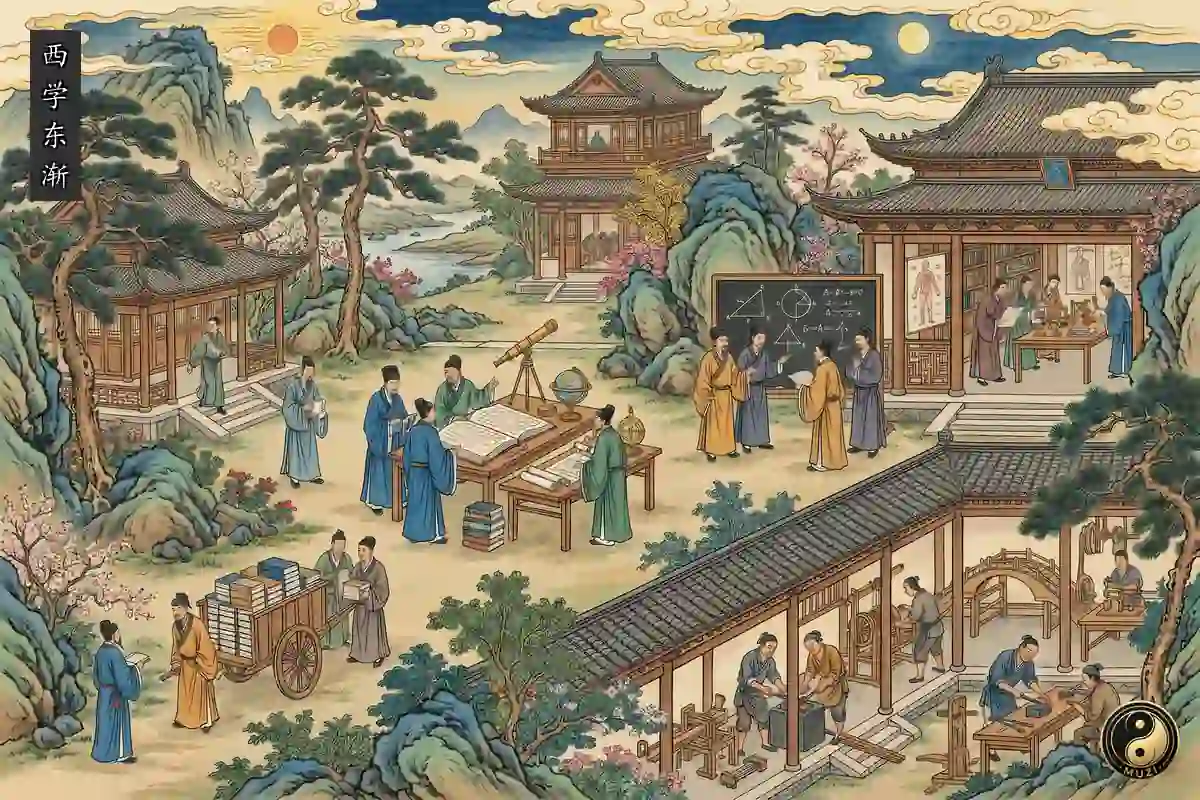
The Eastern Transmission of Western Learning was an extremely brutal cross civilizational forced system rule transplant surgery. From Xu Guangqi translating Euclid's *Elements* to introduce rigorous Western logical deduction, to the Self Strengthening Movement's establishment of the Tongwen Guan (the Capital School of Combined Learning) and the mass dispatch of young students to study in America, Chinese civilization began passively and violently uninstalling its old metaphysical and classical studies master control programs. This transplant process was riddled with high disorder rejection reactions. The old guard's defenders of orthodoxy, in order to protect their own system privileges, fought to the death to block the writing in of heretical rule such as calculus, Newtonian mechanics, and modern chemical equations. But the cruel data of geopolitical wars proved again and again that the old parameters had failed. In the end, the pioneers, through the compromise patch of Chinese substance, Western application (*zhong ti xi yong*), painstakingly welded modern science's experimental empirical standards and mathematical logic matrices into the shell of traditional culture. This knowledge system overhaul, a blood and bone severing transfusion, was painful, yet it successfully installed in the ancient Eastern dragon the modern physical engine needed to enter industrial civilization.
The operation of the Eastern Transmission of Western Learning relies on repeatable structure. Through learning, imitation, institutionalization and daily use, people transform local experience into a more stable civilizational capacity. This process allows it to cross eras and continue shaping later ideas and practices. It also makes this chapter not merely historical knowledge, but a clue for observing how civilization accumulates capability.
The Eastern Transmission of Western Learning also shapes different groups of people. Scholars, artisans, families, government offices, merchants, soldiers or local communities may all participate at different levels in its formation and transmission. It was the grand introduction of modern natural and social sciences, iterating the civilizational cognitive framework through intense pain. This is precisely why it can form meaningful connections with other chapters. It has its own functional boundary, yet it also sends outward echoes in ideas, institutions or technique. This is its internal logic.
Western Learning Influx is a key node in Chinese civilization. The massive introduction of modern natural and social sciences, absorbing external factors through painful adaptation to update the knowledge framework. Its importance lies not only in naming an idea, but in showing how people, families, social order, and civilizational values connect. It gives the reader a first doorway into the logic of this chapter. Through it, abstract values enter concrete life.