In the fourth year of Ming Yongle (1406 CE), Zhu Di, having seized the throne through the Jingnan Campaign, issued an edict to relocate the capital from Nanjing to Beijing and construct an entirely new palace complex modeled on the Nanjing imperial palace. The project was led by the master builder Kuai Xiang from the Xiangshan artisan guild of Suzhou, mobilizing one million conscript laborers from across the nation: precious nanmu timber was felled from southwestern forests, massive white marble blocks were quarried from Fangshan, specially made floor tiles called *jin zhuan* (golden bricks) were custom ordered from Suzhou. The construction took fourteen full years to complete. The entire palace complex strictly follows the *Zhou Li Kaogong Ji* dictum *jiang ren ying guo, fang jiu li, pang san men* (the builder designs the capital as a square of nine *li* per side with three gates on each face), using a central axis as the spinal column of its spatial hierarchy.
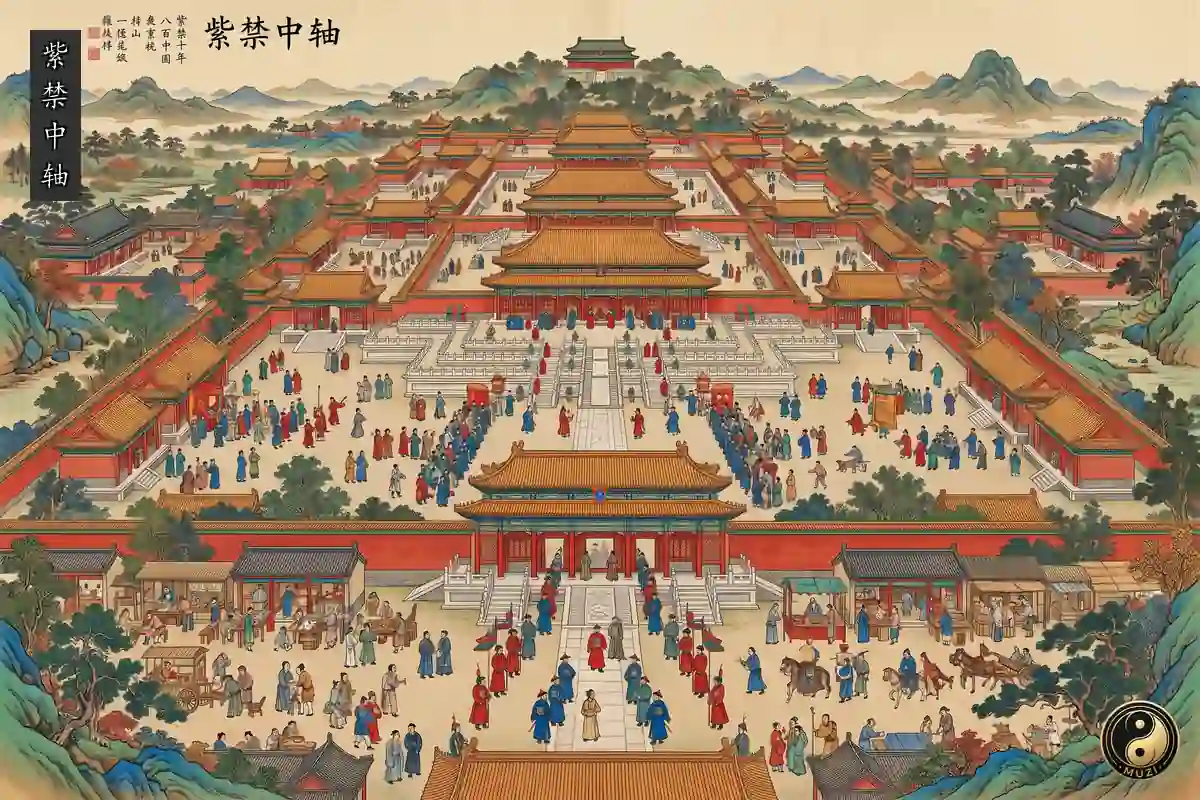
This central axis begins at Yongding Gate in the outer city to the south, passing sequentially through Zhengyang Gate, Tiananmen, Duanmen and Wumen, through the Gate of Supreme Harmony to reach the Forbidden City's core zone. The three Great Halls, Taihe Dian (Hall of Supreme Harmony), Zhonghe Dian (Hall of Central Harmony), and Baohe Dian (Hall of Preserving Harmony), stand elevated on a three tier white marble platform, forming the ritual center of the Outer Court. Continuing north through the Gate of Heavenly Purity into the Inner Court: Qianqing Gong (Palace of Heavenly Purity), Jiaotai Dian (Hall of Union), and Kunning Gong (Palace of Earthly Tranquility), then through the Imperial Garden out Shenwu Gate, ascending Jingshan's Wanchun Pavilion and proceeding northward to terminate at the Drum Tower and Bell Tower. The total length is approximately 7.8 kilometers, making it one of the world's longest and best preserved urban central axes. Taihe Dian is the largest surviving timber frame palace hall in China.
The progression from Wumen Gate into the Forbidden City is a precisely engineered spatial psychological sequence. Wumen, also called the Five Phoenix Tower, has a lofty frontal rampart with wing towers extending forward on both sides, forming a U shaped enclosed space. Stepping into it and looking up at the high walls on all sides, a sudden sense of compression arises, compelling the visitor to involuntarily lower their head and quiet their breath, psychologically entering a state of submission before even seeing the emperor. Passing through the Wumen tunnel, the field of vision suddenly opens: the Inner Golden Water River (*Nei Jinshui He*) meanders from west to east across the plaza, five white marble arch bridges span it like rainbows resting on water, and sky light and cloud reflections flow across the river surface, releasing the visitor from the preceding claustrophobia into a moment of grandeur and wonder.
The Forbidden City contains 980 surviving buildings with 8,886 rooms, covering a total area of 72 hectares, surrounded by walls nearly eight meters high and a moat 52 meters wide. The three Great Halls of the Outer Court take the three yang lines of the *Qian* (Heaven) hexagram to correspond to heaven; the three palaces of the Inner Court take the *Kun* (Earth) hexagram to represent earth; the six palaces on east and west sides each take the number six to match the six lines of the *Kun* hexagram, embodying the cosmic view of yin yang complementarity and the positioning of Heaven and Earth. Nearly all roofs are covered with imperial yellow glazed tiles, except for the Wenyuan Pavilion which uses black tiles on the principle that water conquers fire to protect the books stored within, and the Eastern Palace residence of the Crown Prince uses green glazed tiles to symbolize growth and renewal.
Behind the northern side of the Hall of Preserving Harmony lies a massive stone carving weighing approximately 200 tons, over 16 meters long and over 3 meters wide. It was transported from the Fangshan quarry during harsh winter by pouring water along the route to form ice, then sliding it on a dry dock sled to the Forbidden City, making it the largest single piece stone carving in the palace. On either side of the Hall of Supreme Harmony plaza stand the Hall of Military Eminence (*Wuying Dian*) and the Hall of Literary Glory (*Wenhua Dian*), one for military affairs and one for literary affairs, symbolizing the equal importance of civil governance and martial strength. The corner towers at the four corners feature extraordinarily complex roof forms with 72 ridges; folk legend holds that only with the divine guidance of Master Lu Ban could craftsmen assemble them. These details together constitute a symbolic system of enormous depth extending from the macro axis down to the smallest ornamental element.
The internal logic of why the Forbidden City's central axis occupies a unique position in world architectural history lies in its fusion of Confucian ritual hierarchy, the cosmological schema of yin yang and the five elements, and the physical spatial experience of system into a single indivisible system using brick, stone, timber and tile to construct a world through which one can walk and physically perceive order. This axis is not merely the city's spine but the supreme crystallization of imperial China's political ideals and spatial imagination. It proves that system has never been merely a practical shelter from wind and rain, but the most direct means by which a civilization expresses its core beliefs to heaven, earth and humanity.