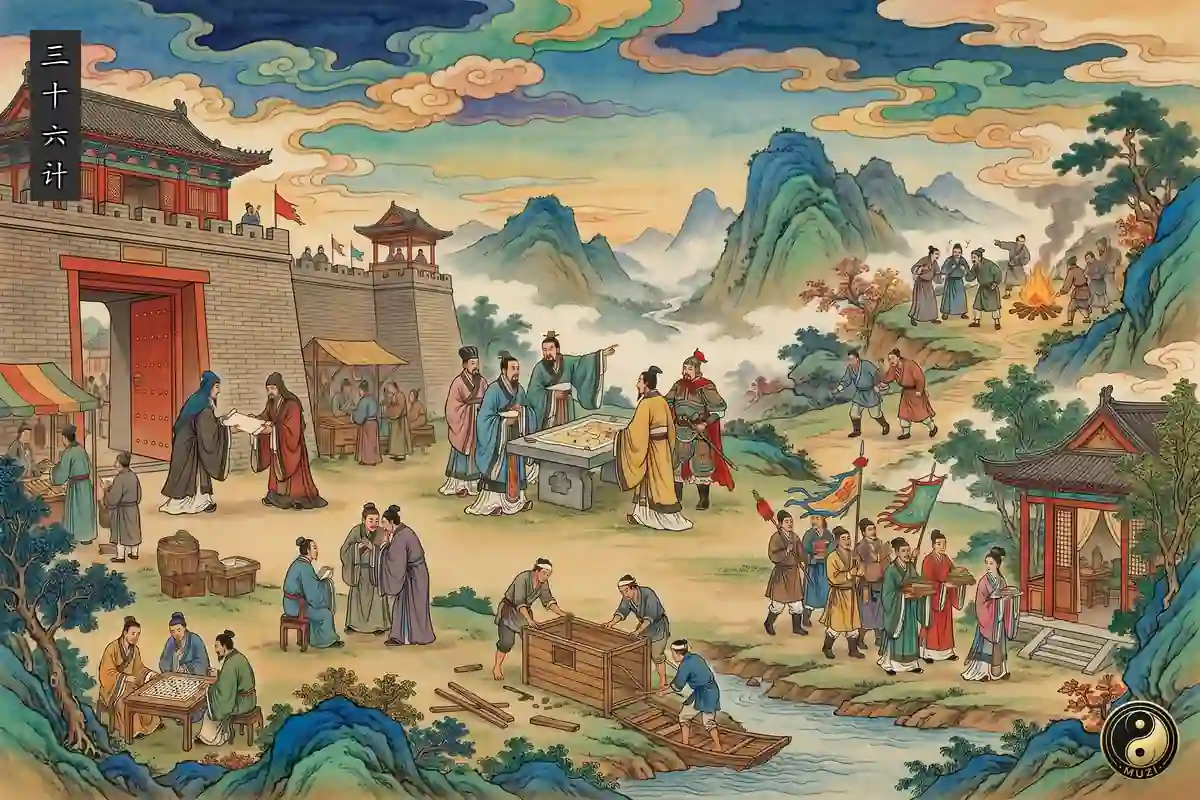
The Thirty-Six Stratagems is an ancient Chinese tactical compendium that uses extremely concise language to contain techniques of information manipulation and psychological attack applicable to both the battlefield and the marketplace. Unlike the Art of War, which provides a macro-strategic framework, the Thirty-Six Stratagems constitute a library of tactical modules that can be directly loaded and immediately executed. Each stratagem is in essence an information-attack scheme targeting a specific vulnerability in human cognition: *man tian guo hai* (cross the sea by deceiving the sky) manipulates visual attention, *sheng dong ji xi* (make a feint to the east while attacking in the west) manipulates the spatial allocation of attention, *jie dao sha ren* (kill with a borrowed knife) manipulates the intervention of a third party's force. Stratagems can be freely combined and flexibly switched, paralyzing the enemy's decision-making system inside a fog of information.
The textual origin and date of assembly of the Thirty-Six Stratagems have long been debated. The name first appears in the History of the Southern Qi (Biography of Wang Jingze, c. fifth century): during a rebellion, Wang Jingze quoted a popular saying, *Tan gong san shi liu ce, zou wei shang ji* (Of Lord Tan's thirty-six stratagems, retreat is the best). As a complete military manual, however, the text emerged only during the Ming and Qing dynasties. The received edition is organized into six suites (stratagems for winning engagements, for confronting the enemy, for attacking, for chaotic situations, for combined operations, and for defeat), with six entries per suite totaling thirty-six. Each stratagem is summarized in a four- or five-character phrase capturing its core operational logic, accompanied by a brief strategic explanation and historical battle example.
Many individual stratagems are not abstract tactical concepts but concrete tactical labels with explicit historical origins and specific battle names. For example, *wei Wei jiu Zhao* (besiege Wei to rescue Zhao) derives from the Records of the Grand Historian (Biographies of Sun Tzu and Wu Qi): in 354 BCE, Wei attacked Zhao, and Zhao appealed to Qi for help; the Qi commander Tian Ji and his strategist Sun Bin, rather than marching directly to rescue Zhao, struck straight at the Wei capital Daliang, forcing the Wei army to abandon its siege and rush home, where it was ambushed and routed by the Qi forces en route. This classic indirect-approach concept remains a mandatory case study in military-tactics textbooks today. An early version of *jie dao sha ren* (kill with a borrowed knife) appears in the Zuo Zhuan: Duke Zhuang of Zheng exploited the conflict between Song and Xu, first provoking Song to attack Xu, then using Xu's grievance as a pretext to attack Song, engineering a chain of interlocking strikes among three states.
The classification system of the thirty-six stratagems is tightly matched to their strategic function. The winning-engagement suite (*man tian guo hai*, *wei Wei jiu Zhao*, *jie dao sha ren*, *yi yi dai lao*, *chen huo da jie*, *sheng dong ji xi*) applies to offensive strategies when one holds the advantage. The defeat suite (*mei ren ji*, *kong cheng ji*, *fan jian ji*, *ku rou ji*, *lian huan ji*, *zou wei shang*) provides survival schemes for situations of absolute inferiority where conventional tactics have failed: the empty-city stratagem creates uncertainty by deliberately exposing weakness, the beauty stratagem uses non-military means to divide the enemy's core decision-makers, and retreat is best cuts losses decisively when all other options are exhausted.
In popular culture, the influence of the Thirty-Six Stratagems has long transcended the military domain. Phrases such as *jie dao sha ren*, *chen huo da jie*, and *zou wei shang* have become high-frequency idioms in everyday Chinese. In commercial competition and workplace maneuvering, the terminology of the thirty-six stratagems is routinely borrowed to describe market strategies and interpersonal dynamics. This pervasive popular penetration proves a fundamental point: the stratagems target not specific battlefield conditions but universal psychological weaknesses in human decision-making: overconfidence, attentional bias, information blind spots, and the sunk-cost trap. These weaknesses are long-lasting features of human nature that transcend eras and civilizations.
The process by which the Thirty-Six Stratagems were rediscovered and rehabilitated in twentieth-century China is itself noteworthy. In 1941, a handwritten manuscript entitled Thirty-Six Stratagems was found at a secondhand book stall in Binzhou (present-day Bin County), Shaanxi; it is the earliest known surviving version of the original text. During the War of Resistance against Japan, generals on both the Nationalist and Communist sides cited specific stratagems to guide actual operations: Mao Zedong in On Protracted War effectively employed the thinking of *yi yi dai lao* (wait at ease for the exhausted enemy) to direct guerrilla warfare, avoiding decisive engagements with the main Japanese force and wearing down the enemy's fighting will and supply capacity through prolonged attrition. After the Reform and Opening Up, application of the thirty-six stratagems in the commercial sphere expanded dramatically, with many entrepreneurs treating the book as a practical manual for competitive strategy, using *chu qi zhi sheng* (prevail through the unexpected) as a guiding principle to identify unexploited profit spaces in the market.
The internal logic of the Thirty-Six Stratagems is to design every tactical action, on the premise of entirely discarding moral constraints, as a precision strike against the enemy's decision-making system: information deception to disrupt perception, psychological manipulation to distort judgment, timing optimization to maximize action efficiency. In essence, the stratagems are a systematic exploitation manual for human cognitive vulnerabilities, and this is precisely the fundamental quality that makes them simultaneously admired and feared. This is why the Thirty-Six Stratagems, as a body of pure tactical wisdom, have been continuously studied across the boundaries of war and peace, of East and West.