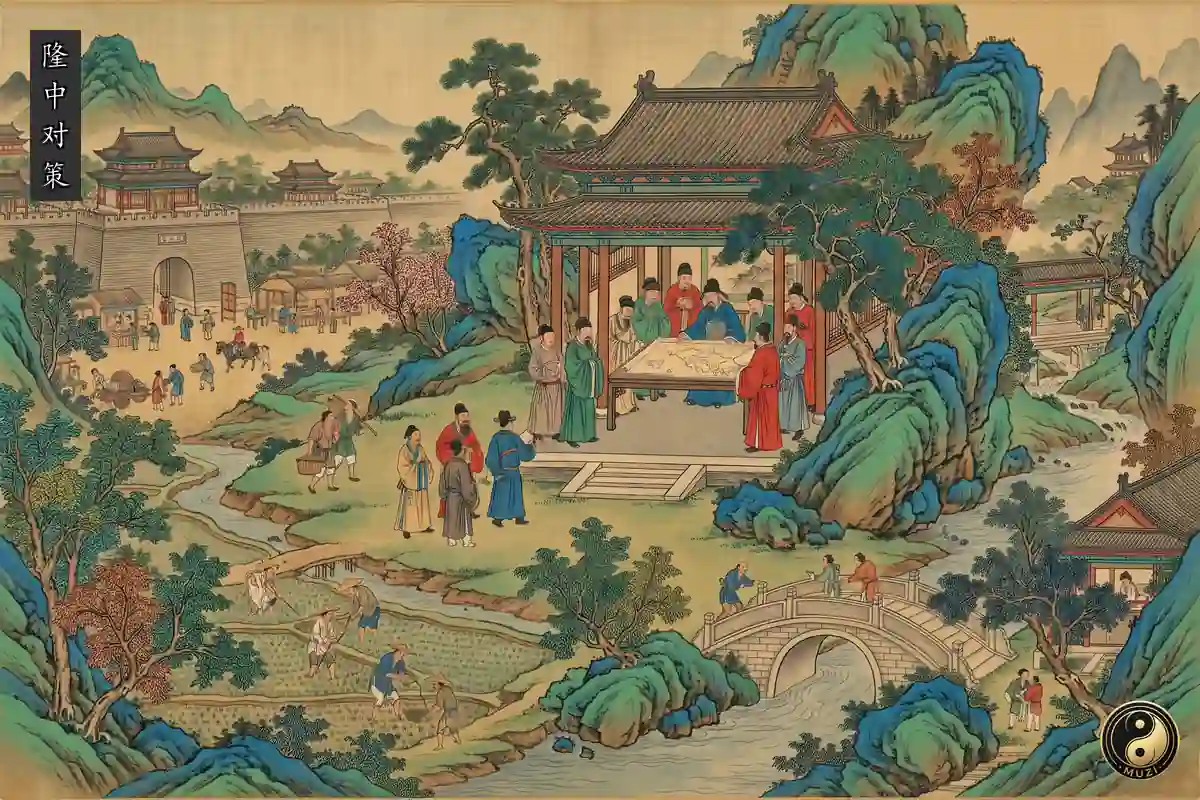
The Longzhong Plan is the most celebrated geopolitical strategic blueprint in Chinese history, presented by Zhuge Liang to Liu Bei in the twelfth year of the Jian'an reign (207 CE) at Longzhong, west of present-day Xiangyang in Hubei province. The Records of the Three Kingdoms (Biography of Zhuge Liang) preserves the full text of this conversation: at the time, Liu Bei was approaching fifty, having taken refuge under the Jingzhou warlord Liu Biao and stationed his forces at Xinye; Zhuge Liang was only twenty-seven, living in seclusion at Longzhong, personally tilling the fields, yet he had already conducted a supremely penetrating analysis of the empire's power dynamics. *You shi xian zhu sui yi Liang, fan san wang, nai jian* (Thereupon the lord went to call on Liang; three visits in all were made before he was received): Liu Bei visited Longzhong three times; on the first two occasions Zhuge Liang was absent, and only on the third did they meet.
Zhuge Liang's assessment of the strategic situation proceeded on three levels. First: Cao Cao *yi yong bai wan zhi zhong, xie tian zi er ling zhu hou, ci cheng bu ke yu zheng feng* (already commands a million troops and manipulates the Son of Heaven to issue orders to the feudal lords; he truly cannot be directly challenged); the disparity in strength was too great, and Cao Cao's hegemony in the north had to be acknowledged as an unchallengeable fact. Second: Sun Quan *ju you Jiang Dong, yi li san shi, guo xian er min fu, xian neng wei zhi yong, ci ke yi wei yuan er bu ke tu ye* (holds the Jiangdong region, where three generations have established themselves, the terrain is perilous, the people are loyal, and capable men serve him; he can be an ally but not a target); Sun Quan's regime was firmly rooted, rich in talent, and geographically formidable. Third: Jingzhou and Yizhou: the former *bei ju Han Mian, li jin Nan Hai, dong lian Wu Hui, xi tong Ba Shu* (commands the Han and Mian rivers to the north, reaches the South Sea to the south, connects with Wu to the east, and links to Ba and Shu to the west); the latter was *wo ye qian li, tian fu zhi tu* (fertile plains stretching a thousand li, a land of heavenly abundance). Neither had a strong ruler, and both were strategic bases Liu Bei could and must seize.
The core strategy Zhuge Liang proposed, *dong lian Sun Quan, bei ju Cao Cao, kua you Jing Yi* (ally eastward with Sun Quan, resist Cao Cao to the north, and straddle both Jingzhou and Yizhou), was a perfectly calibrated tripartite equilibrium scheme. From a geopolitical standpoint, the logic of these three steps was exceptionally clear: first, seize Jingzhou as a forward base controlling the strategic hub of the middle Yangtze; second, conquer Yizhou to secure an undisturbed rear production base; finally, leveraging the east-west pincer formed by Jingzhou and Yizhou, await *tian xia you bian* (a shift in the empire's fortunes, meaning internal turmoil in the Central Plains or a crisis on the northern frontier) to launch a two-pronged northern campaign.
The influence of the Longzhong Plan extended far beyond the Three Kingdoms period. Over the subsequent eighteen hundred years of Chinese history, innumerable geopolitical crises compelled decision-makers to return to Zhuge Liang's assessment of the strategic value of Jingzhou and Yizhou for inspiration. During the Southern Song, court debates raged over whether to push the Yangtze defense line from the Jingzhou-Xiangyang corridor into the Central Plains; cautious voices invoked Zhuge Liang's *tian xia you bian* principle against premature northern expeditions. In the late Ming, the rebel leaders Zhang Xianzhong and Li Zicheng followed military paths between Sichuan and Huguang that almost exactly replicated the plan's strategic template. Even in the 1940s during the War of Resistance against Japan, the Nationalist government's decision to make Chongqing the wartime capital, using Yizhou as a rear base, the Yangtze as a natural barrier, and waiting for a shift in the international situation, was strategically identical in spirit to the Longzhong Plan.
In the decade following the Battle of Red Cliffs (208 CE), the plan essentially achieved its first-phase objectives: Zhuge Liang personally traveled to Eastern Wu to forge the Sun-Liu alliance; at Red Cliffs, fire attacks shattered Cao Cao's combined land and naval force; the allies subsequently seized four commanderies in southern Jingzhou and conquered Yizhou in 214 CE. But the unexpected loss of Jingzhou in 219 CE, when Guan Yu's northern campaign was ambushed by Eastern Wu, destroyed the two-pronged northern offensive the plan had envisioned. Thereafter, Zhuge Liang's five northern expeditions (228 to 234 CE) could only strike from a single axis through the Qinling mountains, never breaking through Cao Wei's defenses. He died of illness at the Wuzhangyuan military camp at the age of fifty-four.
The Longzhong Plan is equally essential for understanding Zhuge Liang's political philosophy. The plan's keyword is not restore the Han dynasty, a point frequently misread in later literary romances. Zhuge Liang never once invoked the political slogan of Han restoration in his proposal; his strategic premises were entirely pragmatic: acknowledging Cao Cao and Sun Quan as two existing great powers whose elimination was impossible, and accepting a tripartite division as the only viable equilibrium under real conditions. Zhuge Liang's lifelong endeavor was not the restoration of a defunct dynasty but the creation of a sustainable, self-legitimizing political survival space for Liu Bei's faction. The highest purpose of his five northern expeditions was not to sweep away Cao Wei and unify the realm but to maintain strategic initiative through active offense, preventing Cao Wei from assembling a severe all-out assault against Shu-Han. Only by grasping this point can one correctly appreciate the historical significance of the Longzhong Plan: it was not an idealist manifesto of dynastic restoration but an unprecedentedly sober analysis of power politics.
The internal logic of the Longzhong Plan is to achieve the maximum strategic transformation with the minimum military conflict. In essence, it is an operating manual for going from no seat at the table to establishing the table itself: amid encircling enemies, first clearly identify who is unconquerable, who is a potential ally, and who is ripe for the taking, then use alliance and precision strikes to sculpt a favorable and sustainable strategic equilibrium. This is precisely why the Longzhong Plan is the most classic zero-to-one geopolitical blueprint in the history of Chinese strategic thought: it was not a grandiose declaration of ideals but an executable plan grounded in a precise calculation of the actual balance of power.