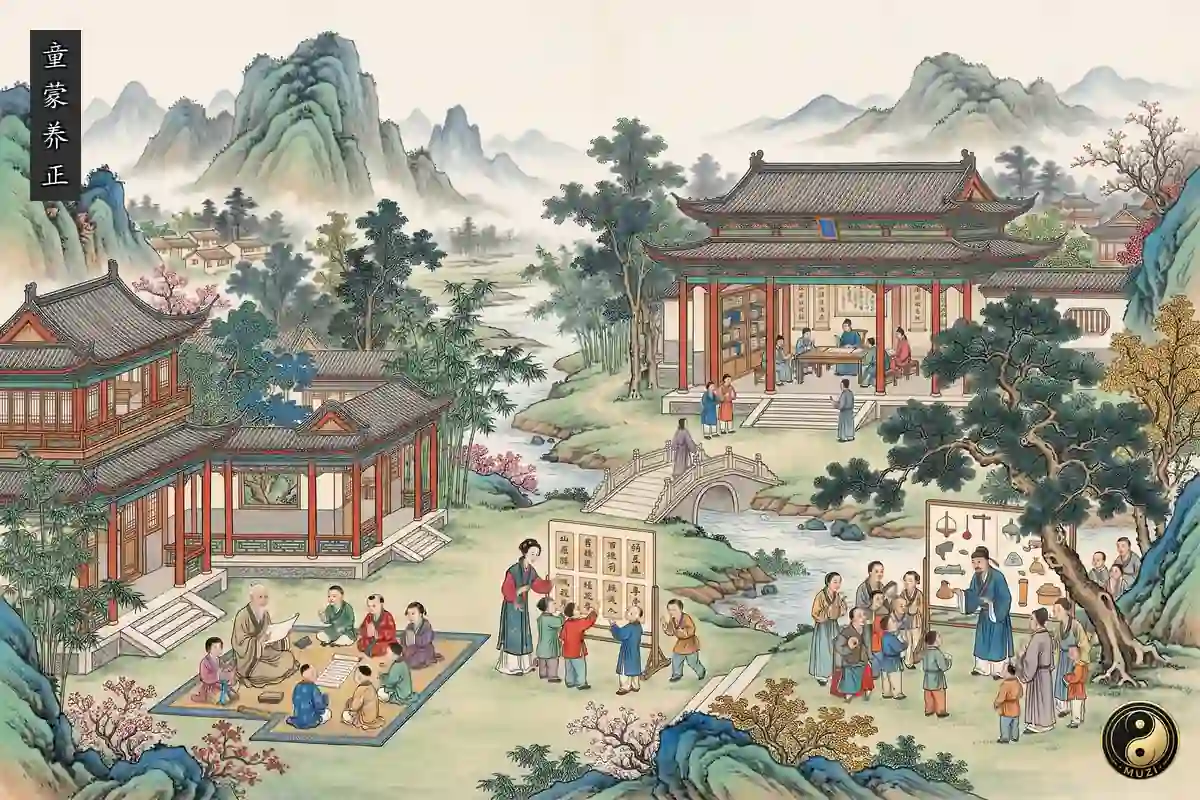





















As papermaking and movable type printing became widespread, and as the imperial examination exerted unlimited allure on the commoner class, society's demand for basic education (literacy and rules) underwent explosive growth. However, the original Confucian guideline such as the *Lun Yu* (Analerta) and the *Wu Jing* (Five Classics) was abstruse and profound; for lower level child nodes whose administrative capability had not yet fully developed, directly reading it would easily cause a brain crash. The civilian sphere urgently needed a micro compression pack decoder that could deliver low threshold access while bundling literacy functions with values packaging. This step shows the reader that it is not an isolated piece of knowledge, but a civilizational mechanism that continuously functions within real social relationships.
What is most worth noting about primary moral cultivation (*tong meng yang zheng*) is that it turns a seemingly familiar civilizational element into an entry point for understanding how society operates. Behind it are usually concrete people, institutions, technologies, ideas or scenes of daily life, not an empty label. Following this entry point, the reader will discover that Chinese civilization, when handling problems, often does not advance on a single track, but instead connects inner cultivation, outer norms, and shared life. This gives it both historical warmth and mechanical clarity.
The primer education system (*meng xue*) was an extremely ingenious rhythmic data compression mechanism. Its architects violently pulverized and reassembled vast bodies of astronomy, geography, history, philosophy and ethical rules into minimal rule blocks of three or four characters per line (such as *ren zhi chu, xing ben shan*, at the beginning of human life, nature is inherently good). This direct tonal parallelism and rhyme scheme exploited the human brain's innate recollection vulnerability for musical rhythm, formidably reducing the storage and retrieval energy cost of information. Young children did not need to understand the complex logical matrix behind the text; they only needed to perform high frequency repeated recitation as if playing audio, and could thereby complete the physical storing of several thousand core Chinese characters. Even more formidable was that these catchy audio packets had been covertly hard coded with the most stringent Confucian patrilineal obedience norms and ethical values. As children's administrative capability gradually decompressed these texts with age, they had already been firmly standardized into safe base level components conforming to the empire's operational standards.
The operation of primary moral cultivation relies on repeatable structure. Through learning, imitation, institutionalization and daily use, people transform local experience into a more stable civilizational capacity. This process allows it to cross eras and continue shaping later ideas and practices. It also makes this chapter not merely historical knowledge, but a clue for observing how civilization accumulates capability.
Primary moral cultivation also shapes different groups of people. Scholars, artisans, families, government offices, merchants, soldiers or local communities may all participate at different levels in its formation and transmission. It was a primer textbook system in which phonetics, ethics and history were highly compressed, forming a standardized basic education system across all of society. This is precisely why it can form meaningful connections with other chapters. It has its own functional boundary, yet it also sends outward echoes in ideas, institutions or technique. This is its internal logic.
Primary Education is a key node in Chinese civilization. A rhythmic, mnemonic textbook curriculum integrating literacy, ethics, and history to achieve standardized base-level education across society. Its importance lies not only in naming an idea, but in showing how people, families, social order, and civilizational values connect. It gives the reader a first doorway into the logic of this chapter. Through it, abstract values enter concrete life.