










The marks that generations of people have left upon the land with their own hands — the Great Wall winding along the ridges, the Grand Canal linking north and south, Dujiangyan watering the plains of abundance, the Qin Straight Road connecting Guanzhong, transforming rugged terrain into pathways and weaving fractured waters into a network that nourishes all things.
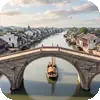
Grand Canal
AE49The world's longest man-made waterway — crossing five major river systems to connect north and south, continuously pumping southern grain and wealth into the empire's heart.
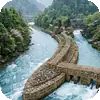
Dujiangyan
AE50A two-thousand-year-old dam-free irrigation miracle — the fish-mouth divider, the flying-sand weir, and the bottle-neck channel still irrigating the Chengdu Plain's Land of Abundance today.
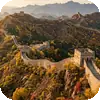
Great Wall
AE51The longest military fortification in human history — winding ten thousand li along the northern ridges, guarding the boundary of agrarian civilization for two millennia.
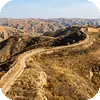
Qin Straight Road
AE52The ancient expressway built by Qin Shi Huang — a geometric military corridor stretching seven hundred kilometers straight along the loess ridge, enabling cavalry to reach the frontier in three days.
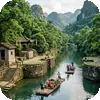
Lingqu Canal
AE53Qin Shi Huang's canal cutting through the Xiang-Li watershed to connect the Yangtze and Pearl River systems — China's first cross-basin artificial waterway.
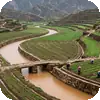
Zhengguo Canal
AE54An irrigation canal that diverted silt-laden Jing River water to transform Guanzhong's saline-alkali land — a single engineering project that directly fueled Qin's war machine to conquer the six states.
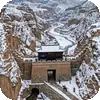
Hangu Pass
AE55The natural choke point between the Xiao Mountains and the Yellow River — one man holding the pass against ten thousand, the most vital strategic gateway between ancient Guanzhong and the Central Plains.
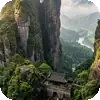
Jianmen Pass
AE56Seventy-two peaks standing like blades in confrontation where the Daba Mountains fractured — the only passage into Shu, nature's security black-box for separatist regimes.
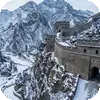
Yanmen Pass
AE57The perilous pass in the Heng Mountains — for millennia, one of the core defense lines where agrarian civilization withstood the high-intensity shock of northern nomadic cavalry.
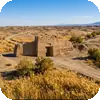
Yumen Pass
AE58The Silk Road's western gateway — where the Han dynasty established the Protectorate of the Western Regions, the empire's westernmost terminal for exercising sovereignty over Inner Asia.
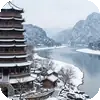
Liuhe Pagoda
AE59A thousand-year-old pagoda on the Qiantang riverside — both a tide-taming lighthouse and a spiritual monument to humanity's architectural will confronting the river's nonlinear fury.
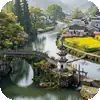
Huizhou Water Outlet Works
AE60Landscaped water exits at Huizhou village stream mouths — a hydraulic damping system built through rock-stacking, tree-planting, and bridge-building, intelligently regulating the village microclimate.
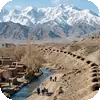
Karez
AE61Turpan's underground canal miracle — delivering Tianshan snowmelt to oases with zero evaporation loss, ranked alongside the Great Wall and Grand Canal as one of ancient China's three greatest engineering feats.
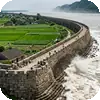
Qiantang Seawall
AE62Hundreds of kilometers of stone seawall lying like a dragon — precision mortise-and-tenon joinery resisting violent tidal bores, defending the security of Jiangnan's wealthiest region.
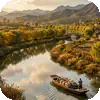
Tongji Canal
AE63Emperor Yang of Sui's super waterway network — a herringbone pattern connecting the entire empire, maximizing the bandwidth for pumping Jiangnan wealth to the imperial center.
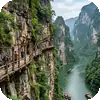
Three Gorges Plank Road
AE64A suspended walkway carved into the vertical cliffs of the Three Gorges — trackers and soldiers clawing out a logistics miracle against heaven-defying terrain with bare hands.