










An azure corridor stitched together by monsoon winds, ocean currents, and natural harbors — from Quanzhou's Zaytun Harbor to the islands of the South China Sea, the Maritime Silk Road carried porcelain, tea, and stories to distant seas, opening China's gaze to the wider tides of the world.
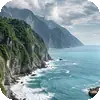
Taiwan Island
AE81China's largest island, an emerald screen in the western Pacific — compressing ecosystems from tropical rainforest to alpine tundra, a micro-continent of global biodiversity.
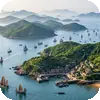
Zhoushan Archipelago
AE82China's largest archipelago — over a thousand islands scattered like pearls in the East China Sea, the empire's forward-deployed natural aircraft carrier group guarding the confluence of river and sea.
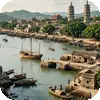
Quanzhou
AE83The world's largest port during the Song and Yuan dynasties, the starting point of the Maritime Silk Road — where Marco Polo beheld the Zaytun city in full bloom, the Orient's greatest harbor.
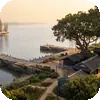
Huangpu Port & Shibosi Site
AE84The ancient port and customs office of Guangzhou — China's first national-level maritime trade authority, witnessing the prosperity of the Age of Discovery on the South China Sea.
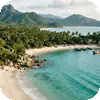
Hainan Island
AE85China's second-largest island, a tropical paradise of coconut breezes and ocean waves — where Su Dongpo in exile wrote 'Hainan, ten thousand li, truly my homeland.'
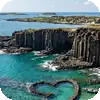
Penghu Islands
AE86A chain of basalt islets in the middle of the Taiwan Strait — fishing lights and ancient village houses, the historic relay station and forward fortress between the two shores.
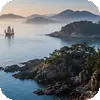
Jiaozhou Bay
AE87A superb natural deep-water harbor on the south coast of the Shandong Peninsula — the ultimate geopolitical focal point over which modern powers fought for a century to control North China.
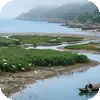
Min River Estuary
AE88The winding waterway where the Min River breaks through the Zhejiang-Fujian hills to strike the East China Sea — rugged terrain that birthed the unofficial private maritime trade and pirate legends of the Ming-Qing era.
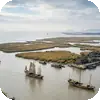
Yangtze Estuary
AE89Where the Yangtze ends — sediment colliding with the sea, extending China's territory into the Pacific millimeter by millimeter each year, the nation's newest living land.
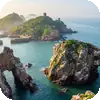
Miaodao Islands
AE90A chain of stepping-stone islets locking the Bohai Strait between the Shandong and Liaodong peninsulas — the final iron chain of maritime defense guarding the capital region.
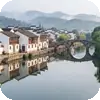
Ningbo
AE91Where the Grand Canal and the Maritime Silk Road intersect in a perfect cross — a nationally chartered gateway for tributary trade and logistics with Japan and Korea across the ages.
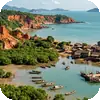
Leizhou Peninsula
AE92One of China's three great peninsulas — like a rigid needle thrust into the South China Sea, a continental forward antenna facing and managing the Beibu Gulf.
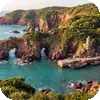
Weizhou Island
AE93The youngest volcanic island in the Beibu Gulf — dotted with sea caves carved by erosion, a natural monitoring tower China has deployed in the southern blue-water commons.
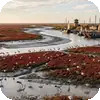
Yancheng Coast
AE94The vast silt tidal flats of northern Jiangsu forcibly deposited by the old Yellow River — the empire's inexhaustible sea-salt factory, the material bedrock of the ancient salt-and-iron monopoly.
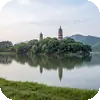
Wenzhou
AE95A natural deep-water port wedged in the crevice of the Zhejiang-Fujian mountains — from here, Wenzhou merchants departed with the monsoon winds, laying their commercial networks across the entire globe.
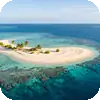
South China Sea Islands
AE96Coral atolls, reefs, and shoals scattered across millions of square kilometers of deep-blue sea — the most extreme physical extension of Chinese sovereignty into the open ocean.