










A grand and orderly symmetry projected upon the land — from Chang'an's 108 wards to Beijing's Central Axis, where jagged administrative boundaries, measured cartography, and the geometry of the imperial capital blend into a political landscape in harmony with nature.
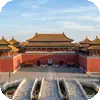
Beijing Central Axis
AE113The national power axis running through the Forbidden City — from Yongding Gate south to the Bell and Drum Towers north, the perfect projection of Chinese ritual order onto the Earth's surface.
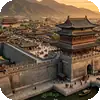
Chang'an City
AE114Sui-Tang Chang'an — one hundred and eight wards laid out like a chessboard grid, the largest and most orderly imperial capital planning masterpiece of the ancient world.
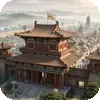
Luoyang Ancient City
AE115Luoyang, Center of All Under Heaven — the survey benchmark established at the Gaocheng Observatory, capital of thirteen dynasties, the orthodox capital coordinate every emperor dreamed of anchoring legitimacy to.
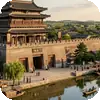
Kaifeng Ancient City
AE116Northern Song Kaifeng — the waterway network bursting through ward walls, China's first open night-market and urban consumer carnival.
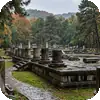
Ming Palace Site
AE117The Ming Palace ruins of Nanjing — capital of six dynasties and ten kingdoms, where every time the north fell, Han regimes retreated here to continue the mantle of Chinese civilization.
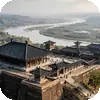
Xianyang Palace Site
AE118The Qin Xianyang Palace ruins — spanning the Wei River, mapping its separate halls onto the constellations, humanity's earliest super-stage for performing sovereignty through landscape geometry.
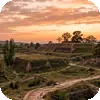
Weiyang Palace Site
AE119The Han Weiyang Palace ruins — a monumental palace built atop a colossal rammed-earth platform, using extreme vertical perspective to manufacture suffocating awe before imperial authority.
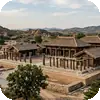
Yin Xu
AE120The ruins of Yin at Anyang — where oracle bones were unearthed, the Shang ancestral temples and bronze foundries, the dawn of Chinese written history and the pinnacle of the Bronze Age.
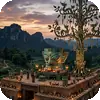
Sanxingdui Site
AE121The Sanxingdui ruins — a bronze sacred tree and golden masks that stunned the world, a mysterious ancient Shu civilization center operating on a completely different ritual logic from the Yellow River basin.
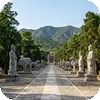
Ming Tombs
AE122The thirteen Ming imperial tombs — perfectly following the arc of the Tianshou Mountains, a grand mausoleum matrix using the natural peaks as cemetery walls, the ultimate underground political landscape.
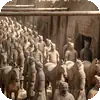
Mausoleum of the First Emperor
AE123The Qin Shihuang Mausoleum — eight thousand terracotta warriors arrayed underground in full battle formation, the ultimate subterranean palace seeking to replicate supreme earthly sovereignty in the underworld.
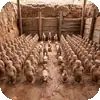
Han Yangling
AE124The Han Yangling Mausoleum — a vast collection of miniature pottery figurines and granary models entombed, locking state assets into an underground model, the foundational work of the Chinese imperial tomb system.
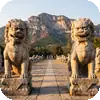
Tang Qianling
AE125The Tang Qianling Mausoleum — using a natural double-peaked karst mountain as the tumulus, Wu Zetian's blank stele standing on the spirit way, a timeless masterpiece that lets posterity judge her merits and faults.
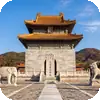
Eastern Qing Tombs
AE126The largest imperial tomb complex inside the Great Wall — a Manchu-Han synthesis wrapping shamanic northern wildness and Confucian ritual order into the dynasty's underground ledger.
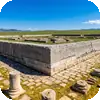
Xanadu Site
AE127The Yuan Upper Capital ruins — a surreal dual capital nesting the rectangular Han axial grid within the circular nomadic tent ethic on the vast grassland, the northern power gateway of the Mongol empire.
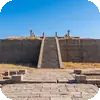
Ye City Site
AE128The Cao-Wei Ye City ruins — the first capital to isolate the ruler's core citadel outside the grid of wards, shattering the Han chaos of mixed officials and commoners, the ancestral template for a thousand years of rigidly compartmentalized imperial city planning.