










A crescent-shaped inland arc of gobi, desert, and grassland — along the 400-millimeter rainfall line, farmers and herders have met and mingled across the centuries, the Silk Road and the border towns forming a long corridor of trade and culture.
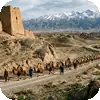
Hexi Corridor
AE65The narrow oasis belt pinched between the Qilian Mountains and the desert — the golden passage of the Silk Road, Chinese civilization's sole overland corridor into the heart of Eurasia.
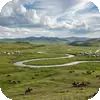
Hulunbuir
AE66China's finest natural grassland — an endless green ocean that supplied the nomadic cavalry beyond the Great Wall with an unceasing stream of warhorses and livestock.
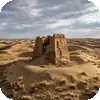
Ordos
AE67The semi-arid plateau enclosed by the Yellow River's great horseshoe bend — a suspended sword over Guanzhong and the Central Plains, the drill ground where farmers and herders clashed across history.
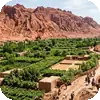
Turpan
AE68China's lowest point and hottest place — extreme aridity and solar radiation producing the sweetest melons and the Karez underground canal experimental field.
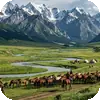
Ili River Valley
AE69Where the Tianshan tears open a gap to capture Atlantic westerly moisture — a miraculous 'Jiangnan beyond the frontier' flourishing in the heart of the continent's extreme arid zone.
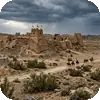
Junggar Basin
AE70A semi-enclosed basin pinched between the Altai and Tianshan ranges — with lush pastures and a strategic position, the core base of successive nomadic empires.
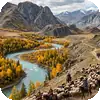
Irtysh Valley
AE71China's only river flowing north into the Arctic Ocean — cutting a green corridor through the extreme arid interior, concealing the gold and boreal forests of the Altai Mountains.
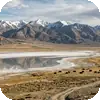
Altun Mountains
AE72The hyper-enclosed uninhabited zone at the junction of the Kunlun and Qilian ranges — extreme altitudinal isolation creating a forbidden zone of life and the ultimate backup vault for Tibetan antelope and wild yak.
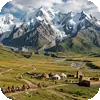
Qilian Mountains
AE73A high-altitude glacier belt straddling the south side of the Hexi Corridor — its endless frozen reservoir drip-irrigating the entire lifeline of the Silk Road.
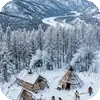
Greater Khingan Range
AE74The steep ecological fault where taiga forest transitions abruptly to arid Mongolian steppe — the evolutionary cradle from which northern nomadic, hunting, and fishing peoples emerged from the forest onto the grassland to begin their conquest of the Central Plains.
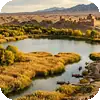
Juyan Lake
AE75A terminal oasis where the Heihe River dies into the Badain Jaran Desert — the Han dynasty's extreme northern outpost, where military wooden slips were unearthed, a forward server of the Qin-Han empire in the Gobi.
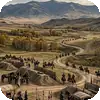
Ulanbutong
AE76The grand grassland battlefield where the Kangxi Emperor personally led his army to crush the Zunghar threat — a rolling meadow arena that decided the final shape of the empire's northern frontier.
Xilingol Steppe
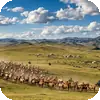
AE77The quintessential temperate steppe of the Inner Mongolian Plateau core — the central stage and geopolitical buffer zone of nomadic courts through Yuan, Ming, and Qing dynasties.
Zanda
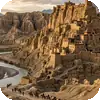
AE78The site of the ancient Guge Kingdom — a colossal forest of yardang earth pillars carved by water erosion, a giant maze of clay geometries secretly hiding a vanished kingdom in extreme desolation.
Bayinbuluke
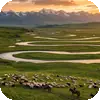
AE79Alpine wetlands deep in the Tianshan, formed by the nine bends and eighteen meanders of the Kaidu River — the swans' homeland and the nomadic high-altitude liquid pasture.
Lop Nur
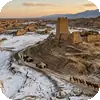
AE80The burial ground of the Loulan Kingdom — a once-vast lake desiccated entirely into a giant ear-shaped salt crust, sealing and encrypting a thousand years of Silk Road exploration memory.