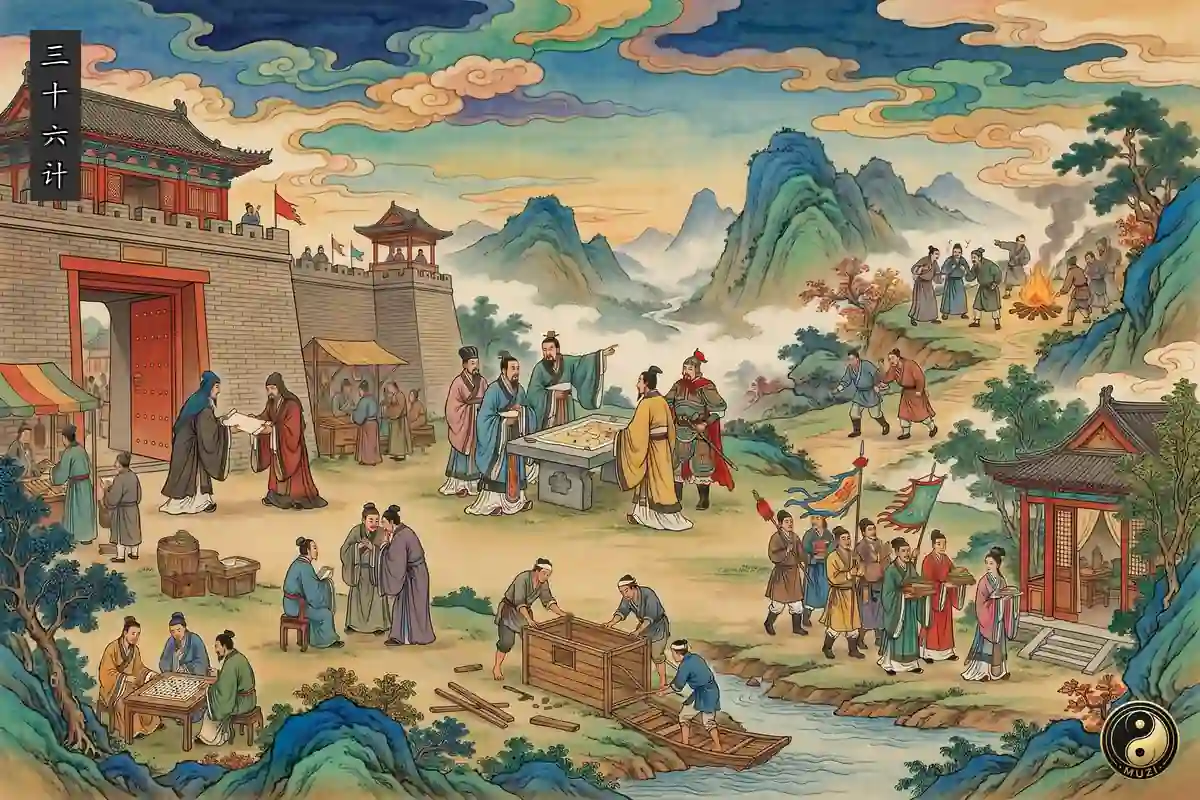
Each of the Thirty-Six Stratagems has only a few lines, yet its name is four or five characters, easy to remember once heard. What matters in it lies not in the depth of its military thought but in gathering the schemes earlier people had used into a small book that can be consulted by name, and in giving each one an explanation and a note, so that readers know where the stratagem came from, when it can be used and when it cannot.
The four characters "thirty-six stratagems" appear first in the histories. The Book of Southern Qi, in the Biography of Wang Jingze, records that when Wang Jingze rose in arms (he died in 498) and was told that the Marquis of Donghun meant to flee, he said: "Lord Tan's thirty-six plans, and running away is the best of them. You father and son had better run quickly." Xie Xianghao, a researcher at the Shandong Academy of Social Sciences, holds that "Lord Tan" is Tan Daoji, the famous general of the Song dynasty of the Southern Dynasties, and that the stratagems are his work; Hui Hong's Night Talks at Leng Studio of the Song period has the line "of the thirty-six plans, running away is the best plan." But the book in circulation today is much later. Wang Junlin of Shandong Normal University says that the early edition now known is a reprint by the Xinghua Printing Works in Chengdu in 1941, taken from a handwritten original said to have been found at a bookstall. Before the 1940s the book was recorded in no history or other writing. The preface to the New Edition of the Thirty-Six Stratagems (Warrior Press, 1981) says: "It was truly compiled into a book probably around the Ming and Qing."
There is another account. A collector says he bought, in a Jining antiques market in 2003, a set of Sui-dynasty jade slips, sixty-six pieces, the first carved with the four characters "thirty-six stratagems" and the last with "carved by He Zhen on the first day of the eleventh month of the sixteenth year of Kaihuang" (the sixteenth year of Kaihuang being 596). Xie Xianghao says this made him "more certain still" that the author was Tan Daoji. Zhao Chengfeng adds that the slips lack the general statement, the six-set headings and the notes of the version now known, which may have been added later by someone versed in the Book of Changes. Whether the slips are genuine, and their date, are only recorded here, without a ruling.
The book has a fixed form. Its general statement reads: "Six times six is thirty-six; in the numbers there is craft, in the craft there are numbers. Yin and yang are set in order," and the stratagems fall into six sets, in order the Winning, Confrontation, Attack, Chaotic, Joint-Force and Losing sets, six stratagems each. Xie Xianghao explains that the original book is arranged by stratagem name, that the first three sets are for the stronger side and the last three for the weaker, and that each name is followed by an explanation and then a note, the notes "citing mostly battles from before the Song." In the sets of the Thirty-Six Stratagems, the explanations often quote a hexagram of the Book of Changes: "Make a noise in the east, strike in the west" quotes the Cui hexagram, "wait at ease for the weary" the Sun hexagram, and "running away is the best" the Shi hexagram; and the notes cite the Records of the Grand Historian, the Book of Han, the Zuo Commentary, the Discourses of the States, the Hanfeizi and other books.
These schemes walk the road of deceit, and old books already argue over it. The Hanfeizi, in the chapter "Objections, I," records that when Duke Wen of Jin asked Uncle Fan how to meet a larger force with a smaller, Uncle Fan answered: "Between battle lines, one does not tire of deceit." Yong Ji said instead: "To deal with the people by deceit gains a moment and loses what follows." The Duke rewarded Yong Ji first, and later someone objected that what Uncle Fan meant by "not tiring of deceit" was "not deceiving his people but deceiving his enemy." The notes of the Thirty-Six Stratagems also show restraint; the note to "Make a noise in the east" says that if the enemy's mind is not confused and one uses this stratagem, "one will bring about one's own defeat; it is a risky plan."
Its notes often draw directly on other canons. The Sunzi, discussed under Art of War, is quoted directly: the note to "wait at ease for the weary" quotes words found in the chapter "Weak Points and Strong," "He who first occupies the field and awaits the enemy is at ease; he who comes later and hurries to battle is weary"; the note to "Besiege Wei to rescue Zhao" quotes what Sun Bin said to Tian Ji, "strike at the hollow place and hit the weak spot, so that his movement is blocked and his position held," and names the Records of the Grand Historian, volume 65, as its source, which is the same chapter as the horse race of Tian Ji and the battle of Guiling in Balance of Power. The note to "befriend the distant and attack the near" says "amid the maneuvering of the vertical and horizontal, each takes what profit he can." The explanations quote hexagrams and the general statement speaks of putting "yin and yang in order," which is the reading of I Ching Hexagrams carried into a book of war. The note to "make a noise in the east" tells of Zhou Yafu "holding the wall and refusing battle": when the Wu troops feigned an attack on the southeast he guarded the northwest, and the note uses this to show that if the enemy's mind is steady the stratagem fails, so the holding firm treated in Scorched Earth appears here as a case where the stratagem fails. Many of the cases in the notes come from the Records of the Grand Historian and the Book of Han, and the book treated in Records of the Grand Historian is among them.
Before this book was put together, the schemes of earlier people lay scattered in the cases of various books, for each reader to dig out. Once it was put together, the schemes have names, an order and cases to compare, and it also keeps the line first used to mock a man for running away. Yet what the book says of "running" is quite serious: "Surrender is total defeat, peace is half a defeat, running is not yet defeat. Not yet defeated is the turning point toward victory." Wang Jingze's gibe was turned by the book into an account that can be worked out.
Wang Jingze's line mocking flight later gained six sets of names and, one by one, explanations and notes; schemes gained an order, retreat was counted as "not yet defeated," and ways of deceiving the enemy came with a warning that some plans are "risky." The origin of the book is still argued, with Tan Daoji on one side and Ming-Qing compilation on the other, and neither is settled; but most notes name their sources, so a reader can follow them one by one, compare them, and ask first what a stratagem is and then in what situation it fails.
The Thirty-Six Stratagems is the class in the chapter on Strategies on a set of schemes drawn from military practice and popular tradition: the phrase "thirty-six stratagems" first appears in the Book of Southern Qi, and around the Ming-Qing transition an anonymous compiler gathered the circulating schemes into a military treatise arranged as six sets of six.
 Literature
 Han Feizi
 Zuo Tradition
 Records of the Grand Historian
 People
 Duke Wen of Jin