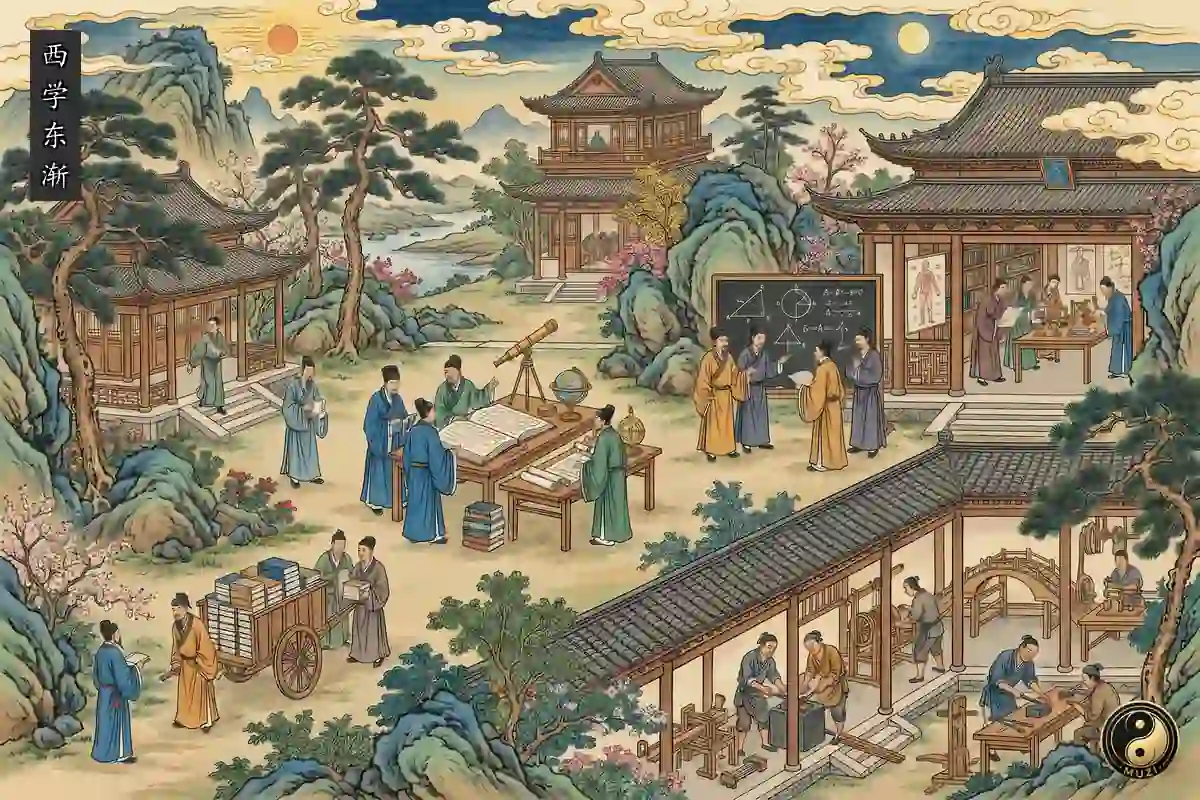
Mathematics and calendar science in the late Ming were in decline. The biography of Xu Guangqi on MacTutor, the history-of-mathematics site of the University of St Andrews, writes that Xu Guangqi put the decline down to scholars' neglect of practical learning and to the mixing of mathematics with numerology; even the Nine Chapters on the Mathematical Art was almost unknown, and Xu himself had never read it. On the calendar, the Draft History of the Qing records that when an eclipse was predicted wrongly in the early Chongzhen years, Xu Guangqi submitted: "The astronomical officials use the method of Guo Shoujing; over time it must drift, and it should be corrected in time." The History of the Ming, in its account of Italy, records that in the Wanli years the Italian Matteo Ricci came to the capital and made a Complete Map of Ten Thousand Countries saying there were five continents in the world; the History of the Ming judged this account "vague and impossible to verify", yet also admitted "his countrymen crowd the Middle Land".
Among the books that came in, the Elements of Geometry is called by Xu Guangqi, in his preface, "the ancestor of all measure and number"; he says that he and Ricci together "translated its essentials, six volumes". The General Catalogue of the Four Treasuries explains that the original had thirteen volumes and over five hundred propositions, that Ricci's teacher Clavius (Ding) added a commentary and two more volumes, fifteen in all, and that the Chinese version took only six; each volume has definitions, axioms and propositions, and each proposition has its method, explanation, demonstration and corollary. MacTutor records that the six books were translated in 1607 from Clavius's commentary. Xu Guangqi's Afterword adds what followed: Ricci sent a corrected copy and asked that someone in the south reprint it, and by the time Xu went north, "the master had died".
In the calendar the effect is on record. The General Catalogue records that in the second year of Chongzhen, after an eclipse prediction failed, the Ministry of Rites petitioned to open an office to revise the calendar, led by Xu Guangqi, who "oversaw the completion of the Calendar Books in several dozen volumes"; when Xu fell ill and died, Li Tianjing took over. The Draft History's biography of Adam Schall (Tang Ruowang) states that in the first year of Shunzhi, Prince Dorgon told Schall to correct the calendar and named it "the Calendar by Imperial Pattern", and that "from the second year of Shunzhi it was issued with the new calendar throughout the realm"; in the trial of observation, "only the new method matched; the Datong and Muslim methods were both out of time". The road was not smooth: Yang Guangxian petitioned the throne against ten errors in the new method, in the fifth year of Kangxi according to the Draft History, Schall and others were sentenced, and "from then the new method was abandoned"; when the Kangxi emperor took the government in hand, he had Ferdinand Verbiest (Nan Huairen) manage the calendar and the new method returned. The Draft History records that the emperor, while the dispute was unsettled, felt that "what I have not studied, I cannot judge right from wrong", and so "applied himself fiercely to study". In the Daoguang years, "the officials of the Astronomical Bureau were by then well versed in Western methods and need no longer employ Westerners", and Westerners' entry to the Bureau stopped. These events join the calendar tradition treated in the entry on the Lunisolar Calendar.
Even then there were two ways of speaking about how Western learning sat beside native learning. In its entry on the Zhoubi suanjing the General Catalogue says "Western methods come from the Zhoubi; these are clear proofs" and adds "only later observations improved them, ever closer"; in the entry on the Celestial Source Sea Mirror (Ceyuan haijing) it says "Chinese and Western methods illuminate one another and there is no call for a border between them"; reviewing the Tongwen suanzhi it says "Chinese and Western methods each have their strengths and neither can eclipse the other"; and of the Elements of Geometry it says "to call it the crown of Western arts is not too much". One mathematical example: the Catalogue says that the method of "establishing the celestial unknown" had by the Ming no one who knew it; Xu Guangqi cited Li Ye's book but "had not the leisure" to explain its meaning; in the Qing "Europeans first presented the method of borrowed roots", and Mei Juecheng realised it was the old method of the celestial unknown, whose Western name, rendered into Chinese, was "the method that came from the east". This puts it in a relation of mutual comparison with the mathematical tradition treated in the entry on Nine Chapters.
Entry into the system of schools came later. Wei Yuan dated the original preface to the Illustrated Treatise on the Maritime Countries (Haiguo tuzhi) "the twenty-second year of Daoguang, the year renyin, the Jiaping month"; the Jiaping month is the twelfth month, roughly January 1843. The preface says that the book was made "to learn the strengths of the barbarians in order to control them". According to the Treatise on Selection in the Draft History of the Qing, the Beijing Tongwen Guan (College of Languages) began in the first year of Tongzhi (1862) and at first taught only foreign languages; in the sixth year a school of mathematics was proposed, and the original memorial said: "Now we do not count it a shame to be behind others, but only a shame to learn from them; so we shall rest content with being behind and never learn." In the twenty-fourth year of Guangxu (1898) the Imperial University of Peking was planned, and the edict required "the learning of the sages' principles as the root, and broad adoption of Western learning that suits current affairs", and ordered the academies of each province changed into schools teaching both Chinese and Western learning, which bears on the academies treated in the entry on Academy Regulations. In the twenty-seventh year (Xinchou, 1901) an edict merged the Tongwen Guan into the university; when Zhang Baixi drafted the regulations he cited the Book of Rites, "families had their school-rooms, hamlets their xiang, districts their xu, the state its university", and said "before the Zhou, selection and schooling were one; after the Han, selection alone was stressed". Western-style schooling thus came to touch the ancient scheme treated in the entry on Schooling Roots and the selection treated in the entry on Imperial Examinations.
Six volumes of the Elements, several dozen volumes of Calendar Books, one College of Languages: Western learning came in as one concrete thing after another. The History of the Ming called Ricci's five continents "vague and impossible to verify", the General Catalogue called the Elements "the crown of Western arts" and also said that Chinese and Western methods "each have their strengths"; Wei Yuan wanted to "learn the strengths of the barbarians", and the memorial for the College said that to count learning from others a shame was to rest content with being behind. After each dispute the calendar was changed, a school was founded, and the celestial unknown, which no one in the Ming knew, was recognised again by way of the borrowed roots.
Western Learning is the class in the chapter on Education on the coming in of foreign learning. It covers how Western mathematics, the natural sciences and new fields of study entered China from the late Ming to the early Republic: Matteo Ricci settled at Zhaoqing in 1583, the first six books of Euclid's Elements were published in translation in 1607, and the Tongwen Guan was founded in Beijing in 1862.
 Literature
 Book of Rites
 History of Ming
 People
 Guo Shoujing
 Li Ye