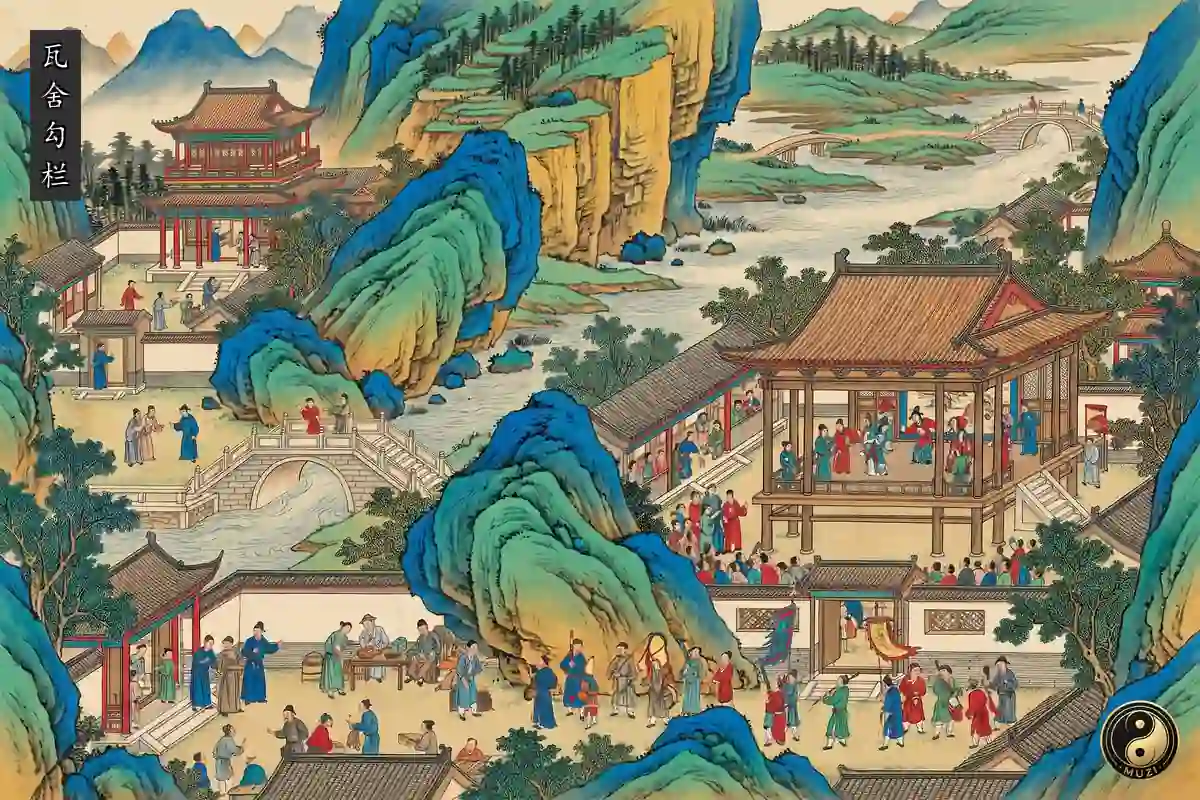
In a town set among blue-green mountains and red autumn trees, crowds fill a two-storey pavilion and stream between market stalls, courtyards and arched bridges.
1147 · EvolutionMeng Yuanlao's preface to the Dream of the Splendours of the Eastern Capital is signed on the last day of the Dingmao year of Shaoxing (New Year's Eve of 1147, already 1148 by the Gregorian calendar), recalling the wazi and goulan of Bianjing.
What a wazi was, the Song people themselves explained, and disagreed. The Record of the Splendours of the Capital says: "'Wa' means 'gathering in the open and easily scattering'; nobody knows when it began." The Dream of the Millet says a wazi takes the meaning of "tiles together when they come, tiles apart when they go". For Hangzhou's wazi both the Dream of the Millet and the Xianchun Records of Lin'an give one origin: the Prince of Yang, commander of the Palace Guard, since his soldiers were mostly from the north-west, set up wazi, "gathering performers and musicians as a place for soldiers to amuse themselves in their leisure". As for storytelling, Wang Guowei's Song and Yuan Drama History cites Gao Cheng's Origins of Things, which says "in Emperor Renzong's time there were townspeople who could talk about the Three Kingdoms", and says that it "began in the early Song".
Meng Yuanlao wrote of Bianjing from memory; the preface is signed "on the last day of the Dingmao year of Shaoxing" (the last day of the seventeenth year of Shaoxing, which falls early in 1148), and says that he "left the capital for the south the year after Bingwu of Jingkang". In the book he writes of the streets of Bianjing: "South of the street are the Sangjia Wazi, then to the north the Middle Wazi, then the Inner Wazi. Among them are more than fifty large and small goulan." The Yecha and Elephant sheds of the Inner Wazi "could hold several thousand". He lists the entertainments in the capital's wazi "since the Chongning and Daguan years": songs, fast songs, zaju, puppets, history telling, short tales, shadow plays, medley-style ballads, turning dances and riddles, and "in wind or rain, cold or heat, the sheds had audiences, day after day". At the Ghost Festival, "the performers of the stage-sheds, once the Qixi was past, put on the Maudgalyayana Rescues His Mother zaju", and "the audience doubled".
How these places were run is recorded in more detail for Lin'an. The Old Affairs of Wulin records "the wazi goulan (those inside the city under the Office of Palace Repairs, those outside under the Palace Command)", with "thirteen goulan in the Northern Wazi". Itinerant players who did not enter a goulan but performed in open ground were "also a lower grade of art". The Record of the Splendours of the Capital says in zaju "the mo-ni is the head; four or five make a troupe; they first do an ordinary familiar scene called the 'colourful act', then the proper zaju, together called two acts".
The Yuan records come from Xia Tingzhi's Green Bower Collection. Its preface says: "Within the capital and without, in the commanderies and towns, there are what are called goulan" and "spectators scatter gold on them". The book records that the performer Xiaochunyan "when performing in a goulan always wrote the titles on the beams all round, for the audience to choose and demand"; that Wei Daodao "danced Partridge Sky alone, four pieces, in a goulan"; and that Zhu Lianxiu was "unrivalled in zaju in her day". Du Shanfu's Villager Does Not Know the Goulan, in the original given in the Court and Country New Sounds, the Songs of Peace, tells of a countryman coming to town where someone at the door calls out to him, "he took two hundred coins and let me in", and inside he saw "layer upon layer, sitting in rounds". The authorities were also at work: the Treatise on Punishments in the History of Yuan has "sons of the people who do not attend to their livelihood and in towns and markets perform tales and teach farces, gathering crowds for ribaldry, shall all be forbidden" and "whoever writes verses and songs carelessly in order to criticize shall be banished".
Why such places count as a canon depends on what they left. First, performance gained a fixed place and a management: the wazi of Lin'an were assigned to two offices, the goulan of the Yuan were in capital and commanderies, and performers there "performed" and were "chosen and demanded". Second, many kinds lay before the same audience, and the entertainments listed in the Dream of the Splendours of the Eastern Capital are an example. Third, they left writing: when Wang Guowei wrote his Song and Yuan Drama History he cited, on storytelling and puppets, the Dream of the Splendours of the Eastern Capital, the Dream of the Millet, the Old Affairs of Wulin and the Record of the Splendours of the Capital.
The goulan are tied to five other canons. With Song and Yuan Zaju: the Record of the Splendours of the Capital records the form of zaju, and the Green Bower Collection records the zaju performers of the Yuan, both with the goulan as stage. With Quyi: history telling, short tales and medley-style ballads in the capital's wazi were all performed in the wazi, where Huo Siyou "told the Three Divisions" and Yin Changmai told the History of the Five Dynasties. With Yuan Qu Verse: the Green Bower Collection records Li Dingnu who "sang the Eight Beats of Ganzhou in a goulan, and drew eight cheers", so that the name of a tune appears in the cheering of a goulan. With Ritual and Puppet Theatre: the capital's wazi had "staff puppets" and "string puppets", and at the Ghost Festival the Maudgalyayana Rescues His Mother was performed. With Marketplace Hubs: the Dream of the Splendours of the Eastern Capital says "the taverns and wazi, in wind or rain, cold or heat, day and night, were crowded like this", so that the wazi joined taverns and shops into one.
The wazi and goulan gave town performance a fixed stage, a fixed audience and people to manage it: Bianjing had more than fifty goulan, the wazi of Lin'an were assigned to the Office of Palace Repairs and the Palace Command, and the goulan of the Yuan were found in capital and commanderies. Storytelling, zaju, puppets and medley-style ballads stood side by side in the same wazi, and zaju and storytelling both had them as their stage. The "day after day" of the capital's entertainments, the performers who let the audience "choose and demand", and the law "gathering crowds for ribaldry, shall all be forbidden" record one and the same thing: in the Song and Yuan, watching plays and hearing songs was already something that people ran, people recorded and people restrained.
Theaters is the class in the chapter on Performance on the fixed commercial performance venues of Song and Yuan cities. Wazi and goulan appeared in Northern Song Bianjing, and performance acquired a fixed place, ticketed management and a market in which performers competed.
The actors and surrounding crowd inside the raised stage at right are the clearest performance core of the washe-goulan scene.
Market and Tea Tables
The lower-left stalls and seated customers show the commerce clustered around the fixed performance venue.
Bridge Conversation
The onlookers talking on the bridge at left center reinforce the social circulation around the theater district.
Street Crowd Below
The bannered and conversing crowd below the stage shows the urban flow of entertainment-goers outside the venue.
A Song-dynasty entertainment quarter: on stage, variety performers act, sing, and tumble, while a crowd fills the benches below and drums and clappers drive the rhythm of urban popular culture. The commercial, ticketed urban performance hubs powering marketplace economic vitality.
Theaters is like a big courtyard in the city that stays open all year: people do not come just at festivals, nor is a troupe invited to someone's house; those who want to see a play buy a ticket and go in.
Wazi and goulan appeared in Northern Song Bianjing; the Dreams of Splendor of the Eastern Capital records more than fifty goulan large and small in Bianjing; and in the Yuan the goulan of Dadu and other cities staged zaju.
Imagine an evening in Bianjing, when a young man walks into a wazi and is dazzled by a row of goulan. He stops at the door of one, buys a ticket, and squeezes in to find a place. As soon as the actor on the stage opens his mouth, the audience falls quiet.
When the show breaks up and he walks out, he tells his companion: I will come again tomorrow, and I want to see the one next door too.
In the years of Renzong and Shenzong of the Northern Song, wazi and goulan appeared in Bianjing and became fixed commercial performance venues; Meng Yuanlao's Dreams of Splendor of the Eastern Capital records more than fifty goulan large and small in Bianjing; and in the Yuan the goulan of Dadu and other cities staged zaju. (This is an illustrative story, not a historical account.)





 Bianjing WaziThe Sangjia, Middle and Inner wazi south of the East Corner Tower street
 Lin'an WaziThe Nan, Zhong, Da and Bei wazi in and outside Southern Song Lin'an
 Wazi PerformersPerformers of the capital's wazi, listed by kind of act
 Yuan GoulanGoulan of Yuan capital and county towns and the performers in them
 Canon
 Literature
 Record of a Dream of Splendour in the Eastern Capital
 People
 Zhao Zhen
 Meng Yuanlao