


Variety Theater
A fully mature stage storytelling art, officially transitioning theatrical forms away from pure dance into complex multi-act narratives.
 Yuan ZajuYuan dynasty (c. 1260-1368)
To understand Variety Theater, we first need to see the historical pressure behind it. It was not a decorative cultural label, but a response to problems of order, trust, production, education, politics or shared life. Those problems pushed people to seek more durable ways of living together. This gives the chapter element meaning beyond a single historical moment.
Variety Theater is first of all a concrete civilizational mechanism. A fully mature stage storytelling art, officially transitioning theatrical forms away from pure dance into complex multi-act narratives. It brings a value, technique or institution out of abstraction and into social organization and lived practice. Through it, the reader can see how an age turns experience into rules and how those rules continue to shape later life.
Variety Theater works through repeatable structure. Through learning, imitation, institutionalization and daily use, people turn local experience into a more stable civilizational capacity. This process allows it to cross time and continue shaping later ideas and practices. It makes the chapter not only historical information, but a clue to how civilization accumulates capability. It also helps later readers see why the same element can reappear in different social settings.
Variety Theater also shapes different groups of people. Scholars, artisans, families, officials, merchants, soldiers or local communities may all participate in its formation and transmission. The full maturity of stage dramatic art transitioning forms into complex multi-act plots. This is why it can form meaningful links with other chapters. It has its own functional boundary, yet it sends conceptual, institutional or technical echoes outward.
Variety Theater is a key node in Chinese civilization. A fully mature stage storytelling art, officially transitioning theatrical forms away from pure dance into complex multi-act narratives. Its importance lies not only in naming an idea, but in showing how people, families, social order, and civilizational values connect. It gives the reader a first doorway into the logic of this chapter. Through it, abstract values enter concrete life.
Song-Yuan Za-ju (Song-Yuan Variety Theater: the fully-mature stage-narrative art, the 4-gong-5-fa and 4-zhe-1-xie-zi multi-act-narrative and sheng-dan-jing-mo-chou role-typology complex) is, in the map of the Chinese classical stage-narrative-art tradition, the first-generation source-rule of the four-gong-five-fa-module-containment and object-oriented-narrative-engine tradition that. under the historical pressure of can-jun-xi rudiment and za-ju name-origin and Wenzhou Yongjia Southern-Xi and Jin-dynasty Yuan-ben and Yuan-dynasty Four-Masters peak and four-zhe-one-xie-zi structuring and chang-nian-zuo-da modularization and sheng-dan-jing-mo-chou role-typology from Tang-dynasty to Qing-dynasty (8th century to 19th century CE). defined as the Zhang-xie-zhuang-yuan as the first-complete Yongjia Za-ju and Guan Han-qing and Bai Pu and Ma Zhi-yuan and Zheng Guang-zu as the Yuan-Qu Four-Masters and Dou-e-yuan and Xi-xiang-ji as the canonical scripts and four-zhe-one-xie-zi and chang-nian-zuo-da and sheng-dan-jing-mo-chou as the standard-script rule-library the most-fundamental civilizational answer that, in the Chinese classical long-form stage-narrative-art system. the Song-Yuan Za-ju is the four-gong-five-fa-module-containment and object-oriented-narrative-engine that hard-rules script and performance as the four-zhe-one-xie-zi multi-act-structure and chang-nian-zuo-da 4-gong module and shou-yan-shen-fa-bu 5-fa module and sheng-dan-jing-mo-chou 5-class role-type module and Yuan-Qu Four-Masters 150 and playwrights 500 and works mechanism. To trace a single coherent lineage down to its source, you have to start from the Tang can-jun-xi (c. 8-9c) za-ju rudiment to the Tang Duan An-jie Yue-fu Za-lu (c. 9c) za-ju name mention to the Northern-Song Bian-jing Za-ju performance (c. 11c, per Meng Yuan-lao Dong-jing Meng-hua-lu Chong-guan since, in-the-capital Tile-House arts... emphasized Za-ju) to the Northern-Song Za-ju and Southern-Xi rudiment (c. 12c, per Zhou Mi Wu-lin Jiu-shi Southern-Xi mention) to the Southern-Song Wenzhou Yongjia Za-ju (per Ye Zi-qi Cao-mu-zi Southern-Xi out-of Xuan-he after, Southern-crossing moment, called 'Wenzhou Za-ju'. Yongjia people composed Zhao-zheng-nu and Wang-kui first-big-spread in Zhejiang-region) THE canonical founding to the Southern-Song Zhang-xie-zhuang-yuan (c. 12-13c, the first surviving Yongjia Za-ju, per Qian Ceng Ye-shi-yuan Shu-mu and Yong-le Da-dian juan 13991 inclusion) to the Jin-dynasty Yuan-ben rudiment (c. 12-13c, the Jin-dynasty Za-ju rudiment, per Yuan Tao Zong-yi Nan-cun Chuo-geng-lu Jin had Yuan-ben, Za-ju actually-began-this) to the Yuan-dynasty Yuan Za-ju peak (Yuan-Qu Four-Masters and 150 and playwrights and 500 and works) to the Yuan Guan Han-qing Dou-e-yuan and Dan-dao-hui and Jiu-feng-chen and Wang-jiang-ting (c. 1250-1290) the 4 most-cited Yuan-Za-ju to the Yuan Wang Shi-fu Xi-xiang-ji (c. 1290-1310) 5-ben 21-zhe the first 5-ben long-form Yuan-Za-ju to the late-Yuan Zhong Si-cheng Lu-gui-bu (1330 CE) 150 and playwright biographies to the late-Yuan Xia Ting-zhi Qing-lou-ji (c. 1360 CE) 120 and performer biographies to the early-Ming Zhu Quan Tai-he-zheng-yin-pu (1398 CE) 585 qu-pai and 12-ke Za-ju classification to the Ming Zhu You-dun (1379-1439) 31 Za-ju to the Ming Wang Ji-de Qu-lu (c. 1620 CE) Za-ju-system-treatise to the Qing Jiao Xun Ju-shuo (c. 1810 CE) Za-ju-textology. To trace Song-Yuan Za-ju as the four-gong-five-fa-module-containment and object-oriented-narrative-engine you have to do the most-complete back-trace author-by-author book-by-book. The earliest textual anchor is the Tang can-jun-xi: with the Tang can-jun-xi (c. 8-9c) Za-ju rudiment as the marker , so that can-jun-xi in the Tang first acquires the fundamental position of the Za-ju rudiment. The late-Tang Za-ju name mention: the late-Tang Duan An-jie (9c) , with Yue-fu Za-lu Za-ju name mention (Xian-tong since, namely-had Fan's Female-Knight, Za-ju's beginning also) as the marker of the Za-ju written-ization , so that Duan An-jie and Yue-fu Za-lu in the late-Tang first acquires the fundamental position of the Za-ju written-ization. The Northern-Song Bian-jing Za-ju performance: the Northern-Song Bian-jing Tile-House and Bian-jing Za-ju (c. 11c, per Meng Yuan-lao Dong-jing Meng-hua-lu Chong-guan since, in-the-capital Tile-House arts... emphasized Za-ju) , so that Northern-Song Bian-jing Za-ju in the Northern-Song first acquires the fundamental position of the Bian-jing performance. The Northern-Song Za-ju and Southern-Xi rudiment: the Northern-Song Zhou Mi (1232-1298) , with Wu-lin Jiu-shi (1270s-1290s) Southern-Xi mention and early Wenzhou and Hang-zhou Za-ju rudiment as the marker of the Southern-rudiment , so that Zhou Mi and Wu-lin Jiu-shi in the late-Southern-Song first acquires the fundamental position of the Southern-rudiment. The Southern-Song Wenzhou Yongjia Za-ju THE canonical founding: the Southern-Song Ye Zi-qi (active early 14c) , with Cao-mu-zi (c. 1378 CE completed) Southern-Xi out-of Xuan-he after, Southern-crossing moment, called 'Wenzhou Za-ju'. Yongjia people composed Zhao-zheng-nu and Wang-kui first-big-spread in Zhejiang-region as the marker of Wenzhou Za-ju THE canonical founding , so that Ye Zi-qi and Cao-mu-zi in the late-Southern-Song first acquires the fundamental position of Wenzhou Za-ju THE canonical founding. The Southern-Song Zhang-xie-zhuang-yuan first-Yongjia-Za-ju: the Southern-Song Zhang-xie-zhuang-yuan author (anonymous, c. 12-13c, per Qian Ceng Ye-shi-yuan Shu-mu and Yong-le Da-dian juan 13991 inclusion, 53-chu and first Yongjia-Za-ju complete-script, the first surviving Yongjia-Za-ju and the first-known Chinese-dramatic-script to-reach-the-modern-age) , so that Zhang-xie-zhuang-yuan in the late-Southern-Song first acquires the fundamental position of the first-Yongjia-Za-ju. The Jin-dynasty Yuan-ben rudiment: the Jin-dynasty anonymous (c. 12-13c) , with Jin-dynasty Yuan-ben (the Za-ju rudiment, per Yuan Tao Zong-yi Nan-cun Chuo-geng-lu Jin had Yuan-ben, Za-ju actually-began-this) and 5-roles and brief-plot and comedic-dialogue and hundreds-of-Yuan-ben titles preserved as the marker of the Jin-dynasty Za-ju rudiment , so that Jin-dynasty Yuan-ben in the Jin-dynasty first acquires the fundamental position of the Jin-dynasty Za-ju rudiment. The Yuan-dynasty Yuan Za-ju peak THE canonical peak: the Yuan-dynasty Yuan-Qu Four-Masters (c. late-13c-early-14c) , with Guan Han-qing (c. 1220-1300, Qu-sheng) and Bai Pu (1226-1306) and Ma Zhi-yuan (1250-1321, Qu-zhuangyuan) and Zheng Guang-zu (?-1330) , containing 18-surviving Guan Han-qing Za-ju and 15-surviving Bai Pu Za-ju and 7-surviving Ma Zhi-yuan Za-ju and 6-surviving Zheng Guang-zu Za-ju (the Yuan-dynasty Za-ju peak and 50 and surviving Yuan-Za-ju and 500 and lost Yuan-Za-ju) as the marker of THE canonical peak , so that Guan Han-qing and Bai Pu and Ma Zhi-yuan and Zheng Guang-zu in the Yuan-dynasty first acquires the fundamental position of THE canonical peak. The Yuan-dynasty Guan Han-qing Za-ju canonical-scripts: the Yuan-dynasty Guan Han-qing (c. 1220-1300) , with Dou-e-yuan and Dan-dao-hui and Jiu-feng-chen and Wang-jiang-ting (c. 1250-1290, 4-zhe standard Yuan-Za-ju 4-scripts, the most-cited Yuan-Za-ju 4-scripts) as the marker of the canonical-scripts , so that Guan Han-qing in the Yuan-dynasty first acquires the fundamental position of the canonical-scripts. The Yuan-dynasty Wang Shi-fu Xi-xiang-ji first-long-form-Za-ju: the Yuan-dynasty Wang Shi-fu (c. 1260-1336) , with Xi-xiang-ji (c. 1290-1310 completed, 5-ben 21-zhe, the first Yuan-Za-ju 5-ben long-form and the longest-surviving Yuan-Za-ju and the most-cited Yuan-Za-ju) as the marker of the first-long-form-Za-ju , so that Wang Shi-fu and Xi-xiang-ji in the Yuan-dynasty first acquires the fundamental position of the first-long-form-Za-ju. The late-Yuan Yuan-Qu playwright-biography Yuan-dynasty Yuan-Qu-history: the late-Yuan Zhong Si-cheng (c. 1275-1345) , with Lu-gui-bu (completed Zhi-shun first year 1330 CE, 2 juan, recorded 150 and Yuan-dynasty playwright biographies and 500 and works catalog) as the marker of the Yuan-dynasty Yuan-Qu-history , so that Zhong Si-cheng and Lu-gui-bu in the late-Yuan first acquires the fundamental position of the Yuan-dynasty Yuan-Qu-history. The late-Yuan performer-biography performer-history: the late-Yuan Xia Ting-zhi (?-?) , with Qing-lou-ji (completed Zhi-zheng period c. 1360 CE, 1 juan, recorded 120 and Yuan-dynasty za-ju performers and Qing-lou and Za-ju performance history) as the marker of the performer-history , so that Xia Ting-zhi and Qing-lou-ji in the late-Yuan first acquires the fundamental position of the performer-history. The Yuan-Ming Za-ju classification 12-ke classification: the early-Ming Zhu Quan (1378-1448) , with Tai-he-zheng-yin-pu (completed Hong-wu thirty-first year 1398 CE, 2 juan, recorded 585 qu-pai and 12-ke Za-ju classification and 200 and Yuan-dynasty and early-Ming Za-ju playwright reviews) as the marker of the 12-ke classification , so that Zhu Quan and Tai-he-zheng-yin-pu in the early-Ming first acquires the fundamental position of the 12-ke classification. The Ming-dynasty Za-ju Ming-echo: the Ming-dynasty Zhu You-dun (1379-1439) , with 31 Za-ju (c. 15c, the first complete 31 Ming-dynasty Za-ju and containing Feng-yue-mu-dan-xian and Xiang-nang-yuan and Ji-mu-da-xian and Bao-zi-he-shang and Mu-dan-yuan and Yan-hua-meng and Shi-mei-ren-qing-shang-mu-dan-yuan etc.) as the marker of the Ming-echo , so that Zhu You-dun in the Ming Yong-le Xuan-de first acquires the fundamental position of the Ming-echo. The Ming-dynasty Za-ju-system-treatise system-integration: the Ming-dynasty Wang Ji-de (c. 1560-1623) , with Qu-lu (completed c. 1620 CE, 4 juan, containing Za-ju system-treatise and Southern-Xi system-treatise and 40-chapter qu-xue discussion) as the marker of the system-integration , so that Wang Ji-de and Qu-lu in the Ming Wan-li first acquires the fundamental position of the system-integration. The Qing-dynasty Za-ju-textology Qing-textology-conclusion: the Qing-dynasty Jiao Xun (1763-1820) , with Ju-shuo (completed c. 1810 CE, 6 juan, containing Za-ju and dramatic-form data-textology 600 and entries) as the marker of the Qing-textology , so that Jiao Xun and Ju-shuo in the Qing Jia-qing first acquires the fundamental position of the Qing-textology. 《》,《》,《》、《》,《》、《》,:、,、、、。,《》,。
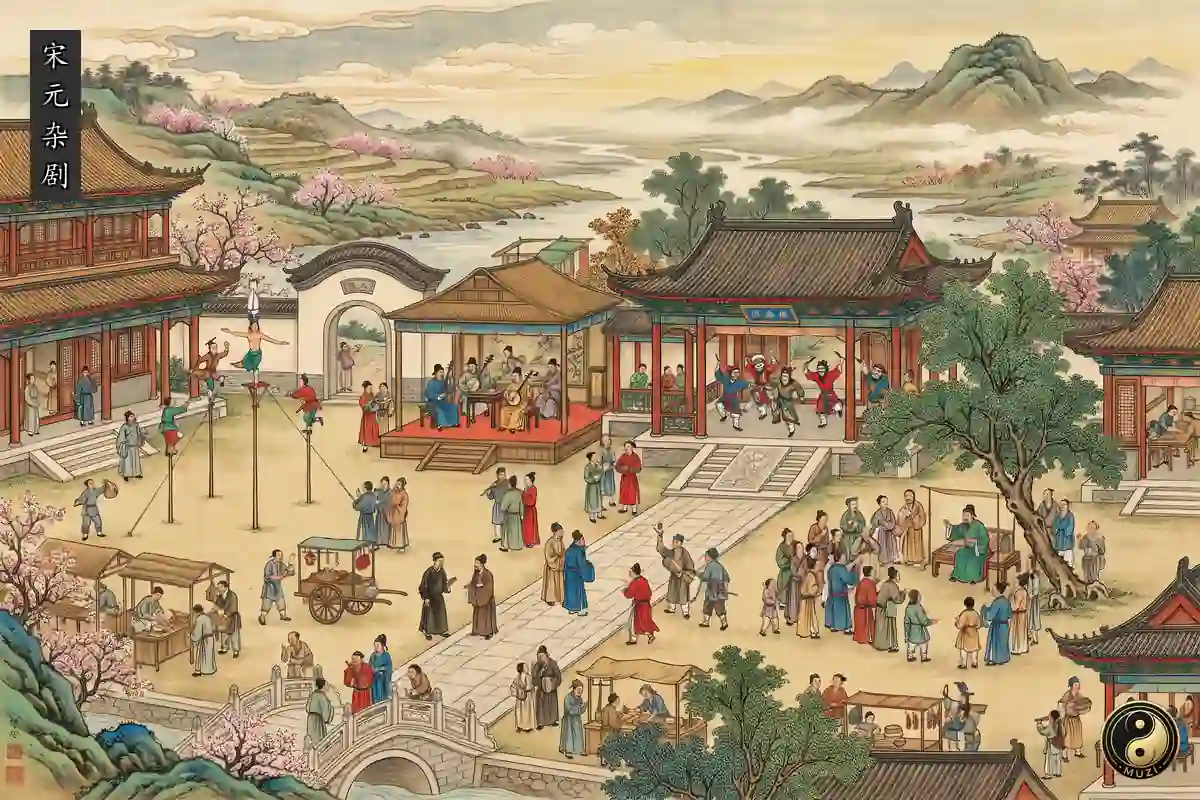
On a Song-Yuan variety-play stage, painted-face performers in every role-type act out the drama while a side band of clappers, drums, and flutes accompanies and a dense crowd fills the ground below. The full maturity of stage dramatic art transitioning forms into complex multi-act plots.
A playwright wrote a new opera. During rehearsal, the actors argued.
The lead actor said, This aria is too long. The audience will be restless.
The lead actress said, It is the heart of the play. Cut it and the story loses its soul.
The playwright thought. Then he inserted a martial arts sequence in the middle of the aria, a series of flips and sword fights. After the fight, the aria continued.
A play cannot be only singing, only fighting. Singing, speech, acting and acrobatics must alternate. The audience's eyes and ears need rest.
They rehearsed for three months. On opening night, the house was full. For two hours, no one left. During the saddest passages, the audience wept. During the fights, they cheered.
Afterward, one viewer said, You did not write a play. You wrote a world.
Explanation
Song-Yuan opera marks the full maturity of Chinese narrative stagecraft. It was no longer mere song-and-dance but a comprehensive art combining singing, speech, acting and acrobatics. The system of four skills and five techniques was formalized, and the libretto evolved from lyric collections into complete stories with characters, conflicts and climaxes. This was the critical step from pure musical performance to full-fledged narrative theater.