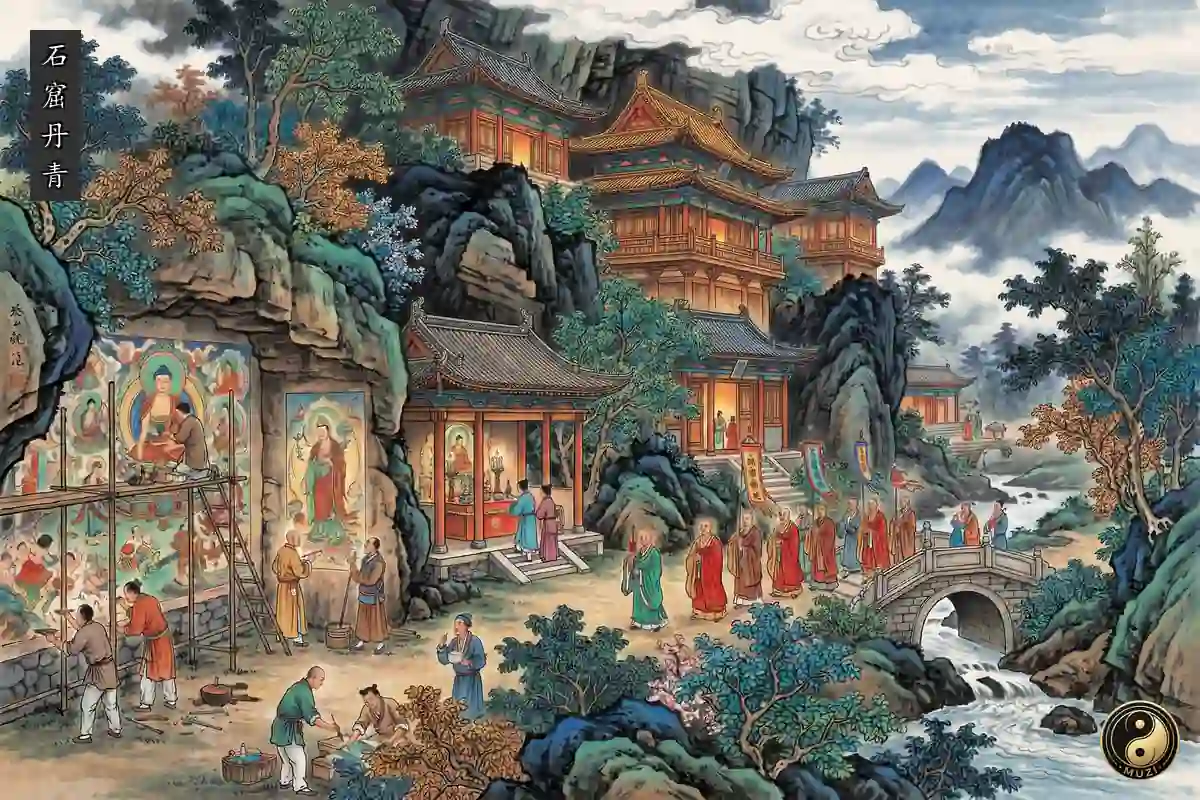


Buddhism's entry into China is told, in legend, as beginning with a dream. The Hou Hanshu, in the account of the Western Regions, writes: “It is handed down that Emperor Ming dreamed of a golden man, tall, with a light about his head, and asked his ministers. One said: 'In the west there is a god called Buddha; his body is sixteen feet tall and golden.' The emperor then sent envoys to India to ask about the Buddha's way, and had images painted in China.” This is what is “handed down,” but the words “had images painted” point to the heart of the later grottoes: the Buddha needed a form, and the form needed to be painted or cut where people could see it.
How Mogao began is told in more than one way. The Dunhuang Academy's introduction to the Mogao Caves says that, according to the Li jun xiu Mogao ku foka bei, a stele of the first year of Shengli under the Wu Zhou (698), the monk Le Zun began cutting the first cave in the second year of Jianyuan under the Former Qin (366); the Academy's page on Cave 332 quotes the stele: Le Zun “suddenly saw a golden light, in the shape of a thousand Buddhas.” The introduction also gives two other views, one placing the start at the end of the Western Jin and one in the ninth year of Yonghe under the Eastern Jin (353), and says that “at present the three views stand together, but the second year of Jianyuan under the Former Qin is usually followed.” By the Academy's account, the 492 numbered caves hold more than 45,000 square meters of murals. UNESCO's description likewise dates the start to 366.
Yungang in the Northern Wei was another kind of beginning, one that came from the court. The Weishu, in its treatise on Buddhism and Daoism, writes that Tanyao “reported to the emperor that, at Wuzhou pass west of the capital, he would cut into the rock wall and open five caves, each with a Buddha statue. The tallest were seventy feet, the next sixty, and the carving was marvelous.” In the same treatise the emperor Gaozong decrees that the Buddha's teaching “helps the prohibitions of royal government and adds to the good nature of humaneness and wisdom,” placing the Buddha within an argument about government. UNESCO says Yungang has 252 caves and niches and 51,000 statues, that the Five Caves cut by Tanyao are a classical masterpiece of the early peak of Chinese Buddhist art, that the grottoes were cut under imperial instruction, and that the influence of Buddhist art from South and Central Asia was interpreted in a Chinese manner.
At Longmen in the Tang, the palace paid. UNESCO says Longmen has more than 2,300 caves and niches, almost 110,000 statues and 2,800 inscriptions on steles, and that the giant sculptures of the Fengxian temple are representative of Tang carving. The Heluo shangdu Longmen zhi yang da Lushena xiang kan ji writes: “In the fourth month, first day, of the year renshen, the third of Xianheng, the Empress Wu gave twenty thousand strings of cash from her cosmetics fund,” “the work was finished on the thirtieth day of the twelfth month of the year yihai, the second of Shangyuan,” “in the eighth month, fifteenth day, of the year jimao, the first of Tiaolu, by imperial order a great Fengxian temple was set up south of the great image,” and also that “the body of the Buddha, with its halo and base, is eighty-five feet high.” It records the dates of the gift and of the finish, the person who paid and the establishing of the temple: the cutting of caves now had the Empress's money and the court's order behind it.
These caves are tied to many entries. The trade route discussed under Silk Road is painted on the Mogao walls: UNESCO says Cave 302 of the Sui shows a camel pulling a cart of a trade mission, and that for a thousand years the Mogao caves played a decisive role in artistic exchange among China, Central Asia and India. The dance and music discussed under Chinese Dance and Chinese Instrumental Music appear in the caves too: the official account of the Dunhuang culture, sports and tourism bureau on The Paper says that the murals have many musical subjects, with orchestras and instruments, and that dancing figures appear in the murals of almost every cave. The paper discussed under Paper Invention became manuscripts in the Library Cave: UNESCO says the Library Cave found in 1900 held tens of thousands of manuscripts and relics. The timber buildings treated in the entry on Timber Building are painted too: the same account says the walls show thousands of buildings, with brackets, pillars, doors and windows, and the Dunhuang Academy's introduction records five timber cave porches of the Tang and Song still standing in front of the caves.
What is painted on the walls is not only the Buddha. UNESCO says that Cave 23 of the Tang shows workers in the fields, Cave 156 a line of warriors, and Cave 61 of the Song a picture of Mount Wutai in which mountains, rivers, cities, temples, roads and caravans are all set down, an early example of artistic Chinese cartography. The Buddha's world and the world of fields, armies and roads appear side by side on one wall, and those who read these walls read the days of the people of the time.
Without the grottoes, much of the appearance of those thousand years would be hard to see: how an imported image of the Buddha slowly took on a local expression, how the court used cutting into a mountain to state its attitude to a faith, and what an orchestra, a dance or a pavilion looked like in its day. The grottoes kept these on the rock walls.
The Five Caves of Yungang came from Tanyao's request to the emperor, and there the Buddhist art that came from South and Central Asia was interpreted in a Chinese manner; the great Longmen niche carries the Empress's gift of twenty thousand strings of cash from her cosmetics fund; and a stele of the Wu Zhou period sets the beginning of Mogao under the name of the monk Le Zun, with two other views still standing beside it. The Mogao walls also show caravans, farmers in the fields, lines of warriors, music and dance, and the Library Cave left tens of thousands of manuscripts. The look of faith, of the court and of daily life was cut into the cliffs in this way and has lasted to the present.
Grotto Art is the class in the chapter on Crafts on cave murals and sculpture: the Buddhist cave temples cut into cliff faces, with their murals and sculpture. The monk Le Zun began cutting the Mogao Caves under the Former Qin, the monk-official Tanyao directed the five Yungang caves under the Northern Wei, and in the Tang the great Vairocana niche of Fengxian Temple at Longmen was completed. Art from the Western Regions and India met native taste here. This class covers murals, religious images (including those outside the grottoes), painted clay sculpture, and pictorial stones and bricks. Silk paintings belong to Painting & Xuan Paper, tomb figures to Terracotta Army, and manuscripts to Slips & Scrolls.
 People
 Wu Zetian (Empress Wu)
 Li Zhi
 Tan Yao
 History
 Opening of the Silk Road
 Atlas
 Dun Huang City