Lingnan was opened by force of arms. The Huainanzi, "Renjian xun", writes that the First Emperor of Qin, wanting "the rhinoceros horn, ivory, kingfisher feathers and pearls of Yue, sent Commandant Tu Sui with five hundred thousand troops in five armies", stationed at "the ridge of Tancheng, the stronghold of Jiuyi, the capital of Panyu, the border of Nanye and the waters of Yugan", who "for three years did not take off their armour or unstring their crossbows; Jian Lu had no way to bring up provisions, and so with the troops he cut a channel to open the grain route, and fought the Yue"; the Yue "set up fierce and able men as their leaders, attacked the Qin at night, and routed them, killing Tu Sui and leaving corpses and blood in the hundreds of thousands", and Qin "then sent out convicts as garrison troops to guard against them". The Records of the Grand Historian, "Annals of the First Emperor of Qin", year 33 (214 BCE), record: "He sent out fugitives, matrilocal husbands and merchants to seize the Luliang lands and made Guilin, Xiang and Nanhai commanderies, and sent convicts to garrison them." The Huainanzi does not name the channel; Yu Mengwei's "old account" ties the first cutting of the Lingqu to the Qin, and whether the two speak of the same channel the pages do not say.
Who cut the channel is told differently. The Records of the Grand Historian, "Biography of the Marquis of Pingjin and Zhufu Yan", carries Yan An's memorial, which says of Qin that it "made Jian Lu cut a channel to carry grain deep into Yue; the Yue fled; the campaign dragged on, the grain gave out, the Yue struck back and the Qin troops were badly beaten". The Tang writer Yu Mengwei's "Record of the Restoration of the Lingqu at Guizhou" says instead: "The old account is that Qin ordered Shi Lu to cut it first, crossing the Yue passes, and Han ordered Ma Yuan, in the campaign against Zheng Ce, to dredge it next." One text has Jian Lu and the other Shi Lu, and the pages do not say whether they are the same man. The History of the Ming, "Treatise on Rivers and Canals", records under the Hongwu reign: "In year 4 the Lingqu at Xing'an was repaired, with thirty-six sluices. The channel rises from Haiyang Mountain, cut in Qin times, and irrigates ten thousand qing. Ma Yuan repaired it; later it fell into ruin. Now it was restored."
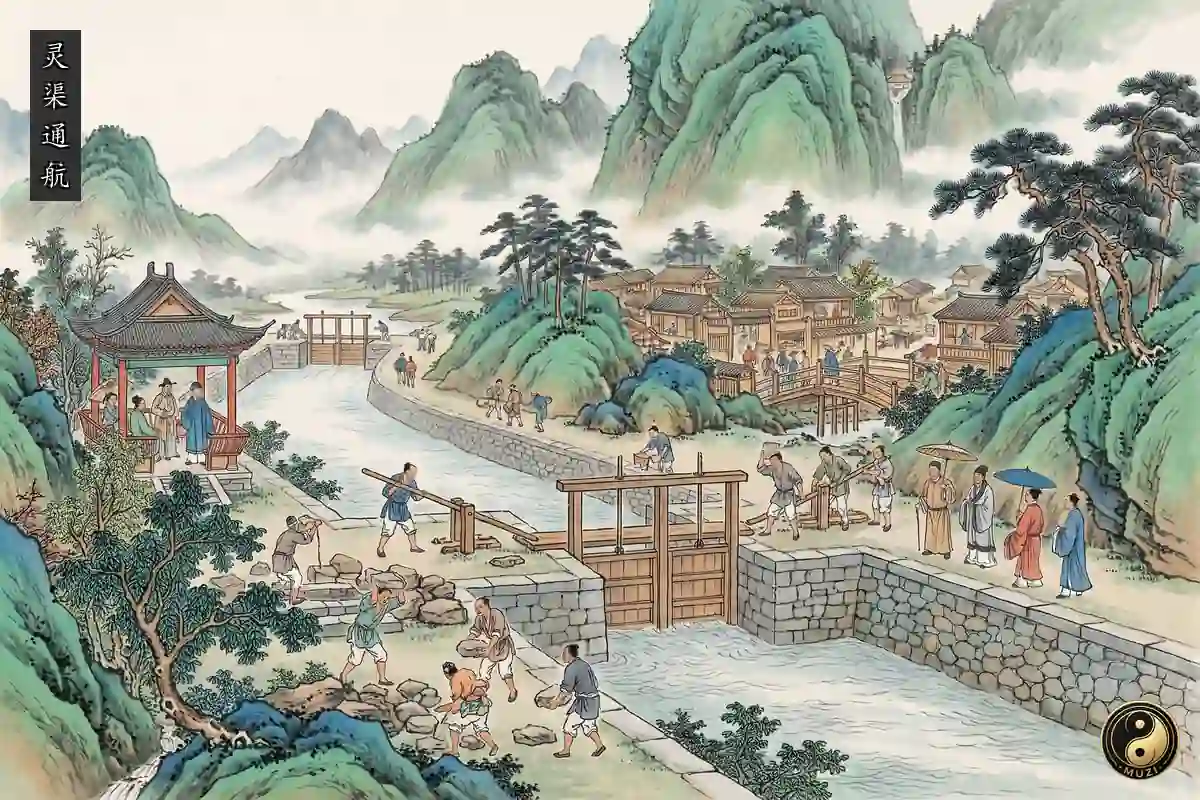
Yu Mengwei writes in the most detail about the works. The Lingqu "led the three rivers and ran through the five ridges", and was used "to carry troops and bring up supplies". Later, "with the years the embankments were all ruined; the river burst and the channel grew shallow", and in sailing it "ten or more households had to be called up to get a single boat through". In the early Baoli years the Palace Attendant Li Bo "fitted the embankment with a ploughshare-shaped spur to check the side flow and fitted gates to step the main flow", but the officials in charge "bound twigs for weirs and set loose timber as gates", and within a few years it failed again. In Xiantong 9 (868) Yu Mengwei moved from Qiannan to Guizhou and asked those about him why it had not been repaired; the junior officer Liu Junsu answered: "The treasury is empty and the villages worn out." He then had Liu Junsu take charge, using "over 53,000 labour days and over 5,300,000 cash", and "began work in year 9 and finished in year 10"; "the ploughshare-shaped embankment was piled of huge stones for forty li", and the gates were "all of hard timber set upright, up to eighteen li", which is how the page reads, "eighteen li". After it was done, "even a boat of a hundred hu could be poled by one man". He says that the court heard of it and "sent down an edict from afar", but that he "would not dare accept the praise of the edict". The record is dated the fifteenth day of the fourth month of Xiantong 11 (870); the month is lunar.
Yu Mengwei also passed a judgement on the channel: "So in the past this channel was used to pacify the barbarians, and now it is used to burden the Chinese; those who understand all grieve over it." The channel was first used for troops, and by the Tang it had become a burden on the people of Gui, who "fled and died, with no one to complain to, almost seven or eight in ten". The uses he lists are not only for boats: in the same series he writes of "setting out sacrificial vessels to civilize those who drank like beasts, and spreading the canonical books to change the tongue of the shrike", tying a waterway to education, and says that the record is meant to "set down the people's hardship, which really comes from this channel". This is his own argument, not a consensus of the dynasties.
Later politics in Lingnan is recorded elsewhere. The Records of the Grand Historian, "Biography of Nanyue", writes: "In Qin times, when the realm had been united, Yangyue was subdued and Guilin, Nanhai and Xiang were established, with exiles settled among the Yue for thirteen years." After Qin fell, Zhao Tuo "attacked and absorbed Guilin and Xiang and made himself King Wu of Nanyue"; in Han year 11 Lu Jia was sent to "set up Tuo as King of Nanyue, exchange tallies and envoys, and bring the hundred Yue into harmony", on the border of Changsha. In the time of Empress Dowager Gao, "the officials asked to forbid iron goods at the Nanyue border markets", and Zhao Tuo then called himself Emperor Wu of Nanyue and sent troops against the border towns of Changsha. The Lingqu on the upper Xiang side lies in this border region; this is this entry's reading, and none of these pages mentions it. The 2018 page in the English edition of China Daily says that the Lingqu was built 2,000 years ago as a water transport route and an irrigation project, and turned Xing'an into an agriculturally developed area.
Set against other canons, a few points join. The entry Grand Canal is about a man-made waterway linking north and south; Yu Mengwei writes that the Lingqu "brought up supplies", and the History of the Ming writes that the canal "carried grain by water from the south-east"; both are about moving grain. The entry Qin Straight Road is about Qin's northern road; the Huainanzi writes of "building the long wall" and the Lingnan campaign in one passage, and Yan An joins the two as "built up in the north against the Hu and hung in the south against Yue". The entry Loose-Rein Rule is about a frontier system that enfeoffs chiefs and governs indirectly; in the Biography of Nanyue, Han Emperor Gao "setting up Tuo as King of Nanyue" is one case in Lingnan, and the pages do not call it loose-rein rule.
From these records, each use has its own source, and they do not necessarily join: the Huainanzi records that the Qin troops "cut a channel to open the grain route" but names no channel; Yu Mengwei's "old account" speaks only of Shi Lu as the first to cut it; his "to carry troops and bring up supplies" is not tied to any dynasty; the forced labour of the people of Gui comes from his record, and the irrigation of "ten thousand qing" from the History of the Ming. Each use rests on only a page or two of text.
The Huainanzi records that the Qin troops "cut a channel to open the grain route" but names no channel; Yan An's memorial says the man who cut it was Jian Lu, while Yu Mengwei's "old account" ties the first cutting of the Lingqu to Shi Lu. Whether the Qin channel was the Lingqu, and whether Jian Lu and Shi Lu were one man, the pages do not say. What can be checked is that the History of the Ming records "Ma Yuan repaired it", that Li Bo and Yu Mengwei of the Tang repaired it in turn, and that in the early Ming "it was restored"; Yu Mengwei says both that it served "to carry troops and bring up supplies" and that it was used "to burden the Chinese". The Lingqu's weight lies in a waterway repaired again and again, whose repairers also wrote down what it cost and gave.
The Lingqu Canal Project is the class in the chapter on Infrastructure on the Lingqu: the canal the Qin dug in 214 BCE for its campaign in Lingnan, together with its rebuilding in the Tang. It crosses the watershed between the Xiang and Li rivers and joins the Yangtze and Pearl river systems, and in the Tang a ploughshare dyke was built and lock gates were set.
 Literature
 Huainanzi (The Masters of Huainan)
 History of Ming
 People
 Ma Yuan
 Shi Lu