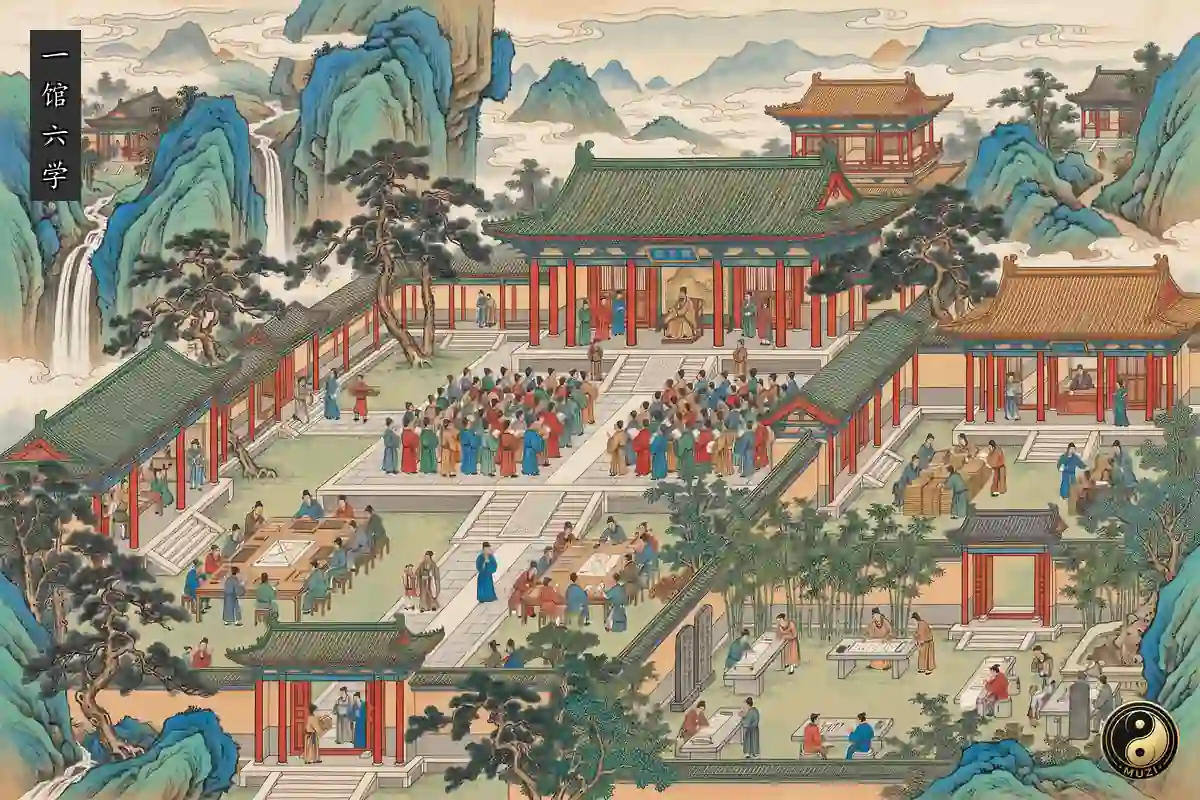
For the state to raise its own talent, it first needs an office to run the schools. The "Treatise on Offices" in the Old Book of Tang gives the history of the Directorate of the Imperial Academy: "Northern Qi called it the Court of the Imperial Academy; the early Sui called it a school, later changed it to a court, and in the third year of Daye changed it to a directorate." It says that the Libationer and Vice Libationer "were in charge of the instruction of the Confucian learning of the realm, with six schools": the Imperial Academy, the Taixue, the Four Gates School, the Law School, the Calligraphy School and the Mathematics School. When the Tang directorate took shape is told differently: Zhu Hong, professor in the School of Liberal Arts at Shaanxi Normal University, writes in his Wenhui Daily column (reprinted by China News Service) that in the first year of Zhenguan (AD 627) the Imperial Academy was separated from the Court of Imperial Sacrifices and became the Directorate, while the Old Book of Tang writes that the Sui had already changed it to a directorate in the third year of Daye. Both statements are given here without judging between them.
This entry is titled Tang Six Schools. The "Treatise on Selection" in the New Book of Tang writes that "there are six schools, all subordinate to the Directorate of the Imperial Academy," and also that "there are two halls: the Hongwen Hall under the Chancellery, with thirty students, and the Chongwen Hall in the Eastern Palace, with twenty." The title speaks of one hall, but the history records two, and the Guangwen Hall was added in the ninth year of Tianbao. The New Book of Tang lists those admitted to the halls as "relatives of the emperor within the fifth degree of mourning, relatives of the empress dowager and the empress within the third degree, and sons of chief ministers and honorary officials of the first rank, of meritorious officials holding real fiefs, of capital officials with posts of the junior third rank, and of the vice directors of the Secretariat and the Chancellery." The six schools were graded by birth: the Imperial Academy had three hundred students, the Taixue five hundred, and the Four Gates School thirteen hundred, of whom eight hundred were "the outstanding among commoners"; the Law School had fifty, and the Calligraphy and Mathematics schools thirty each, filled "by sons of officials below the eighth rank and commoners who were competent in the subject."
The courses were set by subject. The classics were divided into great, middle and lesser, and the Classic of Filial Piety and the Analects "were studied by all"; for mathematics, "the Nine Chapters and the Sea Island together took three years" and "the Zhuishu four years"; for calligraphy, "the Three-Script Stone Classic was limited to three years, the Shuowen two, and the Zilin one." The Old Book of Tang adds the specializations: the Law School "took statutes and ordinances as its specialty and also studied regulations, forms and precedents"; the Calligraphy School took the Stone Classic, the Shuowen and the Zilin as its specialty; the Mathematics School studied the Nine Chapters, the Sea Island, the Sunzi, the Five Departments, Zhang Qiujian, Xiahou Yang and the Zhoubi, with fifteen others studying the Zhuishu and the Jigu. Assessment was also strict: students "who had been rated lowest three times, or who had been in the school nine years, or six years for law students, and were unfit to be sent up, were dismissed"; and every winter "the prefectures, counties, halls and directorate sent those who had completed their studies to the Department of State Affairs."
Taizong's reign was a period of expansion. The "Biographies of Confucian Scholars" in the Old Book of Tang says that in the national schools he "added twelve hundred rooms of school buildings," increased the places in the Taixue and the Four Gates School, and "set up doctors and students of calligraphy and mathematics together," for a total of "3,260 places." The chiefs of Koguryo, Baekje, Silla, Gaochang and Tubo also sent their sons to the national schools, so that "those who took up their satchels and ascended the lecture seats numbered more than eight thousand." The entry for the Doctor of the Law School notes "established by Taizong." He also ordered Yan Shigu to collate the Five Classics, and had Kong Yingda and the scholars compile the Wujing Zhengyi (Correct Meaning of the Five Classics) in one hundred and seventy juan, to "be taught throughout the realm."
The system did not flourish all the way. The Old Book of Tang says that after Gaozong took the throne he "thought little of Confucian learning and valued clerks more," and that by the time of Empress Wu "in twenty years the schools suddenly fell into ruin," the students "no longer cared about the classics." The New Book of Tang records that the Guangwen Hall was set up in the ninth year of Tianbao to "take in students working for the jinshi." It also says that "candidates used to prize the two directorates, but later the sons of salaried families took pride in the Jingzhao, Tong and Hua prefectures and did not enter the schools," that in the twelfth year an order forbade sending up "candidates who did not come through the Imperial Academy or the prefectural and county schools," and that in the fourteenth year the tribute-man route was "restored." In the second year of Yuanhe the court "set up one hundred places for directorate students at the Eastern Capital"; the same passage goes on, "and so the places were first fixed": eighty at the Imperial Academy of the Western Capital, seventy at the Taixue, three hundred at the Four Gates School, and ten each for calligraphy and mathematics, with separate quotas for the Eastern Capital; these figures carry no year of their own. The comment just before reads: "after Tianbao the schools fell increasingly into decay and the students scattered."
The schools connect with several other canons. Nine Chapters: the Mathematics School placed the Nine Chapters in a three-year course, and Yu Junjie (Andrew Yu), in the abstract of a 2018 paper, says that "scholars generally hold that the Tang examination system was unfavorable to the development of mathematics," while he wants to look at the relation between mathematics and the examinations from another angle. Chinese Characters: the Calligraphy School took the Stone Classic, the Shuowen and the Zilin as its specialty, for three years, two years and one year. Confucian Classics: the Wujing Zhengyi was "to be taught throughout the realm," and the classics of the Imperial Academy were divided into great, middle and lesser. Imperial Examinations: in Tang selection, "those from the schools and academies were called students; those from the prefectures and counties were called tribute men," and the schools were one of the two roads. Three Halls System: the Song still had "all schools subordinate to the Directorate of the Imperial Academy," and for law "in the sixth year of Xining a school was first set up within the Directorate, with four instructors."
One directorate registered those who read the classics, studied law, practiced calligraphy and worked arithmetic under the same enrolment; of thirteen hundred in the Four Gates School, eight hundred were sons of commoners. Under Taizong the school buildings grew to twelve hundred rooms and more than eight thousand attended; after Gaozong came the remark that "in twenty years the schools suddenly fell into ruin," and when the places were fixed again in the Yuanhe years, the Four Gates School of the Western Capital had only three hundred. Its ledger holds both prosperity and decline, yet it had law, calligraphy and mathematics, three kinds of skill, written into the state's roll together with the classics.
Tang Six Schools is the class in the chapter on Education on the official schools of the Tang. It covers the early Zhenguan years of Emperor Taizong, when the National University became an independent Directorate of Education overseeing six schools, the National, Grand, Four Gates, Law, Calligraphy and Mathematics schools, while the Hongwen Academy was set up separately for members of the imperial family and high nobility.
 Literature
 The Analects
 Old Book of Tang
 People
 Li Shimin
 Kong Yingda