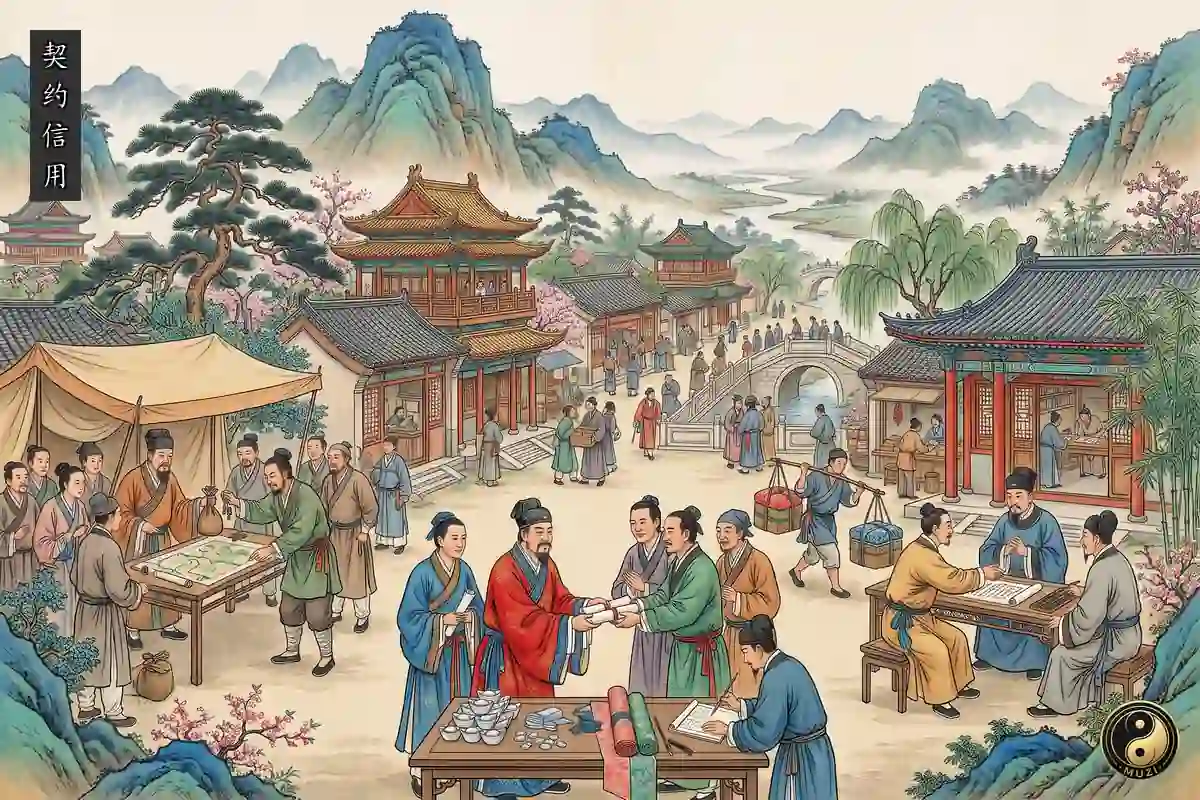
The Rites of Zhou (Zhouli) puts contracts inside the rules for officials who judge cases. Under "Xiaozai" in the Heavenly Office it lists the "eight standards": "hear claims on debts by fubie," "hear giving and taking by shuqi," "hear buying and selling by zhiji"; under "Sishi" in the Earthly Office it says "zhiji bind trust and stop lawsuits"; "Zhiren" says "in every sale, zhiji are made; zhi for a large market, ji for a small one," and sets time limits, "within the term it is heard, beyond the term it is not heard"; under "Chaoshi" in the Autumn Office it says "where there is a debt and a split tally to decide it, then it is heard." A Feng of the Institute of History, Chinese Academy of Social Sciences (Anhui Historical Studies, no. 4, 2015), cites the Zhouli line "in lawsuits over property, decide them by fubie and yueji," says this meant "property lawsuits relied on contracts," and sorts the contracts of the time into three: fubie for loans, shuqi for giving, taking and receiving, and zhiji for sale, pledge and mortgage.
For the Han, A Feng cites the Juyan slip "Contract of Le Nu for the sale of land": thirty-five mu of land, nine hundred coins, the money paid in full; the witnesses were "Chunyu Cishu, Wang Chong and Zheng Shaoqing," who bought two dou of wine, and "all drank it." He says the contract "does not state the date," and cites the Eastern Han commentator Zheng Zhong: "As in today's buying and selling, a deed is written to separate the parties, each keeps one, and in a lawsuit the deed is examined to settle it." The Tongyue (Contract of a Servant), attributed to Wang Bao, is a narrative piece with a deed set inside it: "the deed reads: the 15th day of the first month of Shenjue 3" (lunar), that is 59 BCE, for the purchase of a servant, "price fixed at 15,000."
Once paper became common, contracts were written on paper. A Feng says that by the early fourth century paper held a commanding place among writing materials, that paper contracts of tenancy, hire, loan and sale appear among the Turfan finds, and gives as example the "Contract of Zhao Shanzhong for the purchase of house land," Gaochang Yanshou 5 (628), which stresses "the three parties agree in making the deed" and "if the people have private terms, the terms bind the two parties, each signing his name as proof." In an English article by Valerie Hansen and Rong Xinjiang (on the website of the Yale history department) it is said that of several thousand non-Buddhist documents found in the Astana graveyard, more than 250 are contracts, and that in 1987 the Japanese scholars Yamamoto Tatsuro and Ikeda On sorted them into sale and exchange, letting and hiring, employment and other kinds.
The Tang code set penalties for contracts. Juan 26 of the Tang lü shuyi: "Whoever, owing a debt, breaches the contract and does not pay: for one bolt or more, twenty days overdue, twenty strokes of the light stick, and one degree more for each further twenty days, ending at sixty strokes of the heavy stick"; "whoever, owing a debt, forcibly seizes goods without going to the officials, beyond what the contract allows, is judged as for taking goods unlawfully"; the commentary says that slaves, horses, cattle, camels, mules and donkeys "must all have a market deed under the statutes," and "if the price has been paid and no deed is made, after three days the buyer receives thirty strokes of the light stick and the seller one degree less," ending "the statutes have no text on private contracts, and private deeds are not held to this limit." Taking a Dunhuang contract as his example, A Feng calls its closing words "the state has its laws, the people follow their private contracts" a set phrase of Tang contracts, and reads them to mean that private land deals lacked the protection of state law, so the parties had to "sign with a finger mark as proof"; but he also notes that the phrase carries the sense that the "laws" did not interfere with "private contracts." Both readings stand.
After the Tang, contracts entered the tax rolls. A Feng cites the Wenxian tongkao: in Kaibao 2 (969) under Taizu of the Song, the state "began to collect money for stamping the people's contracts, ordering those who pawned or sold fields and houses to pay for a stamped contract, the contract tax to be paid within two months"; and the Mingong shupan Qingming ji: "Where a transaction is disputed, the officials decide, going only by the contract." Among the Huizhou documents, a Southern Song "red contract" of Chunyou 2 (1242) for the sale of fields and hills by Li Sicong of Xiuning county gives the price as "one hundred and twenty strings in the seventeenth issue of official huihui"; a Ming contract of Hongwu 27 (1394) for the sale of hill land by Xie Zaixing of Qimen reads "price agreed at six strings of notes." The Great Ming Code says: "Whoever pawns or buys fields or houses without paying the contract tax receives fifty strokes of the light stick, and half the price of the fields or houses is also taken by the state." A Feng says that land contracts, together with the yellow registers and fish-scale maps, "became an important proof of land ownership"; in the Qing, in suing over land one had to rely "on contract deeds and neighbors," so that having a contract became a condition for a case to be accepted.
Contracts also left behind a body of documents. Kang Jian (China Social Sciences Today, 21 July 2025) says that a million Huizhou documents survive, and cites Zhou Shaoquan: "without Huizhou documents there would be no Huizhou studies"; A Feng (same paper, 6 March 2014) relays Zhou Shaoquan's 2000 article, which says that Huizhou studies became a new discipline fundamentally because Huizhou documents were found and used. Kang Jian says the joint-agreement documents cover "partnership tenancy, business agreements, timber-sale papers, litigation over forest property, and timber-transport trade," and that hill disputes involve "double sales, unclear boundaries, and theft and sale of felled timber"; these suits, he says, "reflect from one side the importance of forest management in people's production and life." A Feng calls the contract "an important part of private documents."
Why is it canon? A Feng's judgment is that the clauses in written law that regulate contracts are few, and "to understand the civil legal order of traditional Chinese society one must start from contracts." The evidence can be checked: the Rites of Zhou set time limits, the Tang code punished buying slaves or horses and cattle without a market deed, Ming law punished an untaxed contract, Qing courts looked for contract deeds before accepting a case, and later ages founded a discipline on the documents. It joins other canons: the lineages of Lineage Trust Funds, in Kang Jian's account, found in forestland the basis of Huizhou lineage property; the merchants of Merchant Guild Commerce, per Nakajima Gakusho (cited by Kang Jian), drew business capital "again and again from the kin group"; for Jiaozi Banknotes, the Song shi says of jiaozi "lawsuits did not cease"; and the houses of Shanxi Remittance Houses "valued trust over written bonds."
The Zhouli heard cases by fubie, shuqi and zhiji and set the rule "within the term it is heard, beyond the term it is not heard"; a Han land sale had its witnesses, and the Tongyue keeps the text of a deed; the Tang code punished breaking a debt contract and also buying slaves or horses and cattle without a market deed; the early Song collected money for stamping contracts, Ming law punished the untaxed contract, and the Qing accepted a case only if there was a contract. A million Huizhou documents survive, and Zhou Shaoquan said "without Huizhou documents there would be no Huizhou studies." A Feng's conclusion is that to understand the civil legal order of traditional China one must start from contracts; and yet of the Shanxi remittance houses the Qing bai leichao says they "valued trust over written bonds."
Contractual Credit Culture is the class in the chapter on Commerce on private written contracts: tenancy, partnership and sale were often backed by a deed, and credit was written into it. The inscription on the Western Zhou Qiu Wei he records a deal of jades and furs for land, the Tang contracts excavated at Turpan and Dunhuang have complete formats, and Huizhou and other places left large numbers of Ming-Qing land deeds, partnership papers and hiring papers.
 Literature
 Rites of Zhou
 Tang Code with Commentary
 History of Song
 People
 Wang Chong
 Treasures