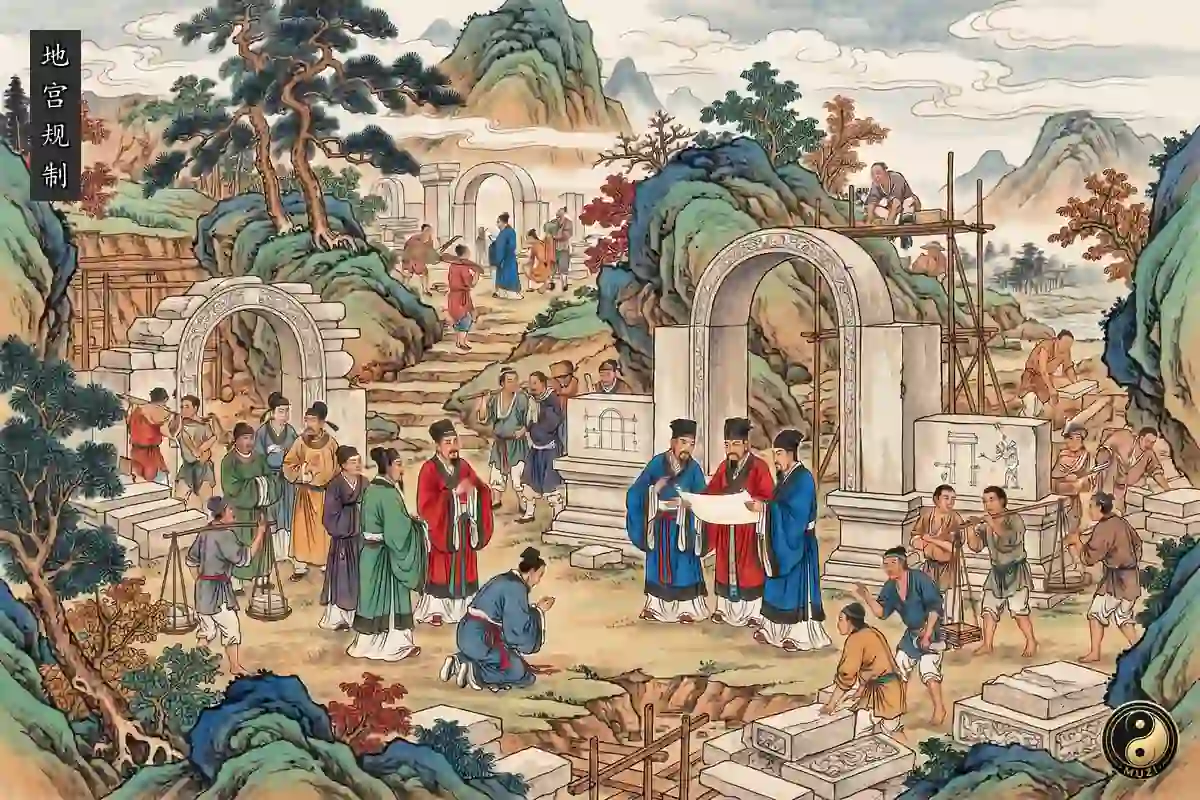

The Records of the Grand Historian (Shiji), "Basic Annals of the First Emperor of Qin", records the burial of the First Emperor: "when he first took the throne he began to dig and work on Mount Li; and when he had united the realm, more than seven hundred thousand people from all over the land were sent to him; they dug through three springs, poured in bronze and set the outer coffin", and in the tomb "quicksilver made the hundred rivers, the Yangzi, the Yellow River and the great sea, set to flow into one another by machinery, with the heavens above and the earth's features below". The UNESCO World Heritage page says the tomb was begun in 246 BCE and that, according to Sima Qian, workers from every province toiled without pause until the Emperor died in 210 BCE, in order to build a subterranean city within a huge mound; it adds that the layout of the grounds echoes the plan of the capital, Xianyang.
Already in the Han some people took this underground city as a warning. The Book of Han (Hanshu), "Biography of the Prince of Chu, Yuan", reports that Liu Xiang, in the reign of Emperor Cheng, memorialised against the building of the Prosperity Mound (the Han tomb Changling) and listed earlier lavish burials: "The First Emperor of Qin was buried at the bend of Mount Li, sealed below through three springs and raised above into a mound more than fifty zhang high and over five li around; the stone outer coffin made a pleasure hall, human fat served as lamps and candles, quicksilver made the rivers and seas, and gold made the wild geese and ducks." He tells how the work ended: "the whole realm, bitter at its labour, turned against it; the work at Mount Li was unfinished when the million men of Zhou Zhang came to its foot", and also "afterwards a herd boy lost a sheep, the sheep went into the shaft, and the herder lit a fire to look for it, and in his carelessness burned the stored coffin". He holds up Emperor Wen of Han as an example: "Emperor Wen understood, and so buried thinly and raised no mound", and he cites the words of Zhang Shizhi: "If there is something in it to be wanted, even a mountain sealed with metal has a gap; if there is nothing in it to be wanted, then even without a stone outer coffin, what is there to grieve?" The Book of Han records what followed the memorial: "when the memorial was presented, the emperor was deeply moved by Xiang's words, but could not follow his plan." What kind of underground palace to build was a matter of dispute from the beginning.
"Serve the dead as one serves the living" is a line in the ritual books about the attitude of sacrifice. The Record of Rites (Liji), "Doctrine of the Mean", says: "Take their places, perform their rites, play their music, honour those they honoured, love those they loved; serve the dead as the living, serve the departed as the present: this is the height of filial piety." To furnish a tomb with palaces, officials, and the heavens and the earth extends the way of treating the living into the afterlife; Liu Xiang points out that what was made in the likeness of the living ended with its halls burned, the tomb dug open, and the stored coffin lost to a fire. Reading the two passages together is this entry's own reading; the Shiji and the Hanshu do not say that the Qin acted on this line of the Doctrine of the Mean.
The Ming rules were recorded in more detail. The History of the Ming (Mingshi), "Annals of Emperor Chengzu", records that in Yongle 7 (1409), on the jimao day of the fifth lunar month, "a mountain tomb was laid out at Changping, and the mountain was named Tianshou"; its "Treatise on Rites" records the rules for imperial mounds: "in the rules for mountain tombs there is a round walled mound; Changling's is the largest, a hundred and one zhang eight chi across", and also that "only Yongling has an arched gate in the middle". In the first year of Hongxi, after Emperor Renzong died, the emperor who succeeded him, preparing Renzong's tomb Xianling, told Jian Yi and Xia Yuanji: "The state has the wealth of the four seas to bury a parent, and need not spare the cost. But the sage emperors and bright kings of old all followed thrift. A filial son wants to keep his parent's body safe for ever, and does not wish for lavish burial", and added that "the late emperor's testament is known to all the realm and we should follow his will", and so built only a five-bay sleeping hall; the History of the Ming describes it as "its scale far smaller than Changling's".
Dingling gave these texts a physical object. A retrospective in the Beijing Daily client of 3 July 2025 (its sections are marked as drawn from Beijing Daily pieces of 2004 and 2016) says the first target of excavation was Changling, and "although archaeologists were not of one mind, the State Council finally approved the excavation of Changling"; no clue to Changling's underground palace was found, and what was proposed first was to excavate Xianling; when experts re-surveyed, they saw that a few wall bricks had sunk on the outer side of Dingling's mound wall, "with signs of a brick arched gate inside", and decided to trial-dig Dingling. The article says that "Dingling was completed in Wanli 18 (1590), but the Wanli Emperor and Empress Xiaoduan were buried only in October 1620", so it was first sealed with earth, and the Ministry of Works set a small stone tablet as a marker, with the inscription "From this stone to the front of the Diamond Wall, sixteen zhang by three zhang five chi deep". "On 17 May 1956 the excavation of Dingling formally began", "on 19 May 1957 the workers at last found the load-bearing wall at the entrance of the underground palace, the Diamond Wall", and by the end of July 1958 the clearing was basically complete, with more than 3,000 objects unearthed. An article by Yang Zheng from the "Five-Colour Earth" column of the Beijing Evening News, as carried on Jingbao Net (the Beijing Daily site), says "the central range of the Dingling underground palace is divided into front, middle and rear chambers". The retrospective says the excavation left regrets, which led to the basic policy of Chinese archaeology afterwards of "not actively excavating imperial tombs".
Its relations with other canons are best told one by one. Terracotta Army is about the burial pits of the First Emperor's tomb; the UNESCO page says that nearly 200 accompanying pits hold thousands of life-size clay figures. Rituals is about carrying out the rites, and "perform their rites" and "serve the dead as the living" stand in the same line of the Doctrine of the Mean. Filial Piety is about xiao: the Doctrine of the Mean ends on "the height of filial piety", and the succeeding emperor says "a filial son wants to keep his parent's body safe for ever"; both use the same word xiao, yet one ends on lavish and the other on thrift. Geomancy is about siting, and the UNESCO page says the Ming and Qing tombs were sited by feng shui principles. Imperial Architecture is about the palace city: the Mingshi "Treatise on Geography" records that in the intercalary seventh lunar month of Yongle 4 an order was given to "build the Beijing palaces", and the tomb site was chosen in Yongle 7, in the same reign.
Without this entry our picture of imperial tombs would be limited to the offering halls and spirit roads above ground, lacking the half below and the argument around it. The rule of the crypt was never a one-way command: the Qin work was written up by Liu Xiang as a warning, a Ming emperor, succeeding Renzong, argued for thrift out of filial feeling, and once Dingling was opened, what followed was the policy of not actively excavating imperial tombs.
The underground city that "dug through three springs and poured in bronze" became, in Liu Xiang's pages, the story of a herder lighting a fire for a lost sheep and burning the stored coffin. The ritual books say serve the dead as the living, Liu Xiang says bury thinly, the succeeding emperor says a filial son does not want lavish burial, and at Dingling the small tablet set by the Ministry of Works read "From this stone to the front of the Diamond Wall, sixteen zhang by three zhang five chi deep", and in 1957 the excavators found the Diamond Wall. In the back and forth of building, criticising and excavating, the crypt left its rules, and also a line: what should be built, and what should be opened.
Crypt Architecture is the class in the chapter on Architecture on the underground construction of imperial tombs, centred on the mausoleum of the First Emperor of Qin and the Ming Tombs. The crypts are roofed with vaults of stone and fitted with waterproofing and drainage works, setting the rite of serving the dead as one serves the living beneath the ground.
 Literature
 Records of the Grand Historian
 Book of Han
 Doctrine of the Mean
 People
 Zi Si
 Qin Shi Huang (Ying Zheng)
 Emperor Wen of Han
 Sima Qian
 Liu Xiang
 Atlas
 Changling Mausoleum