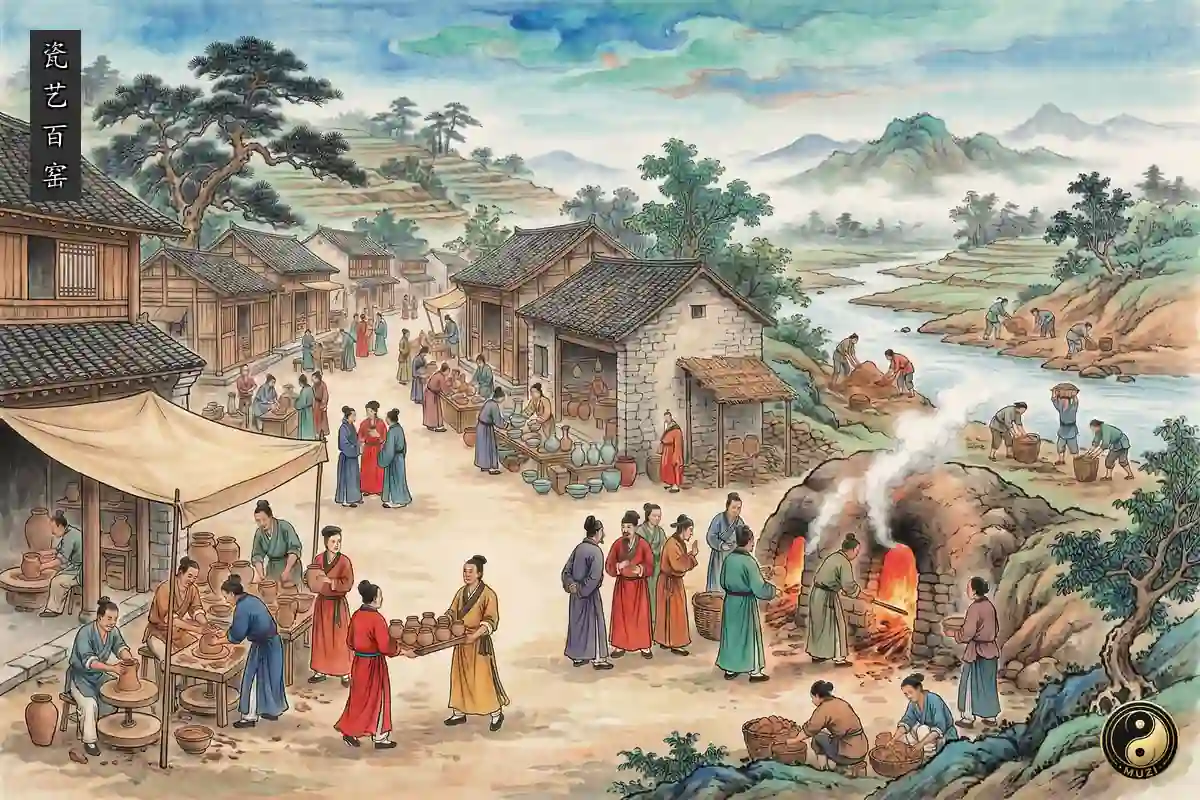


Porcelain is the Chinese way of firing earth into another substance, and its weight shows first in where it came from. A survey in China Daily built on the collection of the National Museum of China says that in the Shang and Zhou there was proto-porcelain, a product in transition from pottery to mature porcelain, grey-green in colour; in the late Eastern Han, noted kilns around Shangyu such as the Xiaoxiantan kiln finally fired mature porcelain with a celadon glaze, and the kiln site was found in 1974. The Chinese Intangible Cultural Heritage website says that the change from proto-porcelain to mature celadon “was completed in the dragon kilns of the Yue kilns.” The material of a vessel was changed at its root, there in the kiln.
Porcelain was tied to ritual vessels from the start, next to Ritual Bronzes. China Daily writes that one change in Shang and Zhou proto-porcelain was the appearance of pieces in the shapes of ritual bronzes; ritual wares fired in the Cao'e River area of Shangyu were also sent farther afield, helping spread those rituals. The heritage website likewise says that Han-period Yue ware “mainly imitated bronzes and early pottery” in shape and decoration. Porcelain learned its forms from ritual vessels and then moved into daily use.
One clear example of daily use is tea. Lu Yu's Classic of Tea (Chajing), on tea bowls, says: “For bowls, Yuezhou is best,” and “if Xingzhou ware is like silver, Yue ware is like jade,” “Yue ware is blue and the tea colour is green,” “the ware of Yuezhou (Zhejiang) and the ware of Yuezhou (Hunan) are both blue, and blue improves the tea.” He matched the glaze of the vessel to the colour of the tea liquor, and the way of drinking tea discussed under Tea Culture thus gained its vessels. The heritage website also writes that the Tang to the early Northern Song was the peak of Yue ware, with glazes praised as “a thousand peaks of emerald” and “like ice and jade,” and that at the same time the “secret colour” ware appeared; the skill and forms of Yue ware also became models that other kilns copied.
Porcelain also left by the water routes. China Daily writes that in the Tang the ports of Guangzhou, Yangzhou and Mingzhou (today's Ningbo) rose with the trade of the Maritime Silk Road, that ceramics from kilns around the country were popular exports, and that Yue celadon was also welcomed. Here the trade route discussed under Silk Road had its sea leg.
Song literati put porcelain into their own lives. China Daily writes that a way of life nurtured by painting, calligraphy, porcelain and other fine crafts, promoted by emperors, aristocrats and intellectuals to show status and taste, included the five Song kilns, Ru, Guan, Ge, Ding and Jun, whose wares are mostly monochrome and convey calm, refinement and restraint. The Taoshuo (Account of Ceramics) records the official kiln: “In the Zhenghe years of the Song the capital set up its own kilns to fire wares, called the official kiln,” and cites the Qingmi cang: “In discussing kiln wares, one must name Chai, Ru, Guan, Ge and Ding.” In this passage porcelain stands beside painting and calligraphy as part of the literati's way of life, and Painting & Xuan Paper and porcelain meet on the Song desk.
In the Yuan, Jingdezhen put painting onto porcelain. China Daily writes that Yuan blue-and-white is painted in cobalt blue on a white ground; before it, monochrome porcelain had been dominant, and the popularity of blue-and-white made the fashion in porcelain more varied; Yuan blue-and-white was mostly fired at Jingdezhen, in larger sizes than before, mainly jars, plum vases and high-footed cups, and it held the tastes and habits of life that came with the Mongol rule. The Taoshuo, citing Rongzhai suibi, records a poem Peng Qizi sent to Xu Tuntian: “Fouliang cleverly fires porcelain, its colour like fine jade.” The Jingdezhen taolu (Record of Jingdezhen Ceramics) says that Jingdezhen was first called Changnan town, that a town was set up in the Jingde years of the Song and so renamed Jingdezhen; that “in the Yuan a prefectural governor was placed to oversee the ceramics of the town”; and that the Ming imperial kiln works are recorded as set up in the second year of the Hongwu era, with a note that the Jiangxi dazhi gives the thirty-fifth year, so two views stand. The book also describes the division of labour in painting blue-and-white on the unfired body: “the painter paints and does not wash colour, the washer washes colour and does not paint, so that one hand serves and the mind is not divided.” A vessel passed through the separate hands of painter and washer, and beyond the kiln fire there was this division of work.
Polychrome porcelain flourished in the Ming and Qing. China Daily writes that the doucai technique reached completeness in the Chenghua years: patterns are first outlined in cobalt blue, a layer of glaze is applied and fired once, then colours are filled in and fired again.
Porcelain, then, is more than a vessel. It grew from the shapes of bronze ritual vessels, took its standard of glaze from tea liquor, went overseas through the ports, and through the painters brought painting into the kiln. Without this craft, ritual vessels, the tea table, the scholar's desk and the cargo holds of exports would all lack something made of earth and completed by fire.
Porcelain first learned its forms from ritual bronzes and only then moved into daily use: Lu Yu ranked tea bowls by the colour they gave the tea, saying “Yue ware is like jade”; the monochrome wares of the five Song kilns joined painting and calligraphy in a way of life that showed status and taste; at Jingdezhen in the Yuan, blue-and-white was painted on a white ground, with painter and washer each keeping to his own task; and the Tang ports carried the wares of kilns across the country overseas. One kind of earth, in the kiln fire, met in turn the needs of ritual, tea, painting and sea trade.
Ceramic Arts is the class in the chapter on Crafts on Chinese ceramics. From the proto-porcelain of the Shang and the mature celadon of the Eastern Han to the famous kilns of the Song and the blue-and-white of Jingdezhen in the Yuan, porcelain was made from clay body, glaze and kiln fire, and in time was traded worldwide. This class also covers earthenware: prehistoric pottery, and historic pottery and sancai, together with glass ware. Porcelain is covered by type: celadon, white ware, black and tea ware, blue-and-white, overglaze enamel and colored glazes.
 Literature
 The Classic of Tea
 People
 Lu Yu (Hongjian)
 History
 Opening of the Silk Road