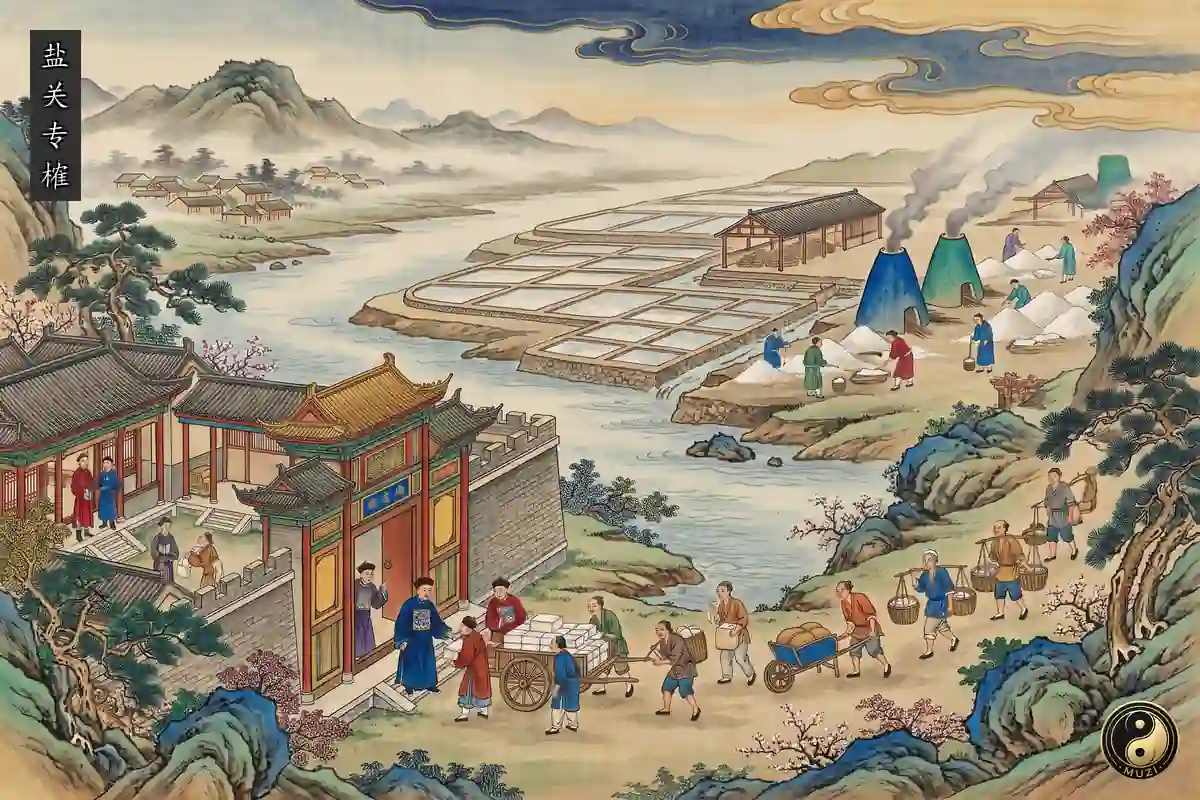


To understand Salt & Transit Monopolies, we first need to see the historical pressure behind it. It was not a decorative cultural label, but a response to problems of order, trust, production, education, politics or shared life. Those problems pushed people to seek more durable ways of living together. This gives the chapter element meaning beyond a single historical moment.
Salt & Transit Monopolies is first of all a concrete civilizational mechanism. Integrating state systems over lucrative commodities with transit tariffs to forge the fiscal pillars of the imperial treasury. It brings a value, technique or institution out of abstraction and into social organization and lived practice. Through it, the reader can see how an age turns experience into rules and how those rules continue to shape later life.
Salt & Transit Monopolies works through repeatable structure. Through learning, imitation, institutionalization and daily use, people turn local experience into a more stable civilizational capacity. This process allows it to cross time and continue shaping later ideas and practices. It makes the chapter not only historical information, but a clue to how civilization accumulates capability. It also helps later readers see why the same element can reappear in different social settings.
Salt & Transit Monopolies also shapes different groups of people. Scholars, artisans, families, officials, merchants, soldiers or local communities may all participate in its formation and transmission. Anchoring the imperial treasury through state monopolies over critical resources and transport transit tariffs. This is why it can form meaningful links with other chapters. It has its own functional boundary, yet it sends conceptual, institutional or technical echoes outward.
Salt & Transit Monopolies is a key node in Chinese civilization. Integrating state systems over lucrative commodities with transit tariffs to forge the fiscal pillars of the imperial treasury. Its importance lies not only in naming an idea, but in showing how people, families, social order, and civilizational values connect. It gives the reader a first doorway into the logic of this chapter. Through it, abstract values enter concrete life.