

Dengfeng Observatory
A national astronomical engineering anchor using precise gnomon shadow tracking to build highly accurate solar calendars and seasonal terms.
 Summer SolsticeSpring and Autumn period to present
 Winter SolsticeSpring and Autumn period to present
Sources (2)
To understand Dengfeng Observatory, we first need to see the historical pressure behind it. It was not a decorative cultural label, but a response to problems of order, trust, production, education, politics or shared life. Those problems pushed people to seek more durable ways of living together. This gives the chapter element meaning beyond a single historical moment.
Dengfeng Observatory is first of all a concrete civilizational mechanism. A national astronomical engineering anchor using precise gnomon shadow tracking to build highly accurate solar calendars and seasonal terms. It brings a value, technique or institution out of abstraction and into social organization and lived practice. Through it, the reader can see how an age turns experience into rules and how those rules continue to shape later life.
Dengfeng Observatory works through repeatable structure. Through learning, imitation, institutionalization and daily use, people turn local experience into a more stable civilizational capacity. This process allows it to cross time and continue shaping later ideas and practices. It makes the chapter not only historical information, but a clue to how civilization accumulates capability. It also helps later readers see why the same element can reappear in different social settings.
Dengfeng Observatory also shapes different groups of people. Scholars, artisans, families, officials, merchants, soldiers or local communities may all participate in its formation and transmission. Precise gnomon towers measuring solar shadows to assemble highly accurate astronomical calendars. This is why it can form meaningful links with other chapters. It has its own functional boundary, yet it sends conceptual, institutional or technical echoes outward.
Dengfeng Observatory is a key node in Chinese civilization. A national astronomical engineering anchor using precise gnomon shadow tracking to build highly accurate solar calendars and seasonal terms. Its importance lies not only in naming an idea, but in showing how people, families, social order, and civilizational values connect. It gives the reader a first doorway into the logic of this chapter. Through it, abstract values enter concrete life.
The Dengfeng Shadow Measurement Platform is located in Gaocheng Town, present day Dengfeng City, Henan Province. It was a giant astronomical observation instrument built under the direction of the Yuan dynasty astronomer Guo Shoujing (1231 to 1316) between the thirteenth and sixteenth years of Zhiyuan (1276 to 1279) for the purpose of compiling the nation's most accurate calendar, the Shoushi Calendar, through high precision solar shadow measurement. The observatory, constructed of brick and stone, consists of two components: a trapezoidal platform body approximately 9.46 meters tall, whose vertical north face acts as the gnomon (*biao*) of a giant sundial, and a horizontal stone scale (*gui*) extending 31.2 meters due north from the platform base, with precisely engraved graduation marks along its surface.
For this giant gnomon, Guo Shoujing invented a critically important and exquisitely ingenious auxiliary optical device: the shadow definer (*jing fu*), a thin copper plate cast with a pinhole aperture at its center. During measurement, the shadow definer is tilted at an angle and fixed above the stone scale; sunlight passing through the pinhole projects onto the scale as a tiny spot of light with extremely sharp edges, rather than the blurry penumbral shadow cast by the gnomon top under direct sunlight. The operator slowly adjusts the shadow definer's tilt angle and position until the bright spot coincides precisely with the scale markings, determining the sun's meridian altitude with unprecedented accuracy. This pinhole projection method functioned as a primitive camera obscura and achieved measurement precision that was not surpassed in Europe until Tycho Brahe's instruments three centuries later.
Guo Shoujing's measurements at Dengfeng were not an isolated single point operation. With the full support of Kublai Khan, Guo Shoujing established 27 simultaneous astronomical observation stations spanning from approximately 65 degrees north latitude at the Northern Sea (in the Siberian regions controlled by the Yuan dynasty) to approximately 15 degrees north latitude at the Southern Sea (the present day Xisha Islands), covering the broadest latitudinal range across the Eurasian continent. This latitudinal coverage exceeded that of the Copernican astronomical observation system by approximately three centuries. The data from these 27 stations enabled Guo Shoujing to calculate the length of the tropical year as 365.2425 days, identical to the Gregorian calendar adopted in Europe 300 years later.
The Dengfeng Observatory was inscribed in 2010 as part of the Historic Monuments of Dengfeng in the Center of Heaven and Earth on the UNESCO World Heritage list. It still stands today between the wheat fields and villages of Gaocheng Town, with its north wall's perfectly vertical plumb line and every finely engraved graduation mark on the horizontal stone scale as sharp as new. These two simplest geometric elements, one vertical gnomon and one horizontal scale, in an age without any glass lens or electronic instrument, accomplished one of the most precise astronomical measurements of the pre telescopic era.
,,,,,。,,。
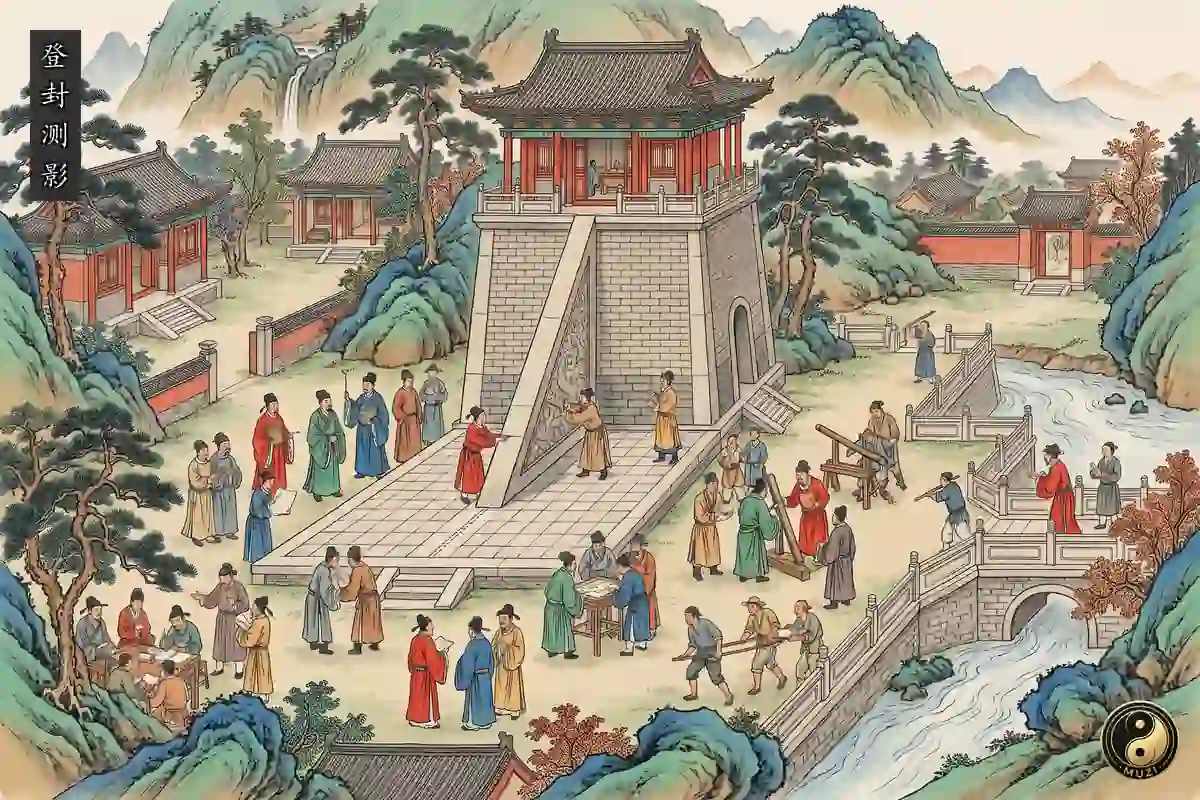
At the Dengfeng Observatory, a towering stone gnomon stands at the centre of the world, astronomers measuring the noon shadow to compute the tropical year, armillary instruments refining the calendar. Precise gnomon towers measuring solar shadows to compile highly accurate astronomical calendars.
An astronomer was ordered to revise the calendar. He needed an extremely precise observation platform. He traveled across the central plains and finally chose a place he considered closest to the center of the earth,Dengfeng.
He built a towering observatory. Atop it lay a giant stone gnomon, a ruler for measuring shadows, dozens of feet long, extending north from the platform. At its center stood a tall vertical pole.
Every noon, he measured the pole's shadow on the stone ruler. Shortest at the summer solstice, longest at the winter solstice. He recorded the data, one year, two years, ten years, accumulating a vast dataset.
A young assistant asked, Master, why measure every day? You measured yesterday.
Yesterday's data is just one point. A thousand points make a line. Ten thousand points reveal a pattern. Each measurement brings us one step closer to the truth.
Using this data, he recalculated the tropical year's length. His result was more accurate than any previous calendar. Later generations standing on his data compiled even more precise calendars.
Explanation
The Dengfeng Observatory was the national platform built by Guo Shoujing for the Shoushi Calendar. Its giant gnomon precisely measured the tropical year length through noon shadow observations. The data enabled Guo to achieve unprecedented accuracy,365.2425 days per year, identical to the Gregorian calendar adopted three centuries later in the West.