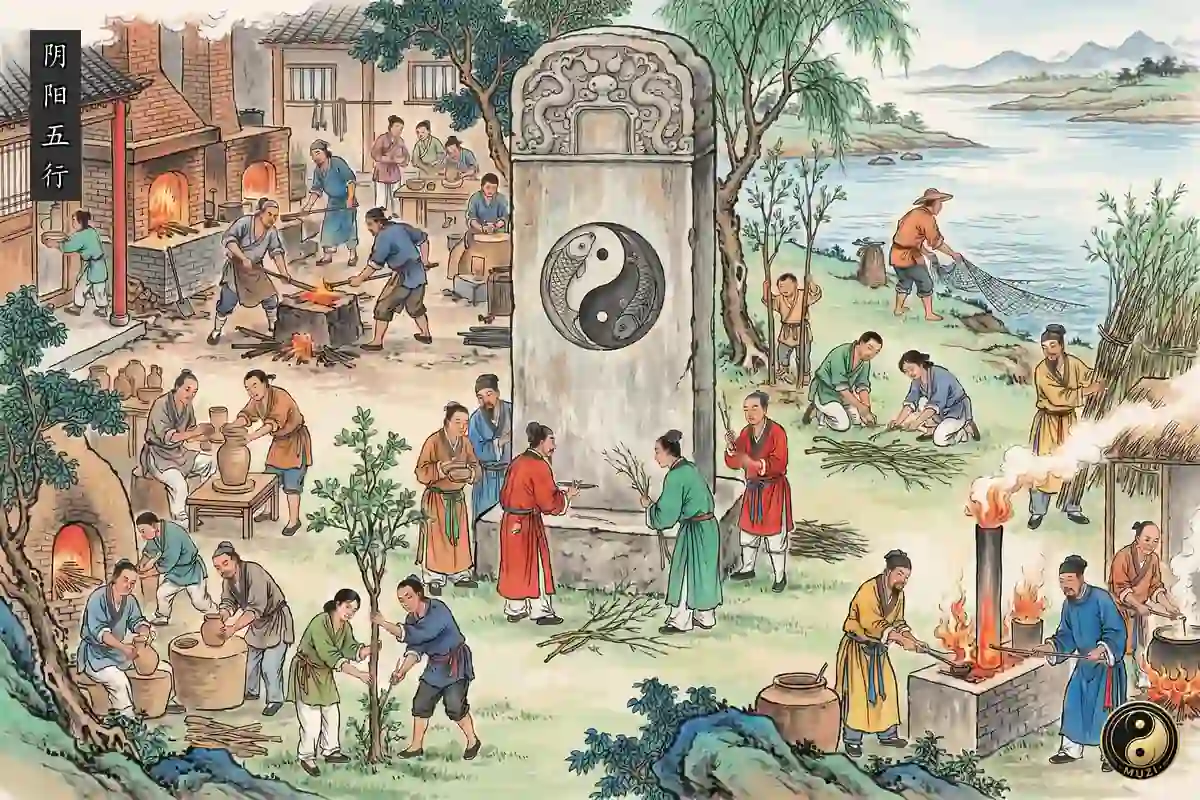
Robin R. Wang, a philosopher at Loyola Marymount University in the United States, notes that in early usage yang was the sunny side of a hill and yin the shady side; Liang Qichao put it as "yin-yang is yin-yang, the Five Elements are the Five Elements" (as cited in an article by Liu Fengcun on China Social Sciences Net). The Five Elements appear in the Hong Fan chapter of the Book of Documents: "the first is water, the second fire, the third wood, the fourth metal, the fifth earth". The Treatise on the Five Elements in the Book of Han says the Hong Fan came from the "Luo writing" that Yu the Great received while taming the flood; this is how Han writers told the story of its origin, not a historical record of it.
An early record of yin and yang used to explain great affairs is in the Discourses of Zhou, part one, of the Discourses of the States. In the second year of King You of Zhou (780 BCE) "the three rivers of Western Zhou all shook", and the Grand Scribe Boyang Fu said: "the qi of heaven and earth does not lose its order", but now "yang is hidden and cannot come out, yin presses on it and it cannot rise, and so there is an earthquake"; and he declared, "Zhou is about to fall." The book goes on to record that in that year "the three rivers ran dry and Mount Qi collapsed", and "in the eleventh year King You was destroyed and Zhou moved east". In this record the earthquake is read as a sign of the rise and fall of the state. In the Warring States period Zou Yan of Qi taught both yin and yang and the five virtues. The Records of the Grand Historian says that he "saw the rulers of states growing ever more extravagant and unable to honour virtue", and so taught that "the five virtues move in turn, each order of rule has what suits it, and the signs that answer to them are thus"; the Treatise on the Feng and Shan Sacrifices also says that "Zou Yan became known among the feudal lords for yin and yang governing the cycles". Neither passage says that it was he who joined yin-yang and the Five Elements into one. In the Western Han, Dong Zhongshu argued for the correspondence between heaven and man through yin and yang and through portents. The Treatise on the Five Elements says: "In the reigns of Jing and Wu, Dong Zhongshu studied the Gongyang Spring and Autumn and began to work out yin and yang, and he became the master of the Ru scholars." In his answers to the throne he said, "the meeting of heaven and man is greatly to be feared", and "when a state is about to fail by losing the Way, heaven first sends calamities to warn it". The chapter on the mutual generation of the Five Elements in the Luxuriant Dew says that the elements "generate those next to them and overcome those one removed", but who wrote the book is disputed: Jiang Xin's doctoral dissertation abstract, posted by the Ruzang Center of Peking University, says it has met "wide doubt from Song scholars and scholars abroad", and holds that the last seven of its Five Elements chapters came from scholars of the Book of Documents in the reigns of Emperors Xuan and Yuan of the Western Han, with "Liu Xiang the most likely".
These ideas entered the institutions of the dynasty. According to the Basic Annals of the First Emperor of Qin in the Records of the Grand Historian, in the twenty-sixth year of his reign (221 BCE) the First Emperor "worked out the transmitted cycle of the five virtues, holding that Zhou had the virtue of fire and that Qin, replacing the virtue of Zhou, followed what fire cannot overcome", and fixed on water: the year now began in the tenth month, "clothing, pennants, banners and flags all honoured black", "six was taken as the measure", and the Yellow River was renamed "River of Virtue". The Treatise on the Feng and Shan Sacrifices says the five-virtues theory came from "the followers of Master Zou" in the time of Kings Wei and Xuan of Qi, and "when Qin became emperor, men of Qi presented it, and so the First Emperor adopted it". In the time of Emperor Wen of Han, Gongsun Chen memorialised that "Han should have the virtue of earth, and the sign answering to the virtue of earth is the appearance of a yellow dragon", while the chancellor Zhang Cang "held that Han was the beginning of the virtue of water"; and in the first year of Taichu under Emperor Wu (104 BCE), "Han reformed the calendar, taking the first month as the start of the year, and honoured yellow among colours".
The ideas also became grounds for judging the conduct of government, and they carried risk. The Book of Han records that Dong Zhongshu "used the changes of calamities and anomalies in the Spring and Autumn to work out why yin and yang went astray", and when praying for rain he would "close off all that is yang and let loose all that is yin". When fire struck the Gao Temple in Liaodong and the hall of the Gao park at Changling, he "worked out its meaning" at home; his draft was stolen by Zhufu Yan and presented to the throne, and so "Zhongshu was handed to the law officers and judged worthy of death, but an edict pardoned him", after which he "never again dared to speak of calamities and anomalies". Jiang Xin holds that the theory of correspondence between heaven and man could both defend "great unity" and restrain the ruler's power. The Treatise on the Five Elements records that Liu Xiang "studied the Guliang Spring and Autumn, reckoned its fortunes and misfortunes, and transmitted them through the Hong Fan"; the treatise lists calamities under the Five Elements, for example: "if hunting does not stop for the night, food and drink are not offered, going out and coming in are without measure, the people's farming seasons are taken from them, and there are treacherous plots, then wood will not bend and straighten". The description of a book by Cheng Sudong, published by Peking University Press, calls the Hong Fan Five Elements learning of the Han "a Confucian theory of calamities and anomalies", which "mixed many kinds of numerological knowledge, such as yin-yang, the Five Elements, the monthly ordinances and astrology".
They also entered medical books and the seasonal calendar. The Great Treatise on the Correspondences of Yin and Yang in the Basic Questions says that "yin and yang are the way of heaven and earth, the warp and weft of the myriad things", and "to treat illness one must seek the root"; and with "the east gives rise to wind, wind gives rise to wood, wood gives rise to sourness, sourness gives rise to the liver" it sets direction, the five flavours and the organs side by side. The Monthly Ordinances of the Book of Rites says that in the first month of spring "its days are jia and yi", that the Son of Heaven "wears green clothing", and that "on such a day spring begins, and the abundant virtue lies in wood"; at the beginning of summer "the abundant virtue lies in fire". In modern times the system was looked at anew. As quoted in a report on a lecture by Lin Guizhen carried on Rujia Net, Liang Qichao called it "the great stronghold of superstition for two thousand years", and the same report quotes Gu Jiegang in the fifth volume of Debates on Ancient History, published in 1935: "the Five Elements are the law of thought of the Chinese people, the Chinese people's belief about the system of the cosmos". The first is a criticism; the second describes its hold.
The same set of ideas can be read in the texts of four other canons. With I Ching Hexagrams: the Appended Statements, part one, says "one yin and one yang is called the Way", and "in change there is the great ultimate, which gives rise to the two modes; the two modes give rise to the four images, and the four images give rise to the eight trigrams", using yin and yang to explain how the trigrams arise. With Traditional Medicine: the Basic Questions uses yin and yang to speak of the root in treating illness, and the Five Elements to join the liver with wood, sourness and the east. With Lunisolar Calendar: the Monthly Ordinances pair the seasons with the Five Elements and with colours of dress, and when the Han reformed the calendar in Taichu, the start of the year and "honoured yellow among colours" were settled together. With Confucian Classics: the list of the Five Elements is found in the Hong Fan of the Book of Documents, Liu Xiang "transmitted them through the Hong Fan", and the description of Cheng Sudong's book calls the formation of this Han learning its "classicisation".
Boyang Fu read an earthquake through it, Qin fixed on water by it, the Han reformed the calendar and honoured yellow, Dong Zhongshu judged government through calamities, and Liu Xiang worked out fortunes from the Hong Fan: yin-yang and the Five Elements were one way in which people of the past tied the signs of heaven, the seasons and human affairs together. Qin set its start of the year and its colours by them, the Han court debated earth against water, medical books used them to speak of the organs, and the monthly ordinances used them to arrange the four seasons; Dong Zhongshu nearly lost his life over them, in modern times Liang Qichao condemned them as superstition, and Gu Jiegang called them a "law of thought". Their place in ancient thought is marked out by these institutions, books and debates together.
Yin-yang and the Five Elements is the class in the chapter on the Cosmos on a body of thought, from the Zhou onward, for explaining change in nature. Yin and yang describe two opposite sides that complete each other, and the Five Elements describe five material agents that generate and overcome one another. From Boyang Fu in the time of King You of Zhou to Zou Yan in the Warring States and Dong Zhongshu in the Western Han, people used it to explain how heaven, earth and all things change.
 Literature
 Records of the Grand Historian
 Book of Han
 Luxuriant Dew of the Spring and Autumn
 People
 Yu the Great (Da Yu)
 Liang Qichao
 Emperor Wen of Han
 Dong Zhongshu
 Emperor Wu of Han (Liu Che)
 Liu Xiang
 Atlas
 Changling Mausoleum